



Delhi’s AQI Crisis and India’s Pollution Feedback Loop —Who Owns the Air?
Signal-Talk Analysis · When toxic air becomes seasonal normal — is India facing a pollution problem or a systems failure? That is the signal India is trying to read; 17 March 2026; ST -029/ NV Subbarao (read time: 10 mins).
[This Signal-Talk episode was prompted by questions raised, kind courtesy of Prof. Ashok Jhunjhunwala (IIT Madras), during a recent WhatsApp discussion on Delhi’s recurring AQI crisis].
Breathing Poison – Breathing Indifference: Every winter, Delhi and much of northern India slips into a toxic haze. Schools shut, hospitals fill with respiratory cases, and citizens check AQI apps before stepping outdoors. Yet the crisis repeats year after year — with citizens breathing poison and system breathing indifference.
But the problem is not confined to winter alone. Across much of the year, air quality in several Indian cities remains in the poor to very poor range, with pollution sources shifting rather than disappearing — from stubble burning in winter to dust, vehicular emissions, industrial output, and energy use across other months. What appears seasonal is, in reality, a persistent and endemic urban condition.
This raises a deeper question: Is India facing a periodic pollution spike, or a structural systems failure spanning transport, energy, agriculture, urban design, and economic incentives?
Governments, both central and state, have initiated multiple measures — including the National Clean Air Program (NCAP), Graded Response Action Plans (GRAP), BS-VI emission norms, promotion of electric mobility, and restrictions on construction and industrial activity during peak pollution periods. Yet, these interventions often remain episodic, fragmented, and reactive, struggling to deliver sustained improvements.
Through the Signal-Talk lens, the AQI crisis reveals not just dirty and toxic air, but a complex feedback loop where policy intent, economic pressures, and public behavior interact — often amplifying the very problem they seek to solve.
So, when Air is toxic, and turns even more toxic, and nobody owns the problem — What Is the Signal?
“High AQI”
India Pollution — Scale Context
AQI scores across countries (PM2.5 comparison): The gap is stark.
PM2.5 WHO safe annual level: 5 µg/m³
In the context of air quality, the 2.5 in PM2.5 refers to the size of the particles. Specifically, it stands for particulate matter with a diameter of 2.5 micrometers (microns) or smaller. This is extremely small. For perspective, the average human hair is about 50–70 micrometers in diameter, making PM2.5 particles roughly 20–30 times smaller than the width of a single hair.
PM2.5 tells us how small the particles are.
AQI tells us how much of those particles are in the air.
Top 20 Clean-Air Countries: ~5–10 µg/m³
Global Avg: ~15–20 µg/m³
Delhi (Avg): 150–300+ µg/m³
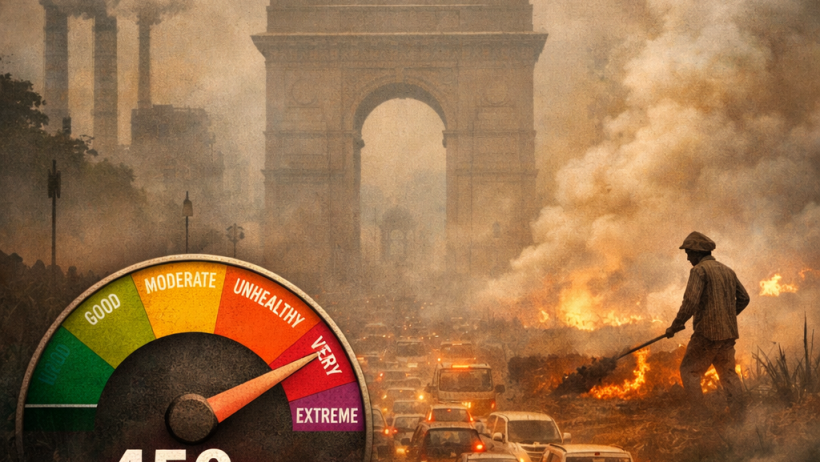
Delhi (winter Avg): 300–400+ µg/m³ with peaks (24-hour avg.) of 440 (Dec 14, 2025) and 461 (Jan 18, 2026) and localized hourly spikes of 700-800 and more.
👉 At least 100 Indian cities are at 10–75× above safe levels
India’s air pollution challenge is not episodic—it is structural and national in scale. An estimated 1.6–1.7 million premature deaths annually in India are linked to air pollution, making it one of the country’s leading public health risks. Nearly all of India’s population lives in areas exceeding WHO air quality guidelines, with several cities routinely recording PM2.5 levels 5–10 times higher than safe limits.
While Delhi often draws global attention during winter peaks, pollution remains elevated across the year in multiple urban clusters—driven by transport emissions, coal-based energy, construction dust, industrial activity, and agricultural burning.
What appears as a seasonal crisis is, in reality, a persistent baseline of degraded air quality across much of the country—a scale that transforms pollution from an environmental issue into a systemic economic and health burden. As a result, pollution in India has become: Not Seasonal, But Systemic, and affecting;
More than 1.7 million lives a Year
– Lost to air pollution in India
9 in 10 Indians breathe unsafe (toxic) air:
– Every single day
PM2.5 Levels: 5–70× Safe Limits:
-Across major Indian cities
- While AQI is the standard metric, other factors like SO2 (Sulphur Dioxide) and NO2 (Nitrogen Dioxide) are significant toxicity contributors too. Industrial hubs like Dhanbad (Jharkhand) and Korba (Chhattisgarh) often rank lower on the standard particulate-based AQI but are “otherwise” highly polluted due to heavy coal mining and thermal power emissions.
India’s high AQI levels is not a seasonal pollution spike. It is a systemic moment, nested in inaction and breakdown of governance and policy.
Axiom: When a crisis repeats every year, it is no longer an event — it is a system design outcome.
In environmental systems—like any complex large system, failure does not arrive suddenly — it accumulates, then reveals itself in extreme events. In this case the signal travels first through lungs and hospitals — spreads rapidly — long before it reaches policy corridors!

SIGNAL
What actually matters?

NOISE
What distracts and distorts?
The signal is clear: 9 in 10 Indians Breathe Unsafe Air.
Delhi frequently records AQI levels above 400–500 (“Severe”) during winter months. Air pollution contributes to an estimated 1.6–1.7 million deaths annually in India.
Kolkata and Mumbai frequently enter the global top 10 during seasonal shifts or post-festival periods (like Diwali).
Further cities like Delhi, Ghaziabad, Kanpur, and Lucknow regularly appear among the most polluted globally.
Major contributors include
- Vehicular emissions
- Construction dust
- Industrial pollution
- Crop stubble burning
- Coal power generation
- Household biomass use.
The 100-City Metric: As many as 92 of the world’s 100 most polluted cities are located in India, highlighting a systemic regional crisis in the Indo-Gangetic Plain.
The Signal is clear: Air pollution is one of India’s most severe public health risk
Several narratives dominate the issue and debates. They typically generate high political noise but limited structural change
• Seasonal blame cycles — pointing only to stubble burning.
• Political blame shifting between states and central authorities.
• Short-term emergency measures like odd-even traffic rules.
• Weather explanations that normalize pollution spikes.
• Festival fireworks debates that overshadow systemic causes.
These narratives dominate headlines — but they obscure the deeper systemic question: Not just what or where the problem is, but how the system address the issue.
The present Indian conversation remains largely clouded by media and political noise — blame game, speculation, tips-n-tricks, and anti-science framing.

System Lens
The deeper structural view
From a Social Cybernetics perspective, AQI deterioration is a feedback failure across multiple systems:
Urban System
Rapid urbanization → Vehicle density → Congestion → Emissions.
Agricultural System
Crop cycles → Mechanized harvesting → Stubble burning → Regional pollution spikes.
Energy System
Coal dependence → Industrial emissions → Persistent background pollution.
Governance System
Fragmented regulation → weak enforcement → temporary crisis responses.
Citizen Behavior Loop
Low public pressure → policy inertia → repeated crises.
Instead of one cause, India faces a multi-node system problem where feedback signals arrive too late or are ignored.
SYSTEM RESPONSE
Current responses treat AQI as an episodic emergency, rather than a structural design failure.
Typical responses include:
• Emergency school closures
• Temporary construction bans
• Traffic restrictions, Odd-even days, etc.
• Anti-pollution water spraying
• Short-term political negotiations between states.
These responses treat AQI as an episodic emergency, rather than a structural design failure. Which means the system cannot be read only through the mechanics of governance.
At the governance level, the system suffers from fragmented ownership — where multiple agencies monitor the air, but no single entity owns the outcome — and that is the big systems gap.

Signal-to-Noise Ratio (SNR)
Editorial score:
7.6
/ 10
Low 1-3
Medium 4-6
High 7-9
Perfect 10 (no Noise)
(Scale: 1 = AQI depleting → 10 = AQI enabling)
Signal: Extreme AQI zone – High toxicity in air, continuity is given. High AQI (> 400) is normalized and accepted as inevitable – URGENT REFORM, REGULATION—LEGISLATION NEEDED
Noise: Indifference and media narratives – political posturing mostly on AQI values
At SNR 7.6 this is a high AQI formative signal — and suggests need for reform to shift the system from its high pollution quotient (AQI> 400) to Low AQI zones (AQI < 100).
The pollution levels and intent (by all stake holders) signal continuity of existing situation, and the breathing of toxic air – unless strategic and structured interventions come into effect – on war footing.
Comparative Signal-to-Noise (SNR) Scores
How different actors frame the same issue—measured using the same Signal-to-Noise logic.
Editorial (Signal-Talk)
7.6
High AQI forming, Structural Reform required
Experts score – WhatsApp Enviro groups- (Respondents = 17)
8.5
Gen AI-4 (LLM ‘s synthesis – Avg. score) #
9.3
Extreme AQI signal, Higher AQIs is new normal – Systemic Issue
Reader’s Pulse (Poll)
[weighted_SNR_score id=”2362″]
Interpretation
The comparative scores reveal a familiar pattern in environmental crises.

Cohort | SNR Score | Description
Editorial: 7.6 --> Concerning and fragmented approach to problem solving.

Global Experts:8.5-->Clear signal of structural crisis

Pulse (Poll*): 3.6 --> Somewhat concerned but mostly resigned and trapped.

GAI-4 (LLMs): 9.3 --> Strong signal of total breakdown
* Poll scores are dynamic and change with responses.


The AQI crisis reflects a classic policy feedback trap:

Problem recognized → temporary fixes → political diffusion → structural reform delayed.

Over time, the system normalizes toxicity.

Citizens adapt behavior — via masks, air purifiers, indoor living — as the environmental baseline worsens.

In Signal-Talk terms, the system is not signal-constrained (has "No checks" on AQI), rather is signal-amplifying (Extreme-High levels AQI Normalized).

The system is mostly unchecked sans effective interventions from Policy-Technology-Judicial-Economic-Agencies (via central govt., state govt., educational hubs, r & d organizations, citizens voice, etc.)
# Gen AI-4 is average score of 4 LLM’s – Chat GPT, Grok, Gemini and Perplexity
SNR scores are on scale of 1-10 (1; System depleting and 10 System forming)
SYSTEM RESPONSE: How should the system respond?
0️⃣The current AQI crisis did not begin overnight and cannot be addressed through episodic controls alone. It requires coordinated, multi-node system redesign with continuous feedback loops:
Firstly, there exists a big Institutional Clarity Gap – Who Owns the Air?
One of the most critical gaps in India’s AQI management is unclear ownership and fragmented accountability. Multiple agencies operate across levels:
– Central Pollution Control Board (CPCB)
– State Pollution Control Boards (SPCBs)
– Commission for Air Quality Management (CAQM) in NCR
– Municipal bodies
– Transport, agriculture, and energy departments
Yet, no single empowered authority owns end-to-end air quality outcomes. Everybody thinks somebody is responsible and so there is nobody who emerges to be the problem solver.
The result:
– Diffused responsibility
– Delayed decision-making
– Reactive coordination instead of proactive control
1️⃣ Shift from Seasonal Response to Year-Round Governance
Move from winter emergency measures to continuous air quality management frameworks, with clear annual targets and accountability
of at least 5% reduction every quarter for the next 24 quarters?
2️⃣ Align Incentives in Agriculture
Replace punitive bans on stubble burning with economic alternatives:
– Subsidies for residue management
– Market linkages for biomass utilization
– Direct farmer incentives tied to non-burning practices
3️⃣ Re-architect Urban Mobility
– Accelerate public transport electrification
– Disincentivize private vehicle usage through pricing and access controls
– Expand last-mile connectivity
4️⃣ Tighten Industrial and Energy Transition
– Faster shift from coal to cleaner energy sources
– Real-time emissions monitoring with public dashboards
– Strict enforcement of emission norms without seasonal dilution
5️⃣ Dust and Construction Management as Core Policy
Treat construction dust not as a minor issue but as a primary pollution source, with:
– Mandatory dust control technologies
– Urban zoning enforcement
– Continuous monitoring
6️⃣ Create a Unified Airshed Governance Model
Air pollution does not respect state boundaries.
Establish a regional “airshed authority” across North India with coordinated decision-making powers.
7️⃣ Strengthen Public Feedback Loops
– Make AQI data hyper-local and real-time
– Link health advisories directly to AQI thresholds
– Build citizen pressure through transparency and accountability
System Insight:
Air pollution requires an “airshed-based authority” with unified command, real-time data integration, and enforcement powers across sectors and state boundaries.
Without clear ownership, the system continues to detect the problem but fail to act decisively.
How clear does the core issue feel to you after reading this episode of Signal-Talk?
Cast your vote and see how your score compares with Community and Gen AI scores.
CAST YOUR VOTE
Rate the signal, not the sentiment (Your rating and email are kept confidential and not shared with anyone)
Your take: Is India’s pollution crisis (exemplified by Delhi’s AQI) mainly a policy failure or a seasonal inevitability?
[weighted_SNR_score id=”2362″]

Signal-Talk Take / Behind the Signal Editorial interpretation based on system behavior, not sentiment
The AQI crisis confronting Delhi and northern India is not simply about smog. It is about how modern societies manage complex systems.
But Delhi’s air quality crisis is not unique. Several cities across the Indo-Gangetic belt—including Ghaziabad, Kanpur, Lucknow, Patna, Lahore, and Dhaka—often record pollution levels comparable to or worse than Delhi. This points to a broader regional pattern rather than an isolated urban failure. What we are witnessing is not a city-level anomaly, but a shared “airshed crisis” spanning multiple countries and urban systems.
Yet that is not the reason to not address Preservation of public health while preventing economic and social disruption.
The priority should be to bring air quality closer to global norms, targeting PM2.5 levels of ~15–20 µg/m³ over time through a phased, sustained effort. This cannot be achieved in one step. A multi-stage roadmap is required:
– Phase 1 (Immediate: 1–2 years): Stabilize peak pollution by ensuring AQI does not exceed ~100 during winter months through strict enforcement and emergency controls.
– Phase 2 (Medium term: 3–5 years): Reduce average AQI levels toward ~50, supported by structural interventions in transport, energy, construction, and agriculture.
– Phase 3 (Long term: 5–10 years): Progressively align with global benchmarks (~15–20 µg/m³ PM2.5) through systemic redesign and continuous monitoring.
This transition must be pursued on a war footing initially, but sustained through consistent policy, aligned incentives, and real-time feedback loops. The objective is not episodic improvement, but a permanent shift in the air quality baseline.
Clean air is not achieved in a season—it is typically built over a decade — has to be led by systemic design efforts than slogans alone.
The System Behind the Indifference — Has to Step In
Indian cities are expanding faster than infrastructure. Farmers are facing economic incentives that encourage crop burning. Most energy systems remain coal heavy, and Transport networks grow without emissions’ discipline.
Each node makes rational choices locally — but the system outcome becomes irrational collectively.
This appears to be the paradox of pollution governance. No single actor alone causes the crisis. Yet everyone contributes to it.
From a social cybernetics’ lens, the AQI problem reveals a broken feedback loop:
Health warnings appear only after pollution peaks. Political negotiations begin after public outrage. Policy responses arrive after damage is done.
Until feedback signals move earlier in the cycle, the system will continue oscillating between outrage and inaction.
And each winter, the same question will return:
How did breathing become hazardous in the capital city of the world’s largest democracy?
In India’s AQI crisis, the question is not just what is causing the pollution. It is as much: Who owns the air?
The signal is not just about the AQI levels. It lies in the system that enables the indifference
👉 The signal ought to emerge as: “AQI 50: Clean the Air, Not Just the Symptoms — Act early, act systemically, and act continuously.”
Signal-Talk: Making sense of what really matters
One Signal at a Time.
Signal-Talk Analysis: ST 029/ AQI, Pollution. Policy, Regulation, Environment, Public Health, Delhi, India, Governance