

Signal Reflection – 001: Yesterday’s speech by President Barack Obama was a reminder that leadership and followership need not always follow the same script. History is filled with charismatic leaders who built movements around themselves. Obama may represent a rare exception. His message, embodied in the phrase “Yes We Can,” pointed citizens toward hope – via institutions, participation, and collective agency than personal devotion.
In a digital age increasingly shaped by personality-driven politics and algorithmic amplification, his leadership style appears less typical and more anomalous. This Signal Reflection explores why Obama remains a “cult outlier” and what that may reveal about leadership, democracy, and public discourse in the algorithmic era. 17 June 2026; ST-036 / NV Subba Rao (Read time: 5 mins).
(Signal Reflections covers Ideas, speeches, books and moments that reveal deeper signals beneath the headlines).
NV Subba Rao is the author of Quo Vadis? Uncle Sam 2.0 — a social media and systems-level exploration of power, media, and democracy in the algorithmic age.
Available on Amazon
Website: UncleSam2.com
In an age where algorithms increasingly reward outrage, grievance, and personality, Barack Obama remains an unusual political phenomenon: a leader whose extraordinary following was built less on personal infallibility and more on collective possibility.
Obama yet again revealed that when a leader’s charisma strengthens institutions rather than substitutes for them, the result may be less, a cult of personality and more a culture of participation.
Yesterday’s powerful speech by President Barack Obama was, in my view, a reminder of what leadership can sound like when conviction is paired with humility and persuasion is anchored in institutions than in personality.
The Speech: Following Michelle Obama’s powerful address, Barack Obama delivered a reminder of what great public leadership sounds like.
What a voice, what a speech:
Watching him speak, I was reminded of a passage from Quo Vadis? Uncle Sam 2.0… that not all cults in the algorithmic age of social media are created equal.
Historically, many of the twentieth century’s most powerful mass followings emerged around leaders who positioned themselves above institutions. Whether in the personality cults surrounding Hitler, Stalin, Mussolini, Mao, or numerous strongmen who followed later, the recurring message has fundamentally been the same: Trust me, if not, you better trust me.
And so, the leader became the movement, and the movement became the nation, aided always by state sponsored media.
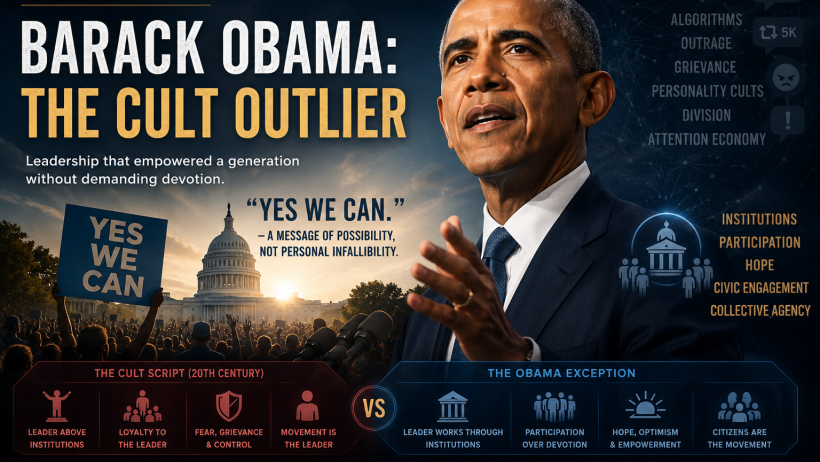
Barack Obama represents and is a curious exception. He undoubtedly generated one of the most passionate political followings of modern times. His speeches filled stadiums and his supporters saw in him something larger than politics itself. Yet the core message was fundamentally different. Not I alone can fix it, but rather “Yes We Can.“
A subtle but profound distinction. The focus was not personal infallibility, but collective possibility. Not loyalty to a leader, but participation in a larger civic project. Not the weakening of institutions, but faith in their ability to work when citizens engage with them.
This is what makes Obama a cult outlier. His charisma as ever points beyond himself.
Whether one agreed with his policies or not, the emotional energy he generated was largely channeled toward hope, participation, civic engagement, and democratic processes rather than grievance, fear, or personal worship.
In Uncle Sam 2.0, I describe this phenomenon as one of the few examples of a modern political figure who generated a quasi-cult following rooted not in fear and resentment, but in empathy, empowerment and optimism.
… “Barack Obama stands out as one of the few widely followed political figures whose extraordinary following was rooted less in grievance and fear, and more in empowerment and optimism. ‘Yes, We Can’ pointed to collective possibility, not personal infallibility.”…
Page 149 (Quo Vadis? Uncle Sam 2.0)
Which is perhaps why Obama’s speech felt both familiar and strangely rare. A reminder it was that the highest form of leadership is not when followers believe in the leader, it’s when the leader helps followers believe in themselves and in the institutions that bind a society together.
An Uncle Sam 2.0 Lens
This observation is not merely anecdotal. In Quo Vadis? Uncle Sam 2.0, I explore two related questions:
The first examines the emotional architecture of political followings: Across modern political movements, slogans often reveal the underlying psychology of leadership. Many are rooted in fear, grievance, threat perception, nationalism, identity, or personal loyalty.
Obama’s signature slogan, “Yes We Can,” stands apart. Its emotional center is not fear, but empowerment. Not submission, but participation. Not dependency, but agency.
The second explores what I call System Integrity Scores (SIS) across post-World War II U.S. presidencies. Rather than measuring popularity or ideology, the framework asks a different question:
Did a leader strengthen institutions, civic participation, democratic resilience, and system adaptability?
On that lens, Obama scores among the strongest post-war presidents, reflecting a leadership style that generally reinforced institutions rather than personalized power.
Which brings us back to yesterday’s speech. Perhaps what felt refreshing was not merely the quality of the oratory. It was the reminder of a leadership model that increasingly appears rare in the algorithm age.
Yet perhaps the more important question is not whether Barack Obama inspired a following. Most consequential leaders do. The more interesting question is what transforms a following into a cult.
In the twentieth century, cults often gathered around charismatic leaders. In the twenty-first century, they increasingly gather around narratives, identities, tribes, and algorithms. Today’s cults do not always march in uniform. They trend, they go viral and they live in feeds – for visibility.
In cultdom’s visibility becomes credibility, repetition becomes truth, and conviction becomes community. As cult expert, Professor Emerita of Sociology – Janja Lalich has argued:
“Cults are ultimately systems of influence that reshape how people interpret reality with both, diehard devotion and loyalty.”
In that sense, the social media algorithm age may be producing new forms of collective belief that are far more subtle, scalable, and pervasive than anything seen before. (Read Part 3: Cult Ascencion)
Leadership Vs. Cult: A distinction is worth noting: Not every charismatic leader creates a cult, and not every devoted following becomes one. Great leaders often inspire admiration, loyalty, and even emotional attachment (Gandhi, Nehru, Lincoln, Einstein, Amitabh Bachchan, Taylor Swift, Steve Jobs, Mamdani, and many others). Cults, however, emerge when devotion begins to replace critical thinking, when loyalty becomes more important than truth, and when the leader, movement, or ideology is elevated above institutions, norms, and accountability.
In effect then, leadership seeks and invites participation to strengthen institutions. Cults however are authoritarian and demand submission while seeking to substitute institutions. The difference may appear subtle at first, but its consequences for democracy can be profound.
Which is what makes Obama such a fascinating outlier. His extraordinary following largely pointed people away from himself and back toward institutions, participation, and collective agency. His message was not “Trust me.” It was, “Yes We Can.”
And perhaps that is why, in an era increasingly defined by personality, performance, and polarization, his leadership still feels different.
One Nation, Under Influence. Welcome to the Congregation of Conviction... Janja Lalich
Signal Reflection: SR 001/ Barack Obama – The Outlier
NV Subba Rao is the author of Uncle Sam 2.0 — a social media and systems-level exploration of power, media, and democracy in the algorithmic age.
Available on Amazon
Website: UncleSam2.com
Uncle Sam 2.0 is more than a book about America, it’s a framework for understanding any modern society in the age of algorithms—how systems hold, how they drift, and what it takes to recalibrate them.
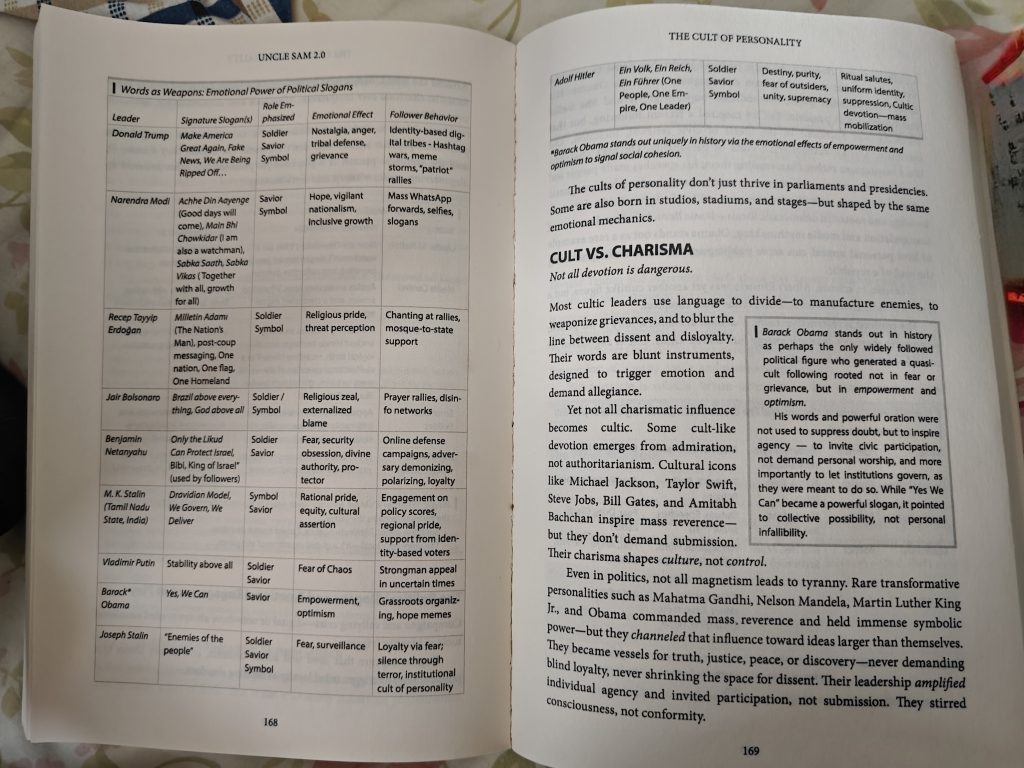
Exhibit A: Political slogans, emotional architecture, and cult dynamics (Uncle Sam 2.0, pp. 168–169)
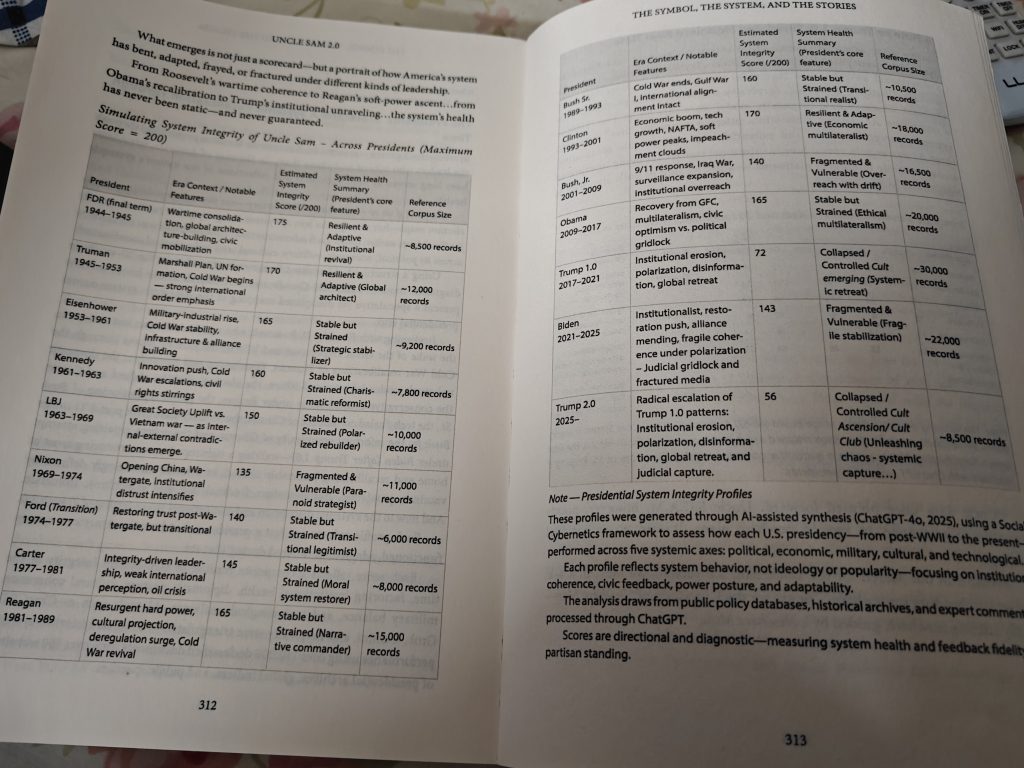
Exhibit B: Simulated System Integrity Scores across post-WWII U.S. Presidents (Uncle Sam 2.0, pp. 312–313)