



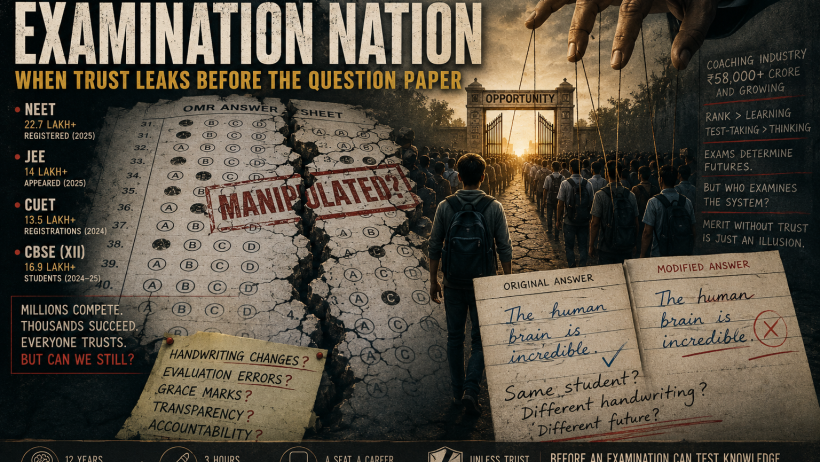

Signal-Talk Analysis · Very few countries organize life around examinations to the extent India does. The country conducts some of the largest examinations in human history, and every year millions of students compete for a few thousand seats. The Indian education system was traditionally built to reward merit.
But as the country steadily evolved from a Board-centric to an Entrance-centric educational model, paper leaks, examination glitches, coaching economies, institutional failures and controversies have become recurring headlines of the landscape. With nearly 90 reported paper leak incidents, 48 re-tests, and an estimated 65 million candidates affected over the past decade, the question is no longer merely about examination security. It is whether students, parents, and society can continue to trust the system that connects effort to opportunity.
So, is India’s examination system still producing merit? Or is it merely managing anxiety, with merit on trial. 22 million dreams and one trust deficit, that is the signal India is trying to read in its examinations model; 8 June 2026; ST -035/ NV Subba Rao (read time: 10 mins).
NV Subba Rao is the author of Quo Vadis? Uncle Sam 2.0 — a social media and systems-level exploration of power, media, and democracy in the algorithmic age.
Available on Amazon
Website: UncleSam2.com
Over the past two decades, India’s education landscape has undergone a quiet but profound transformation. The education system that was once built around schools, teachers, and board examinations, has changed significantly – as India adopted an Entrance-centric system over the previous Board-centric system. Putting merit itself on trial
For a large and growing cross section of students the twelve years of schooling now culminate in a few hours inside an examination hall.
Board examination scores, that were the primary gateway to higher education, have steadily lost their centrality. Now, Institutions and Universities increasingly rely (only) on centralized entrance examinations such as NEET, JEE, CUET, CLAT, CAT, GATE, and UPSC to determine access to opportunity. And so, parents invest life savings, students invest crucial years, Institutions invest credibility, and society invests trust.
Consequently, as the qualifying examinations have become high stakes, they have given way to a pattern of recurring headlines invoking paper leaks, glitches, coaching economies, and institutional failures. And has brought about a real casualty, not in rankings or admissions but in trust itself. As NEET, JEE, CUET and other high-stakes examinations face recurring controversies, the question is no longer merely about paper leaks. It is about trust in the systems that allocate merit, mobility, and aspiration.
As a consequence, many students from age 15 onward start to experience a sequence of high-stakes gateways. And the prep for most of these exams starts from ages 10-12 onwards, with parent’s anxiety getting triggered from children’s primary school years itself:
The logic is understandable. Standardized examinations promise comparability across thousands of schools, multiple state boards, and millions of candidates.
But they also create a new reality:
That a single exam has become the gateway to an entire profession, and trust in that exam has become a national asset.
And nowhere is that more visible than in NEET. Because before an examination can test knowledge, a nation must “trust” those examinations.
That is why the real leak may not be the question paper. It may be trust itself.
Context: In the past school performance mattered. Results of class 10 boards, and class 12 were a factor for admissions. But not anymore. Now it’s all about an entrance examination only and with glitches galore.
The issue since has become cybernetic, and not academic:
- More than 2.27 mm students registered for NEET 2025, making it one of the largest entrance examinations in the world.
- Over 2.2 mm candidates appeared, while approximately 1.236 mm qualified.
- NEET serves as the gateway to MBBS, BDS, AYUSH, and several allied medical programs across India.
- Similar high-stakes examination ecosystems exist through JEE, CUET, CLAT, CAT, GATE, and UPSC, collectively affecting tens of millions of students every year.
- In many professional streams today, Class XII marks function largely as an eligibility threshold, while entrance examinations determine rank, seat allocation, and career trajectory.
- Over the past decade, India has witnessed nearly 90 reported paper leak incidents, resulting in 48 re-examinations and affecting an estimated 65 million candidates across various competitive and recruitment examinations.
- Unlike many advanced economies where internships, apprenticeships, project portfolios, continuous assessment, and multiple pathways can complement academic credentials, educational and career opportunities in India often remain heavily dependent on performance in a few high-stakes examinations, increasing both their importance and their consequences.
So much so that, for many students, a single entrance examination increasingly matters more than twelve years of schooling. Board-centric India has quietly become Entrance-centric India, where the examination often becomes both the gateway and the destination, shaping not only admissions, but how students learn, how parents invest, and how schools define success.
It is also most likely why examinations such as JEE, GATE, UPSC, CAT, and NEET have emerged as some of the most trusted educational brands in the country. Their value lies not in the examination itself, but in the collective belief that performance, rather than privilege, determines outcomes. Once that belief weakens, the examination risks losing something far more important than its question paper.
It risks losing its legitimacy. Each examination controversy may appear isolated. Taken together, however, they raise the larger question: Can a nation built on examinations continue to thrive if trust in examinations begins to erode?
That is the real signal.

SIGNAL
What actually matters?

NOISE
What distracts and distorts?
1. Trust in examinations is becoming a national governance issue – and it’s only worsening.
2. Students invest years, families invest savings, and society invests legitimacy into exam systems.
3. Repeated disruptions across exams indicate systemic vulnerabilities.
4. The biggest cost is psychological and institutional.
5. Examination credibility is now part of national competitiveness.
1. The debate is only about one leaked paper.
2. A re-exam solves everything.
3. Every controversy is an isolated incident.
4. The biggest cost is administrative.
5. This is only an education ministry problem.
6. Why blame the education minister.
7. It’s just a degree anyway.

SYSTEM LENS The deeper structural view
India’s education architecture increasingly resembles a high-pressure funnel:
- Millions compete.
- Thousands succeed.
- Everyone else is sorted.
The result is an ecosystem vulnerable to:
- Coaching dependence
- Exam mafias
- Information asymmetry
- Paper leaks
- Extreme stress
For decades India operated on a simple education trust equation and social contract:
Study → Compete → Qualify → Progress
The system was not perfect. But most people believed it was fair enough. Now that belief has weakened, and the loop has changed:
Study → Doubt → Compete → Suspect → Protest
A systemic rot appears to have set in as question paper leaks have become common, and dilution in academic standards the norm.
The leaks, cancellations, re-examinations, technical glitches, grace-mark controversies, and opaque processes have become a feedback signal eroding trust in the system with significnant hidden costs.
The Hidden Costs
1. The Coaching Economy
Students often spend years and significant family resources preparing for a single examination. A cancelled exam doesn’t merely reset a calendar. It resets lives.
2. Merit Under Suspicion
When leaks occur, even genuine toppers become suspect. The achiever pays the price for the cheater.
3. Institutional Credibility
The problem is no longer NEET. It is the growing perception that large-scale examinations are becoming harder to trust.
4. Mental Health Burden
The system increasingly asks teenagers to absorb uncertainty created by institutions, and that has become a dangerous inversion.
The Bigger Question
Perhaps the most important question is not: “Was the paper leaked?” It is: “Why does one three-hour exam decide so much?”
When too much depends on too little, systems become brittle and fracture.
The challenge confronting India’s examination ecosystem is not merely one of security or administration. It is one of adaptation. Repeated controversies around paper leaks, evaluation disputes, examination integrity, and transparency suggest that the system’s feedback mechanisms may not be evolving as rapidly as the stakes attached to them.
At the same time, national conversations on education often gravitate toward curriculum content, historical narratives, ideological debates, and institutional appointments. While these discussions have their place, they often overshadow more fundamental questions: How do we strengthen meritocracy? How do we improve learning outcomes? How do we develop critical thinking, creativity, scientific temper, and problem-solving capabilities at scale? And how do we ensure that effort and opportunity remain credibly linked?
For a nation aspiring to be a global knowledge, innovation, and economic powerhouse, the challenge extends beyond preserving its civilizational heritage. It also requires continuously investing in the institutions, processes, and educational systems that create future capability – not just a pipeline of students.
The real test, therefore, is not whether India can celebrate its exams, or its past. It is whether it can build an educational system capable of competing for the future.
Axiom: Examinations can screen talent. But only education determines what talent can become.

SIGNAL – NOISE – RATIO (SNR)
Editorial Score: 8.7/ 10
SNR scores are on scale of 1-10 (1= System Depleting: Trust in examinations is not considered critical to educational or societal outcomes. 10 = System Forming: Examination integrity is viewed as a foundational pillar of meritocracy, social mobility, and institutional trust.)
1 = Administrative noise/ Event-centric interpretation. The debate is largely confined to individual incidents such as paper leaks, evaluation errors, grace marks, ranks, cut off marks, or administrative lapses. The focus remains on fixing the immediate problem rather than examining the broader system – with limited impact on educational integrity or public trust.
10 = Strong societal signal/ System-centric interpretation. Examination controversies are interpreted as indicators of deeper systemic vulnerabilities affecting trust, meritocracy, social mobility, and institutional credibility. They are viewed as warning signals within a larger educational ecosystem. Trust in assessments influences student behavior, coaching dependence, institutional legitimacy, and public confidence that opportunity is allocated fairly.
When trust weakens, the educational system risks optimizing for examination performance rather than learning outcomes, critical thinking, and human development.
The signal is not whether a question paper leaked. The signal is whether students, parents, educators, and society continue to trust the system that decides their future.
A score of 10 suggests that the real challenge is not merely conducting examinations efficiently, but preserving confidence that effort, merit, learning outcomes and opportunity remain fairly connected within the system.
Interpretation:
At an SNR of 8.7 (editorial), this emerges as a strong signal — suggesting that the ongoing debate surrounding NEET, CBSE, and other high-stakes examinations reflects more than a series of isolated administrative failures. The convergence of editorial, reader (pulse poll), student cohort, and Gen AI-5 assessments in the 7–9 range points toward a growing concern around the integrity, credibility, and trustworthiness of the systems and methods that allocate merit and educational opportunity, which further determine growth, well-being, and social mobility in India.
The signal becomes even more significant when viewed against the backdrop of India’s transition from a board-centric to an entrance-centric educational model. As admissions to premier institutions increasingly depend on performance in a handful of national examinations, the consequences of perceived unfairness become amplified. Paper leaks, evaluation disputes, allegations of manipulation, moderation controversies, and even concerns over handwriting discrepancies are no longer viewed as operational glitches alone. They begin to challenge confidence in the broader meritocratic contract between effort, performance, and opportunity.
To be clear, India’s entrance examinations have also delivered remarkable outcomes. Institutions such as the IITs, AIIMS, IIMs, and other premier universities have produced generations of globally respected engineers, scientists, doctors, entrepreneurs, and leaders. Few would dispute that examinations such as JEE and NEET are highly effective at identifying and screening academic talent at scale. Yet screening talent and developing talent are not always the same thing.
The broader question is whether an education system should primarily reward mastery of a test, or cultivate curiosity, creativity, critical thinking, communication, collaboration, and problem-solving capabilities that endure long after the examination is forgotten. The world’s most admired educational institutions often attempt to do both.
The signal, therefore, extends beyond examination integrity alone. It asks whether India is striking the right balance between selection and education, between ranking students and developing them, and between preparing young people to clear the next examination versus preparing them to navigate the next fifty years.
The question is not whether India can identify talent. The question is whether it is equally effective at developing it.”
For a nation aspiring to become a global knowledge and innovation powerhouse, that may be the most important examination of all.
CAST YOUR VOTE
Comparative Signal-to-Noise (SNR) Scores
How different actors frame the same issue—measured using the same Signal-to-Noise logic.
Editorial (Signal-Talk)
7.8
Strong Signal: Alert and a warning of examination centric nation/ societal distress
Students survey score Studying any degree (base = 55)
8.9
Gen AI-5 (LLM ‘s synthesis – Avg. score) #
8.7
# Gen AI-5 is average score of 5 LLM’s (Chat Gpt 8.8, Grok 9.5, Perplexity 7.9, Gemini 8.5, Claude 9.0)
Reader’s Pulse (Poll)
[weighted_SNR_score id=”2992″]
# Methodology Note: Reader Pulse and Gen AI-5 scores are independent inputs. Reader Pulse captures public sentiment, while Gen AI-5 reflects a synthesized assessment from five leading AI models using the Signal-Talk EQ Path framework. Together, they provide a comparative view of human and machine interpretation of the same signal. Full methodology: EQ Path Model.
Signal-Talk Insight: Every episode compares three lenses: Editorial View, Reader Pulse, and Gen AI-5. Divergences between the three are often signals in themselves.
CAST YOUR VOTE - Please take the poll below
* Poll scores are dynamic- changes with responses. (P
Ater reading this episode of Signal-Talk, What’s your trust on the Indian Examination System?
Cast your vote and see how your score compares with Community and Gen AI scores.
Rate the signal, not the sentiment (Your rating and email are kept confidential and not shared with anyone)
Your take: Is India merely an examination nation — where the examinations cannot be trusted anymore?
[weighted_SNR_score id=”2992″]
System Response: How should the system respond?
The overt response cannot simply be “re-examination” every time. The pattern is now frequent and the problem a systemic one.
From a systems perspective, the concern extends beyond examination integrity itself. When trust weakens, students gravitate toward coaching over learning, parents invest in test preparation over holistic development, and schools increasingly align themselves with rank production rather than educational exploration. The feedback loop gradually shifts from education for understanding to education for selection.
The resulting signal suggests a growing need for greater transparency, accountability, technological safeguards, and institutional trust across the examination ecosystem. Because before examinations can allocate opportunity fairly, society must believe they are fair. And while examinations may be effective at identifying talent, the larger question is whether the system is equally successful at nurturing curiosity, creativity, critical thinking, and lifelong learning.
The real signal, therefore, is not whether a question paper leaked. It is whether India can preserve trust in the mechanisms that connect effort to opportunity, while ensuring that education remains larger than the examination itself.
That may require:
- strengthening examination integrity through greater transparency, accountability, technological safeguards, and independent oversight,
- rebalancing the educational ecosystem so that learning, curiosity, critical thinking, creativity, and problem-solving are valued alongside examination performance,
- reducing excessive dependence on high-stakes testing by encouraging broader and more holistic measures of student potential and achievement,
- strengthening schools, teachers, families, and communities as primary institutions of learning, rather than allowing coaching ecosystems to become the dominant educational influence,
- and creating educational environments where character, competence, curiosity, and contribution matter as much as rank, score, and percentile.
The debate may also invite a broader question about the purpose of examinations themselves. Many of India’s premier entrance examinations are arguably effective at filtering, ranking and selecting talent at scale. And, in a country of India’s size, some form of large-scale filtering is unavoidable.
The tests JEE, NEET, UPSC, CAT, GATE, and similar, have all helped identify generations of relatively capable engineers, doctors, administrators, and professionals. Yet, they differ vastly in spirit and intent to global tests like SAT, ACT, GRE, GMAT, etc., to provoke the question:
Are examinations in India over-optimized for selection and under-optimized for potential? A comparison shows that global educational systems (mostly the US type) increasingly complement achievement-based assessments with aptitude-oriented measures such as the SAT, ACT, GRE, GMAT, LSAT, MCAT etc.
While not perfect, these examinations attempt to assess reasoning ability, analytical thinking, problem-solving, and learning potential in addition to accumulated knowledge.:
| Selection Exams (India) | Aptitude Exams (USA) |
| Rank candidates | Predict learning potential |
| Reward preparation and mastery | Reward reasoning and learning ability |
| High coaching intensity | Generally lower coaching dependency |
| Useful when seats are scarce | Useful when future performance matters |
| CUET, NEET, JEE, CAT, UPSC, GATE… | SAT, ACT, GRE, GMAT, LSAT, MCAT… |
The distinction matters. One asks, “What have you mastered?” The other asks, “What are you capable of mastering?“
Perhaps the future lies not in choosing between the two, but in finding a better balance. A system that rewards both achievement and aptitude, both discipline and curiosity, both mastery and potential, may ultimately be more resilient than one that relies too heavily on any single examination – susceptible to coaching houses and question banks.
For a nation seeking to become a global innovation powerhouse, identifying talent is important. But unlocking human potential may be even more important.

Signal-Talk Take / Behind the Signal: Editorial interpretation based on system behavior, not sentiment
India often speaks about becoming a knowledge economy. But knowledge economies are built on trust economies that seek, design, and build knowledge for the future.
Consequently, the true examination before India may not be NEET, JEE, UPSC, GATE, CUET, or CBSE. It may be whether institutions can convince millions of students that knowledge and merit matter, and that merit still matters more than manipulation or beating the system
Because when a question paper leaks, an exam is compromised. But, when trust leaks, a whole generation is.
The challenge, however, extends beyond examination integrity alone. Over time, India has built one of the world’s largest and most sophisticated systems for identifying talent. The next challenge may be ensuring that the system remains equally effective at developing it.
For examinations are ultimately a means, not an end. Their purpose is not merely to rank students, allocate seats, or determine cut-offs. Their purpose is to help build the scientists, doctors, engineers, entrepreneurs, policymakers, and citizens who will shape the country’s future.
A nation can become exceptionally good at selecting talent. But It’s larger test is whether it can nurture curiosity, critical thinking, creativity, character, and lifelong learning alongside that selection.
Because examinations may open doors. But education determines what happens after students walk through them.
Signal-Talk Analysis: ST 035/ Examination Nation: When Trust Leaks Before the Question Paper
NV Subba Rao is the author of Uncle Sam 2.0 — a social media and systems-level exploration of power, media, and democracy in the algorithmic age.
Available on Amazon
Website: UncleSam2.com