



A cascade of interpretations – In an algorithmic world, does perception often outrun intent?
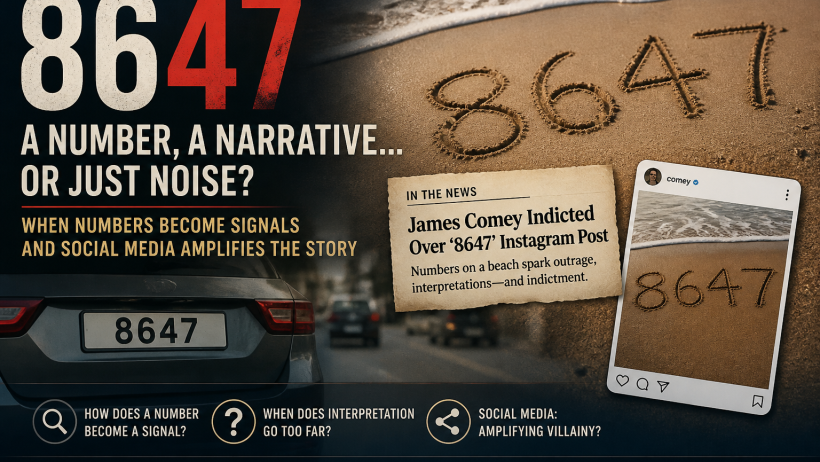
Signal-Talk Analysis · A recent episode involving the number 8647 and James Comey (former FBI director) has been making news—after numbers arranged on a beach and posted on Instagram drew scrutiny and even led to indictment. The interpretation hinged on “86” as slang for “remove,” and “47” as a reference to the 47th U.S. President. Against that backdrop, I saw a car in front of me bearing the number 8647 — and so it got my attention. That’s the signal being read in this episode; 5 May 2026; ST -031/ NV Subba Rao (read time: 08 mins).
8647: A number, a narrative… or just noise?
Saw a car with the number 8647 in front of me, while driving.
And as is a bit of a personal quirk, I started doing what I often do,
mental math — breaking it down, looking for patterns, trying to “decode” it. Somewhere along that mental detour, I was reminded of the recent episode involving James Comey, former FBI director —where even a simple arrangement of numbers on a beach sparked intense reactions, interpretations… concern and even an indictment.
But what really piqued my interest was this:
it was posted on social media – Instagram (and later taken down).
So, the question almost flips—
Was it a number that carried a specific negative interpretation?
Or did the platform give it one? Instagram in this case…
So, did Instagram get the man into a jam, or was the number itself sinister enough to trigger such a response— even without clear linkages?
After all, if the car in front of me was carrying 8647,
what meaning or linkages should I attach to it?
Or should I attach any at all?
That got me thinking.
How does a number become a signal?
And when does interpretation go too far and become overreach?
And more importantly:
When does social media stop reflecting reality…
and start constructing it?
Because once a pattern enters the feed,
it doesn’t just get seen …
It gets amplified, interpreted, and often… distorted.
And somewhere along that chain,
noise begins to wear the costume of signal.
And what if ‘8647’ had other interpretations too…
Top of mind, all I could decipher was that the number was “possibly” a prime number, and the obvious one that 7 was the odd one in the pattern of 8 6 4, with 7 instead of 2
So, with curiosity triggered I went deeper into 8647—this time asking Chat GPT on what the number meant or could mean — with a number theory prompt to my query.
And here’s what came out:
- Not quite a Srinivasa Ramanujan-style 1729 moment.
But a different kind of elegance. - A prime—indivisible, self-contained
- A Gaussian prime (4n+3)—an “island” in the complex plane
- A full-period prime—its reciprocal cycles through 8646 digits before repeating.
Almost as if it insists on exploring every possibility before returning. - A full-cycle number—8646 digits before repeating
- A layered consistency—Left-truncatable prime
8647 → 647 → 47 → 7
Strip it down, and it still holds together – all are primes - Fun fact: The left-truncatable property is a fascinating constraint because it requires a number to be prime at every single step of its “reduction.” Because primes become increasingly sparse as numbers get larger, there is actually a finite list of these numbers. There are exactly 4,260 left-truncatable primes in base 10. The largest one is a 24-digit number: 357,686,312,646,216,567,629,137.
- And yet—not a “happy number.”
It loops, doesn’t resolve cleanly.
Like many things that look structured on the surface. - Fun fact: A happy number is defined by the process of replacing the number by the sum of the squares of its digits:
- 8^2 + 6^2 + 4^2 + 7^2 = 64 + 36 + 16 + 49 = 165
- 1^2 + 6^2 + 5^2 = 1 + 36 + 25 = 62
- 6^2 + 2^2 = 36 + 4 = 40
- 4^2 + 0^2 = 16
- 1^2 + 6^2 = 37
- 3^2 + 7^2 = 9 + 49 = 58
- 5^2 + 8^2 = 25 + 64 = 89
- (Note: 8647 actually enters the 89-loop, making it technically “unhappy.” However, in certain modular arithmetic strings often studied alongside Ramanujan’s mock theta functions, these sequences are used to test distribution density…… whatever that means)
And then a different thought crossed my mind.
What if 8647 wasn’t meant to mean anything at all, let alone sinister?
Maybe:
- It was a student, just exploring primes – scribbling numbers while preparing for an exam, or simply fascinated by primes and patterns.
- Or a researcher or professor,
casually playing with Gaussian primes, leaving behind a trail of thought without context. - Or perhaps just a father and son or two persons having fun on a beach,
arranging pebbles, discovering numbers for the joy of it—
no signal, no intent, just curiosity, just play.
But here’s the shift.
We see a pattern → we assign meaning, if not intent → we amplify the narrative.
And once platform amplification kicks in,
intent becomes irrelevant. Perception takes over.
The number plate becomes a message.
Pebbles on a beach become a signal.
Noise becomes narrative.
A story is born…
That’s the world we live in today.
In an algorithm-driven ecosystem,
interpretation travels faster than intention.
And somewhere along the way,
noise often starts looking like signal.
8647 didn’t change.
The system interpreting it did.
Maybe 8647 on the beach meant something – to someone.
Maybe it meant nothing.
And that’s the real story.
But the instinct to decode it, to project meaning onto it— that’s the real pattern.
Off course the courts will decide….
But by then the social media trial would have played its part …
N V Subba Rao
Author: Uncle Sam 2.0 (Available on Amazon)
www.unclesam2.com

Signal-to-Noise Ratio (SNR)
Editorial score:
2.2
/ 10
Low 1-3
Medium 4-6
High 7-9
Perfect 10 (no Noise)
Scale:
1 = Number detached from context (multiple meanings, speculation high): noise-dominant system
10 = Number grounded in context (and no intent to cancel): No Speculation – signal-dominant system
At SNR 2.2, this represents a weak signal dominated by noise—where context is thin and interpretation begins to drift. It underscores the need to restore context, clarity, and balance, ensuring that meaning is not prematurely imposed but carefully derived.
Comparative Signal-to-Noise (SNR) Scores
How different actors frame the same issue—measured using the same Signal-to-Noise logic.
Editorial (Signal-Talk)
2.2
High speculation, Multiple meanings, Noise Dominating
Experts Score (None)
—
Gen AI-5 (LLM ‘s synthesis – Avg. score) #
2.5
Chat Gpt 2.5, Grok 3.0, Perplexity 2.2, Gemini 2.3, Claude 2.3.
Reader’s Pulse (Poll)
[weighted_SNR_score id=”2578″]
* Poll scores are dynamic- and changes with responses (Please see + take the poll below)
# Gen AI-5 is average score of 5 LLM’s – Chat GPT, Grok, Gemini, Perplexity, and Claude
SNR scores are on scale of 1-10 (1 = System depleting and 10 System forming. in this case 1 = Closed system – High speculation; 10= Open system – Identity enabling and interpretation aligned).
How clear does the core issue of 8647 feel to you after reading this episode of Signal-Talk?
Cast your vote and see how your score compares with Community and Gen AI scores.
CAST YOUR VOTE
Rate the signal, not the sentiment (Your rating and email are kept confidential and not shared with anyone)
Your take: Is 8647 primarily a coincidental number with no inherent intent— or a constructed narrative with intention interpretation and amplification – to a cancel logic?
[weighted_SNR_score id=”2578″]
Axiom: A number acquires power not through digits, but through the stories attached to it.
Signal-Talk Analysis: ST 031/ 8647, Platforms, Social Media. Narratives, Prime Numbers, Interpretations.
NV Subba Rao is the author of the book Quo Vadis?Uncle Sam 2.0 (now available on Amazon)
Unclesam2.com