


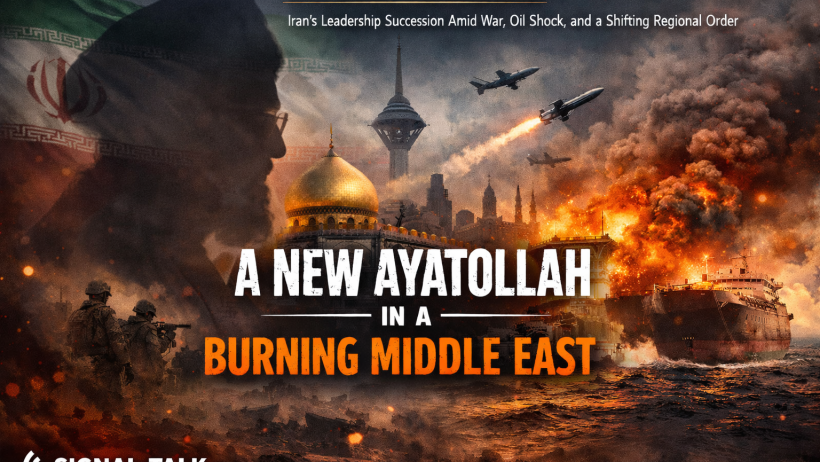

Iran’s Leadership Succession Amid War, Oil Shock, and a Shifting Regional Order- Mojtaba Khamenei is the New Supreme Leader.
Signal-Talk Analysis · A significant leadership change is unfolding — not in calm deliberation, but in the fog of war. “As the Middle East edges toward a wider conflict and missiles fly across the region, Iran quietly reshapes the command of the Islamic Republic.” With crude oil prices on the edge, and global markets tumbling, all eyes are now on Tehran — wondering whether this transition will stabilize the Islamic Republic — or it amplifies the crisis that’s rapidly spreading, not only across the Middle East but the world. That is the signal the world is trying to read; 10 March 2026; ST -028/ NV Subbarao (read time: 8 mins).
The Middle East is burning and is on the edge — missiles crossing borders, oil markets trembling, and regional alliances recalibrating in real time.
Amid this unfolding war, Iran has been forced into one of the most consequential decisions in the life of the Islamic Republic: choosing a new Supreme Leader – Mojtaba Khamenei.
The transition follows the killing of long-time leader Ayatollah Ali Khamenei during U.S.–Israeli strikes, triggering a rare succession process in Tehran even as the region slides deeper into conflict.
For a political system built around clerical authority and centralized command, the stakes are immense. The Supreme Leader controls Iran’s military strategy, its nuclear posture, and the direction of its regional alliances.
Airstrikes, retaliation threats, and warnings that Iran’s next leader could become a direct target have turned what would normally be an internal clerical process into a geopolitical flashpoint.
The result is a moment where two ‘forces‘ collide:
A system built for continuity.
A region consumed by conflict.
Power struggles and changes in Tehran do not remain within Iran’s borders. They ripple outward — through oil prices, shipping lanes, military postures, and diplomatic alignments.
How this transition stabilizes the Islamic Republic — or amplifies the crisis now spreading across the Middle East — is the signal the world is trying to read.
Global Oil System — Scale Context
The Iran succession crisis is unfolding at the heart of the world’s most critical energy corridor. At the center of the crisis lies the most important energy corridor on the planet — the Strait of Hormuz.
Nearly every major oil-consuming economy depends on the stability of this narrow waterway separating Iran from the Arabian Peninsula.
Global Oil Consumption:
~100–102 million barrels per day
Middle East Share of Global Oil Production:
~30–32%
Strait of Hormuz Throughput:
~20 million barrels per day
(≈ 20% of global oil trade)
Global LNG Trade Through Hormuz:
~25–30%
Iran Oil Production:
~3–3.5 million barrels per day
Iran’s Strategic Geography:
Iran controls the entire northern coastline of the Strait of Hormuz, placing it within direct reach of the shipping lanes that carry energy to Asia, Europe, and global markets.
Countries Dependent on Hormuz Oil Flow:
China, India, Japan, South Korea, and much of Europe.
Why Leadership in Tehran Matters
A shift in Iran’s leadership during a regional war does not remain a domestic political event. It directly affects:
• Oil supply stability
• Shipping insurance costs
• Energy prices worldwide
• Global inflation expectations
The Middle East sits at the center of the global energy economy — and Iran occupies one of its most strategic nodes. Which is why the leadership transition in Tehran is watched closely by energy markets, governments, and militaries around the world.
Because when power shifts in Iran, the signal often travels first through oil prices. Even small disruptions to traffic through the strait can ripple quickly through global markets.
- Oil prices, shipping insurance rates, tanker routes, and strategic reserves all respond to signals coming from this narrow stretch of water.
This is not a marginal geopolitical system. It’s a systemic moment.
Leadership transitions at this level are not routine political events. Especially, when they unfold amid war, sanctions, and shifting regional alliances — for they reshape energy flows, security architectures, and global market expectations. As has been witnessed in the last 5-7 days.
The control of the Strait of Hormuz in many ways, is the control of the world’s energy pulse.
Axiom: In energy geopolitics, power rarely announces itself as power — it reveals itself through disruption.
And the signal travels first through oil markets… and rapidly!

SIGNAL
What actually matters?

NOISE
What distracts and distorts?
Iran has entered one of the most consequential political transitions since the 1979 Islamic Revolution. Following the death of long-time Supreme Leader Ayatollah Ali Khamenei, the country’s clerical establishment moved quickly to appoint a successor. In effect, Iran’s political system has just completed only its third Supreme Leadership transition in nearly half a century — from Ayatollah Khomeini (1979-1989), to Ali Khamenei (1989-2026), and now to Mojtaba Khamenei.
This makes the succession far more consequential than a typical leadership change.
The Assembly of Experts, an 88-member body of Shiite clerics responsible for selecting the Supreme Leader, convened and elected Mojtaba Khamenei, the son of the former leader, to assume the role.
The Supreme Leader in Iran is not merely symbolic. The position carries ultimate authority over the military, judiciary, foreign policy, and the powerful Islamic Revolutionary Guard Corps (IRGC).
For global observers, the signal is clear:
Iran’s political system has proven capable of preserving continuity even during crisis and conflict.
War Narratives, Oil Panic, and Dynastic Speculation: The transition has unfolded amid intense geopolitical turbulence. Media reports indicate the leadership change occurred during a period of regional conflict involving Iran, Israel, and U.S. forces, contributing to surging oil prices and heightened geopolitical tension.
Media commentary has also amplified several competing narratives:
• Iran becoming a “clerical dynasty”
• Hardliners consolidating power through the Revolutionary Guard
• The new leader lacking the religious stature traditionally expected of the role
• Concerns about stronger repression domestically
Critics have labeled Mojtaba Khamenei a “shadow leader” who previously operated behind the scenes through influence networks rather than formal political office.
These narratives dominate headlines — but they obscure the deeper systemic question: Not just who the leader is, but how the system would manage succession.
The present global conversation remains largely clouded by competing narratives — dynastic speculation, geopolitical alarm, and ideological framing.
The result: fires rage, smoke thickens, and the signal fades.

System Lens
Iran has announced its next Supreme Leader – Mojtaba Khamenei.
But beneath that announcement lies a deeper systems-level question: how the Islamic Republic manages leadership succession during crisis.
Iran’s political architecture is not designed around frequent leadership turnover. Instead, it is structured around a tightly coupled network of clerical authority, constitutional bodies, and security institutions that collectively reinforce the authority of the Supreme Leader.
At the center of this architecture sits the Assembly of Experts, the clerical body constitutionally empowered to select the Supreme Leader and oversee the continuity of the system.
When leadership transitions occur, the event therefore tests not merely a political decision, but the resilience of the entire governance feedback loop.
In moments of regional war and geopolitical pressure, that loop becomes even more consequential. And the signal often lies not in the announcement of the leader, but in how the system produced him.
Iran’s Governance Feedback Loop
From a social cybernetics perspective, Iran’s political system operates through tightly coupled institutional loops.
Clerical Authority
↓
Guardian Council
↓
Assembly of Experts
↓
Supreme Leadership
↓
Revolutionary Guard and Security Apparatus
↓
State Governance and Policy Direction
Each component reinforces the legitimacy and authority of the others.
When the Supreme Leader dies or steps down, the system activates a feedback stabilization process:
- Interim leadership mechanisms maintain continuity
- The Assembly of Experts convenes
- Candidate legitimacy is assessed through religious and political criteria
- A new Supreme Leader is selected
Unlike electoral democracies that experience frequent leadership turnover, Iran’s model prioritizes continuity and ideological stability.
From a cybernetic standpoint, the system emphasizes control loops rather than competitive political cycles — institutions designed to preserve doctrinal authority and regime continuity across generations.
Yet cybernetics alone cannot fully explain Iran’s governance architecture. The Islamic Republic sits atop one of the world’s oldest continuous civilizations — Persia — whose historical identity stretches back millennia to Aryanam (Aryānām / the land of the Aryans), and whose political culture has long intertwined state authority with spiritual legitimacy.
Modern Iran therefore operates at the intersection of theology, civilization, and institutional design. The doctrine of Velayat-e-Faqih (Guardianship of the Jurist) embeds clerical authority within the state, making leadership succession not merely a political process but a religious and civilizational one.
Which means the system cannot be read only through the mechanics of governance.
It must also be understood through the deeper narratives of faith—theology, history, and ‘identity’ that shape the Iranian state itself. Implying fear, intimidation, bombardments, attacks, etc., may do little to deter their will and resolve.
To not understand Iran in its ‘totality’ — is the big systems gap.

Signal-to-Noise Ratio (SNR)
Editorial score:
7.8
/ 10
Low 1-3
Medium 4-6
High 7-9
Perfect 10 (no Noise)
(Scale: 1 = System depleting → 10 = System forming)
Signal: Institutional continuity and structured succession
Noise: Dynastic speculation, geopolitical drama, and media narratives
At SNR 7.6, this is a formative signal — and far from a system shift or system instability. The succession intent signal is green — suggesting system continuity and system formation.
The transition suggests that despite war, external pressure and internal complexity, the Iranian system retains the capacity to absorb leadership change without immediate destabilization.
The Selection of New supreme leader- Mojtaba Khamenei represents a potential expansion event as feedback on system formation characteristics.
Thus suggesting ‘system continuity’ even in face of extreme adversity.
Comparative Signal-to-Noise (SNR) Scores
How different actors frame the same issue—measured using the same Signal-to-Noise logic.
Editorial (Signal-Talk)
7.8
System-forming, Structure continuity-heavy leaning
Experts score – WhatsApp Geo-politics groups- (Respondents = 24)
8.6
Gen AI-4 (LLM ‘s synthesis – Avg. score) #
8.2
Seeing definitive signal expansion, and minimal evidence of signal compression
Reader’s Pulse (Poll)
[weighted_SNR_score id=”2282″]
Interpretation
The comparative scores reveal a familiar pattern in geopolitical crises.

Analysts and institutional observers tend to read the transition through the lens of system continuity and regime resilience, which explains the relatively high scores from the Editorial and Expert cohorts.

Public perception (SNR~3.00), however, is shaped more immediately by war imagery, geopolitical tension, and oil-market anxiety, producing a far lower confidence score.

In other words, while the system signal points toward controlled succession, the public narrative remains dominated by the fog of war.

As the situation evolves, the gap between these interpretations may narrow — but for now, the signal and the narrative are moving on different frequencies.

In Signal-Talk terms, the system is not signal-constrained, rather is signal-amplifying.
# Gen AI-4 is average score of 4 LLM’s – Chat GPT, Grok, Gemini and Perplexity
SNR scores are on scale of 1-10 (1; System depleting and 10 System forming)
SYSTEM RESPONSE: How should the system respond?
The current crisis did not begin with succession alone.
Iran entered this leadership transition after U.S.–Israeli strikes targeted military and leadership sites inside the country, described by those governments as a pre-emptive effort to remove perceived security threats from Iran’s nuclear and missile programs.
For Tehran, however, the attacks were framed as a direct assault on national sovereignty, triggering retaliation across the region and widening the conflict.
This places Iran’s newly installed leadership in a difficult strategic position.
A nation that sees itself attacked must respond — but the manner of response will determine whether the region moves toward escalation or stabilization.
Three system responses therefore become critical.
- Measured Strength Over Escalatory Retaliation: For the new Supreme Leader, the challenge is to balance national pride with strategic restraint. Iran’s political culture places enormous value on sovereignty, dignity, and resistance to external pressure. Yet large-scale retaliation risks triggering wider regional war. The most stabilizing response would therefore combine symbolic firmness with controlled escalation — preserving national honor while avoiding actions that could ignite a broader conflict.
- Protect the Energy Arteries of the World: Iran’s geography gives it enormous leverage over the Strait of Hormuz, through which roughly a fifth of global oil trade passes. Threats to shut the strait or disrupt shipping lanes would send shockwaves through global markets and risk drawing additional powers into the conflict. Preserving maritime stability, even during confrontation, remains essential to preventing the crisis from spilling into the global economic system.
- Reinforce Internal System Cohesion: The real signal will come not from speeches but from the behavior of Iran’s institutional nodes:
• Clerical leadership unity
• Islamic Revolutionary Guard Corps posture
• Elite political consensus
• Regional proxy restraint
If these actors remain aligned, the system will likely absorb the shock of war and succession.
If fractures appear, escalation dynamics could intensify across the Middle East.
System Insight:
Moments like this test more than leaders. They test whether a political system can defend its sovereignty without letting conflict spiral beyond control.
For Iran’s new leadership, the strategic challenge may therefore be simple — but difficult: Respond with strength, yet govern with restraint.
Because in geopolitics, the true test of power is not how loudly a nation can retaliate — but whether it can preserve both dignity and stability at the same time.
Signal Alert: For now, the selection of Mojtaba Khamenei as Iran’s new Supreme Leader is flashing “Code Green.” The immediate signal points to system continuity. But that continuity comes from a past already locked in confrontation with the United States and Israel. If nothing changes, the signal of continuity may also become the signal of a wider Middle East conflict — and potentially a pathway towards something far more dangerous—WW III.
One possible off-ramp may lie in strategic restraint:
a moment where the United States could choose to declare its immediate objectives achieved and step back from direct military escalation, allowing diplomacy and regional stabilization mechanisms to take hold.
Such a move could shift the region from military escalation toward strategic stabilization. Yet even such a move may not fully ease the wounded pride and sovereignty concerns of the Iranian nation, which now form part of the emotional terrain of this conflict.
In conflict system’s, the social cybernetics feedback loop is not complete until dignity, security, and stability are restored together — for wars rarely end when the bombs stop falling.
How clear does the core issue feel to you after reading this episode of Signal-Talk?
Cast your vote and see how your score compares with Community and Gen AI scores.
CAST YOUR VOTE
Rate the signal, not the sentiment (Your rating and email are kept confidential and not shared with anyone)
Your take: How should the world interpret Iran’s leadership transition?
[weighted_SNR_score id=”2282″]

Signal-Talk Take / Behind the Signal Editorial interpretation based on system behavior, not sentiment
The System Behind the Leader
Leadership transitions reveal the real architecture of power.
In Iran’s case, the system is not designed for frequent political competition or rapid leadership turnover. Instead, it is engineered to maintain ideological continuity and centralized authority across decades.
This makes leadership change less about political drama and more about system preservation.
For global observers, the deeper signal lies in this design.
The Islamic Republic may appear rigid from the outside, but its internal governance mechanisms show a different logic — one built to ensure that when leaders change, the system itself does not.
The signal is not just about the individual who rises to power.
It lies in the system that produces the leader.
The architecture of power in Tehran may remain unchanged.
But a new leader can still reshape the signals that guide conflict, deterrence, and regional stability across the Middle East.
In highly institutionalized systems like Iran’s, leadership succession rarely produces immediate policy reversals. The architecture of power — clerical authority, the Revolutionary Guard, and the constitutional bodies that sustain the system — creates strong incentives for continuity over experimentation. Which means the probability of a dramatic strategic pivot is relatively low in the near term. New leaders in such systems typically begin by consolidating internal legitimacy rather than redefining external strategy.
The Leader’s Strategic Peril: Yet leadership within an unchanged architecture carries its own risks. If the new Supreme Leader pursues escalation, the conflict with the United States and Israel could deepen, potentially drawing the region toward a wider war. If he pursues de-escalation, he risks appearing weak to domestic power centers — particularly the Revolutionary Guard and hard-liner clerical networks that form the backbone of the system. The paradox is clear:
Too much confrontation risks regional war.
Too much restraint risks internal credibility. The most viable path for the new leader may therefore lie in controlled signaling — projecting strength while avoiding moves that could trigger uncontrollable escalation. In geopolitical systems under stress, leadership is often less about choosing between war and peace than about managing the narrow space between them.
👉 The signal ought to emerge as: ““Defend Sovereignty with Restraint — Preserve national dignity while preventing escalation.”
– Not eye for eye — which is simply all-round destruction and global chaos
Signal-Talk: Making sense of what really matters
One Signal at a Time.
Signal-Talk Analysis: ST 028/ Iran, Middel east, Missiles, Ayatollah, Supreme Leader, War, Geo-Politics, Theology, Israel, USA, Governance, Sovereignty