



Signal-Talk Analysis: For more than a century, companies followed a familiar path to growth. They built products, generated revenues, raised capital, and eventually went public. The IPO was primarily a financing event. Now, SpaceX appears to have rewritten that script.
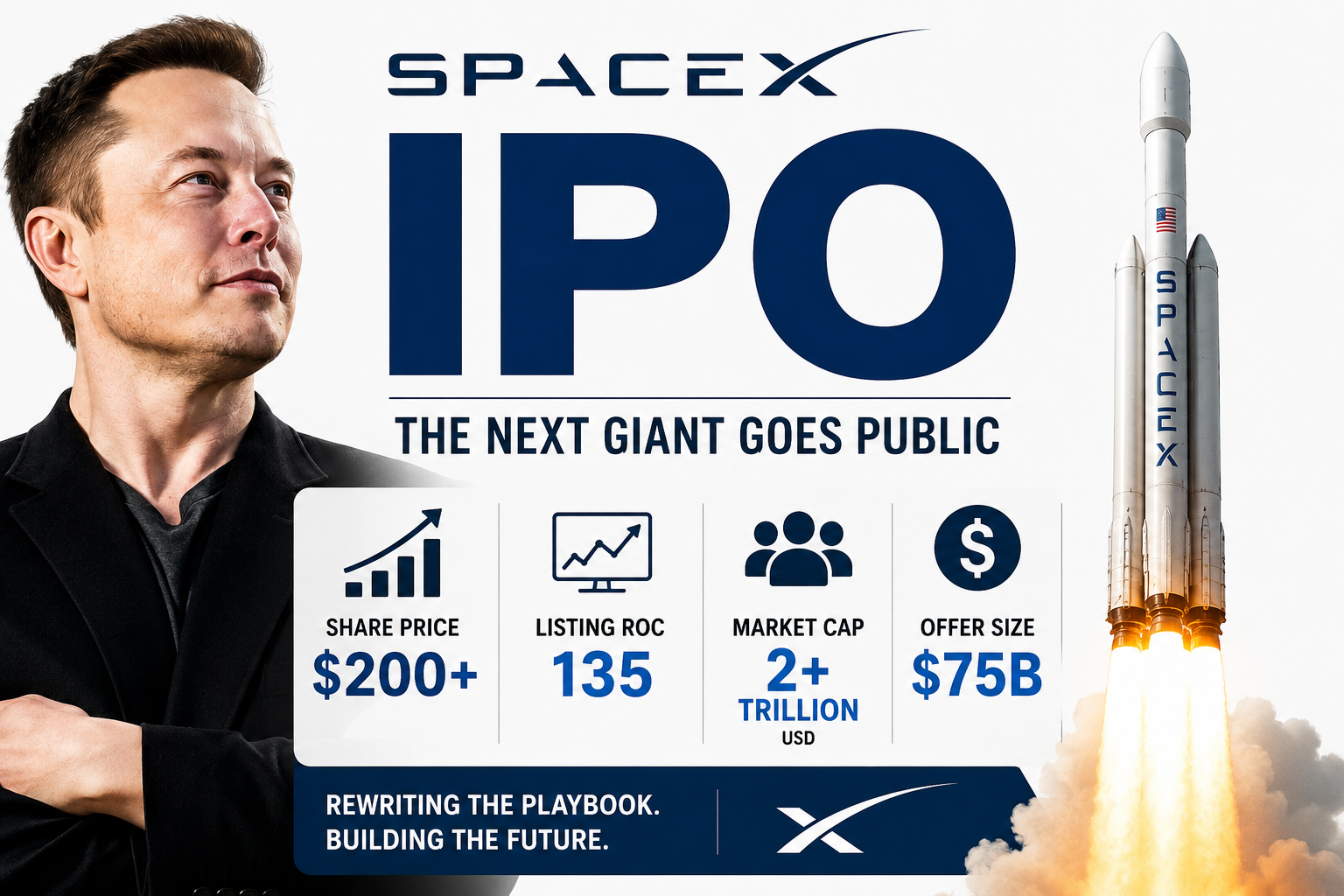
With an estimated offering size of nearly $75 billion and a market capitalization crossing $2 trillion, the story extends beyond rockets, satellites, or even Elon Musk. Instead, it highlights a new corporate-finance playbook where liquidity can be created without surrendering control, where private capital can fund decades of growth, and where public markets become a strategic choice rather than a financial necessity.
The deeper signal lies in the changing relationship between founders, investors, and capital markets. If the strongest companies can remain private longer, scale larger, and enter public markets only on their own terms, then the IPO itself is being transformed from a capital-raising event into a liquidity event.
So, is SpaceX simply the world’s most successful space company? Or is it demonstrating how the next generation of corporate giants will finance growth, preserve control, and reshape the rules of capitalism itself?
A $75 billion offering and a $2 trillion valuation may grab headlines. The larger signal may be that the future of corporate finance is no longer about raising money, but about deciding when you no longer need it. 17 June 2026; ST-036 / NV Subba Rao (Read time: 9 mins).
NV Subba Rao is the author of Quo Vadis? Uncle Sam 2.0 — a social media and systems-level exploration of power, media, and democracy in the algorithmic age.
Available on Amazon
Website: UncleSam2.com
If one thinks that the historic SpaceX (SPCX) debut on June 12 was just another massive tech listing, then one is very likely missing the most brilliant part of the execution and a master class in corporate finance:
How modern companies can raise capital, create liquidity, and retain control?
The biggest lesson from the SpaceX IPO may not be about rockets, or satellites, or even Musk-verse. It’s most likely about who controls the future when capital is no longer the scarce resource.
For decades, IPOs followed a familiar script: raise capital, dilute ownership, and answer to Wall Street.
SpaceX appears to have written a different ending via massive liquidity, founder control, strategic capital, and minimal compromise
Yes, pricing at $135 a share to raise a record-breaking $75 billion out of the gate was a jaw-dropper. But watching the secondary market rapidly push shares above $200 in a post-listing rally —briefly vaulting its valuation past $2.6 trillion and putting a $3 trillion market cap within striking distance, Is simply unprecedented.
Yet, the real genius isn’t the staggering number on the ticker. It’s how they engineered the lockup structure.
For decades, Wall Street regulators have treated the 180-day “cliff” lockup as an ironclad rule. A company lists, early insiders are locked out, and on Day 181, a massive wall of oversupply hits the market, frequently crushing the stock price.
SpaceX completely tore up that playbook. Instead of a cliff, they introduced a highly strategic, staggered rolling release schedule:
- The Tiny Float Catalyst: By launching with an initially tight ~5% free float, they created an environment of acute asset scarcity that fueled the initial surge past $200.
- The Staggered Drip: Instead of a single unlock day, early VCs and employee holdings are being drip-fed into the market using performance milestones (like a 10% booster trigger if the stock sustains a 30% premium) and 7% time-based tranches spanning from Day 70 to Day 135.
- The Index Match: As major indices fast-track SPCX into their benchmarks, passive ETFs are legally forced to buy up every available share. Every time SpaceX carefully opens a release valve on a rolling tranche, the expanding float forces index algorithms to buy more shares to maintain the stock’s correct weighting.
Recall – When the Sellers Arrive
History suggests that IPO success is often tested not on listing day, but when early investors are finally allowed to sell.
| Company | IPO Year | Peak Post-IPO Decline* |
|---|---|---|
| Nykaa – India | 2021 | ~ -72% |
| Zomato – India | 2021 | ~ -65% |
| Paytm – India | 2021 | ~ -75% |
| Meta Platforms | 2012 | ~ -54% |
| Uber Technologies | 2019 | ~ -43% |
| Robinhood Markets | 2021 2024 | ~ -90% Surged ~50% on debut, then sig volatility |
*Approximate peak declines from post-listing highs or IPO-related trading peaks.
What happened?
In most cases, three forces converged:
- Lock-up periods expired.
- Early investors gained the ability to sell.
- Market narratives shifted from growth stories to earnings realities.
The result was often a sharp increase in tradable supply precisely when investor enthusiasm was beginning to normalize
Almost in all cases investors reassessed valuation and growth expectations – as is the practice.
.
Why SpaceX Is Different
SpaceX appears to have studied these episodes carefully.Instead of allowing a large volume of insider shares to hit the market simultaneously, the company has structured:
- Limited initial float
- Staggered release schedules
- Extended insider restrictions
- Strong founder holding commitments
Investors buy stories. Prices are determined by supply.
The objective is not to guarantee a price above $135 but likely to prevent a sudden imbalance between supply and demand – and that’s really keeping price and investor related problems at bay. This would enable them to focus better on execution for growth, earnings and business – by buying time and capital, as never before
SPCX & The Strategic Reality: Leverage is an Earned Asset
Many in the business community are calling this structure an “unrepeatable exception.” They are right and likely for some wrong reasons. SpaceX didn’t get a free pass from investment banks out of goodwill. They earned the leverage to dictate terms.
- Focus Breeds Scarcity: By maintaining a near-monopoly on global launch infrastructure and satellite internet, Musk built an asset with zero true peers.
- Breaking the VC Dependency: For over a decade, SpaceX systematically avoided a premature IPO by running highly structured, private secondary tender offers. They provided controlled liquidity internally, starving Wall Street of the asset and accumulating massive unmet demand.
When a company spends a decade executing flawlessly on a generational vision, it transitions from a price-taker to a rule-maker.
The SPCX listing isn’t just a successful IPO; it’s a structural blueprint for how future foundational mega-caps will interface with public markets. It proves that true strategic focus allows a founder to protect long-term operational integrity. Even under the brightest public lights of media and microscopes of the regulators.

SIGNAL
What actually matters?

NOISE
What distracts and distorts?
1. Liquidity Without Losing The Keys
Traditional IPOs force founders into a trade-off:
2. Raise capital → Lose control.
SpaceX appears to have pursued a different model.
For years it:
• Raised private capital at increasing valuations
• Conducted secondary share sales for employees and investors
• Built Starlink into a recurring cash-flow engine
• Delayed public markets until scale was undeniable
1. Is This a Model Others Can Copy?
Probably not.
2. SpaceX benefits from a combination few companies possess:
• Near-monopoly launch capability
• Global satellite infrastructure
• Massive private investor demand
• Founder-driven narrative strength
• Government and defense relevance
For most firms, public markets remain a necessity.
For SpaceX, they became an option.
The result?
When IPO discussions finally emerged, the company was not seeking survival capital. It was seeking strategic liquidity.
That changes the balance of power – and that likely is the real signal.

SYSTEM LENS The deeper structural view
SPCX IPO increasingly resembles a reinvention of the IPO playbook. It asserted “the strongest companies may go public only when they no longer need to.” And so, it engineered a virtually unheard IPO format, relegating valuations and multiples to lesser importance levels.
WHY SPACE X IS TRYING TO AVOID AN IPO HANGOVER
Most IPOs face a simple problem.
The day a stock lists, investors who bought earlier often want to sell. Employees want liquidity. Venture capital funds want exits. Early shareholders want to monetize years of gains.
If too many shares hit the market at once, supply overwhelms demand and the share price can fall sharply.
SpaceX has attempted to solve this problem through four mechanisms:
1. A Tight Float
Although SpaceX is valued above $2 trillion, only a small fraction of total shares are immediately tradable after listing. Most shares remain locked up, limiting supply in the market.
2. A Staggered Lock-Up
Unlike the traditional 180-day lock-up, SpaceX releases shares gradually. Small portions become eligible for sale at different intervals and after earnings announcements. This avoids a sudden “wall of stock” entering the market.
3. Founder Commitment
Elon Musk and several major investors have agreed not to sell for approximately 366 days after the IPO. That sends a strong signal that the largest shareholders are not rushing for the exit.
4. The Greenshoe Cushion
The underwriters have a 15% over-allotment (“greenshoe”) option. If the stock weakens after listing, they can buy shares in the market to support trading and stabilize the price around the IPO level. This mechanism is specifically designed to reduce early volatility.
And So, The Rise of The Optional IPO
For nearly a century, IPOs were financing events. Unlike now, for SPCX appears to have become a liquidity event.
The old model: Need Capital → Go Public
The new model: Build Scale → Create Liquidity → Go Public On Your Terms
The shift reflects a broader transformation in capital markets where elite firms can remain private far longer, accumulate enormous value, and enter public markets only after much of the growth has already occurred.
The question is no longer: “Can a company reach the public market?” The question is: “How long can it avoid needing one?”
Axiom: When a company can wait to go public, the balance of power shifts from markets to management.

SIGNAL – NOISE – RATIO (SNR)
From IPO as a financial event” to “IPO as a systemic signal about capital markets.”
SNR scores are on scale of 1-10 (1= System Depleting: Event centric interpretation/ Market noise: and 10 = System Forming: System-centric interpretation / Capital market signal…
1 = Event-centric interpretation / Market noisE (System Depleting: The SpaceX IPO is viewed primarily as another high-profile stock market event involving Elon Musk, valuation debates, listing gains, and investor excitement.
Discussion focuses on IPO pricing, first-day listing gains, market capitalization, investor demand, celebrity founder effects, and short-term stock performance. The IPO is treated as a standalone financial event with limited implications beyond shareholders and traders.
10 = System-centric interpretation / Capital market signal (System Forming: The SpaceX IPO is viewed as a transformative signal about the future of capital markets, founder control, private financing, liquidity creation, and the evolving relationship between companies and public markets.
The IPO is interpreted as evidence of a broader shift in corporate finance. It highlights how elite companies can remain private longer, access vast pools of capital, create liquidity without surrendering control, and approach public markets from a position of strength rather than necessity. The event becomes a signal about changing power dynamics between founders, investors, private capital, and public markets.
When the strongest companies no longer need public markets to grow, IPOs cease to be financing events and become strategic choices. The resulting shift affects not only valuations, but also who controls capital, governance, and the future direction of innovation.
Interpretation:
At an SNR (editorial) of “8.8″, this emerges as a strong signal, because beneath the SpaceX headlines lies a deeper signal:
The relationship between founders, investors, and public markets is being rewritten: Capital → Control → Market Power (Corp Finance)
SpaceX may not have reinvented rocketry alone. It may have reinvented the IPO itself.
.
CAST YOUR VOTE

Comparative Signal-to-Noise (SNR) Scores
How different actors frame the same issue—measured using the same Signal-to-Noise logic.
Editorial (Signal-Talk)
8.8
Strong Signal: Alert and a warning of examination centric nation/ societal distress
Retail investors survey score (Attempted via survey – not sure of response levels)
—
Gen AI-5 (LLM ‘s synthesis – Avg. score) #
8.6
# Gen AI-5 is average score of 5 LLM’s (Chat Gpt 8.6, Grok 9.6, Perplexity 7.5, Gemini 8.5, Claude 8.8)
Reader’s Pulse (Poll)
[weighted_SNR_score id=”3110″]
# Methodology Note: Reader Pulse and Gen AI-5 scores are independent inputs. Reader Pulse captures public sentiment, while Gen AI-5 reflects a synthesized assessment from five leading AI models using the Signal-Talk EQ Path framework. Together, they provide a comparative view of human and machine interpretation of the same signal. Full methodology: EQ Path Model.
Signal-Talk Insight: Every episode compares three lenses: Editorial View, Reader Pulse, and Gen AI-5. Divergences between the three are often signals in themselves.
CAST YOUR VOTE - Please take the poll below
* Poll scores are dynamic- changes with responses. (P
Ater reading this episode of Signal-Talk, “what’s your take on the deeper signal behind the SpaceX IPO?”
Cast your vote and see how your score compares with Community and Gen AI scores – The poll would take less than 10 secs. Gracias!
Your take on the SPACEX IPO: ?
[weighted_SNR_score id=”3110″]

Signal-Talk Take / Behind the Signal: Editorial interpretation based on system behavior, not sentiment
For generations, companies went public because they needed money. SpaceX is demonstrating something different: That the strongest companies may go public only when they no longer need it.
That subtle shift may prove far more disruptive than any rocket launch. Because when capital becomes optional, control becomes priceless.
The objective is not to guarantee that SpaceX remains above $135. The objective is to ensure that demand arrives before supply.
By restricting who can sell, when they can sell, and how many shares can be sold, SpaceX has effectively engineered scarcity into the IPO structure. The company is not merely listing shares. It is managing the post-listing market too.
In capital markets, price is determined by value. But in the short run, price is often determined by float. SpaceX appears to honed that distinction better than most companies.
Signal-Talk Analysis: ST 036/ SPACEX IPO: THE $1.75 TRILLION BET / SpaceX, AI and the New Economics of Imagination
NV Subba Rao is the author of Uncle Sam 2.0 — a social media and systems-level exploration of power, media, and democracy in the algorithmic age.
Available on Amazon
Website: UncleSam2.com