
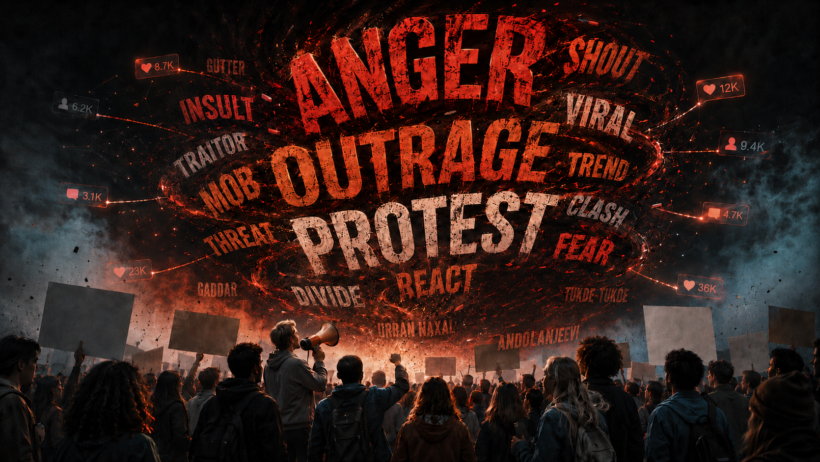

A student raises a slogan. Another responds with an insult. A short clip goes viral. Political camps take sides, television panels raise their voices, and social media begins deciding who is a patriot, a traitor, a victim or a villain.Signal Reflection – 002: In an age shaped by personality-driven politics and algorithmic amplification, words appear to matter more than ever. Student protests, like most protests, usually begin with a grievance. But loaded language, selective video clips and engagement-driven platforms can rapidly turn disagreement into identity conflict, outrage and confrontation. Words such as anti-national, traitor, extremist, infiltrator, mob, gutter, scum, idiot, terrorist and urban Naxal have travelled from political rallies and television studios into parliamentary exchanges and everyday conversation. They do more than criticize conduct. They assign identity, motive and moral worth. Once that happens, compromise begins to resemble surrender, restraint looks like weakness, and the opposing side is no longer merely wrong. It becomes dangerous or illegitimate.
The student may be the immediate story. But the deeper story began much earlier. This Signal Reflection asks why words matter more now, who helped create today’s language of confrontation, and what this reveals about leadership, public discourse and institutional capacity in the algorithmic age.
29 July 2026 | SR-002 | NV Subba Rao | Read time: 7 minutes
(Signal Reflections examines ideas, speeches, books and public moments that reveal deeper signals beneath the headlines.)
NV Subba Rao is the author of Quo Vadis? Uncle Sam 2.0 — a social media and systems-level exploration of power, media, and democracy in the algorithmic age.
Available on Amazon
Website: UncleSam2.com
Students may be leading the protests today, but did they create the language of confrontation dominating public life, and now trending on social media?
The foundations it appears was laid over years. First via cinematic aggression as it entered popular culture. Subsequently, political leaders adopted its taunts, punchlines and public humiliations. Television converted political conflict into spectacle. Social media clipped and circulated the most provocative moments.
As a result, political performance, political rhetoric has become prime social-media content. AI and platform algorithms make it possible to reward every sharp word with applause, outrage and followers. This has created a fertile ground for content creators, political influencers and partisan audiences. It also transformed public disagreement into a continuous performance, shocking many citizens and observers caught in the velocity of words and reels – targeted at the government leadership.
When students shout, threaten, ridicule or react aggressively, it is tempting to blame a restless generation. But we must also ask: where, how and from have they learnt that disagreement must sound like conflict, if not combat?
Who taught them that restraint is weakness, humiliation demonstrates leadership, and the sharpest insult wins the room? So, is there a Newtons 3’rd law phenomenon at play here?
These questions do not excuse threats, violence or abusive conduct by students. Responsibility for one’s actions remains personal. But understanding responsibility is not the same as understanding causation. The behavior visible today has developed within a much larger communication system that has taken concrete shape over the last decade or so.
From Cinematic Anger to Political Performance
For decades, popular cinema made the angry hero culturally attractive: one person, one cutting dialogue, one public humiliation and then applause. Applause that heralded adulation and cult like worship.
Cinema did not cause political aggression by itself. But it seemingly has helped audiences familiarize with a performative language of dominance. What worked as dramatic license gradually found its way into political communication. It set the tempo for social media recognition and celebration. Behaviors that can be explained reasonably well by the theories of Social Cybernetics (& Feedback loops), Uses and Gratifications, Social Connectedness, Network Effects, and Social Capital (Putnam etc.)
Political strength increasingly came to be performed through taunts, labels, mimicry, threats and personal attacks. Television turned these exchanges into prime-time entertainment. Social media extracted the most provocative fragments. Algorithms discovered that anger held attention longer than reason and could be monetized more rapidly and effectively.
Admiring audiences then provided the network effect. Digital bubbles expanded, echo chambers hardened, and increasingly aggressive language acquired social legitimacy.
Meanwhile, the underlying concerns affecting large sections of society, including unemployment, economic insecurity, inequality, inflation, civic injustice and lawlessness, did not disappear. They only became bigger. In many instances, linguistic spectacle displaced serious engagement as ‘real’ leaders became ‘reel’ leaders.
Each provocative word received claps, jeers, shares and followers. But it also raised the threshold for everyone who came next. To be noticed, the next speaker had to go further. To retain the crowd, the next leader had to sound tougher. To trend, the next post had to be more offensive. But the core socio-economic issues let alone not being addressed, were summarily being dismissed.
The Escalation Threshold
To be noticed, the next speaker had to go further. To retain the crowd, the next leader had to sound tougher. To trend, the next post had to become more offensive.
What began as political theatre gradually became the accepted grammar of public discourse. Students did not invent this escalation. They inherited it, absorbed it and are now reflecting it back to the leaders, media institutions and platforms that helped normalize it.
The question, therefore, is not simply: Why are students using such aggressive language?
It is also: Who built the language environment in which slurs, slogans and aggression became acceptable instruments of public life?
Is it students or politicians who leveraged mainstream media and social media to build their image, identity, and mass appeal.
Students may be holding the microphone, but they did not write the entire script. A generation does not suddenly lose the language of restraint. It learns, from those with the greatest power and visibility, which words receive the loudest applause.
And the greater a leader’s reach, the greater the responsibility for the language being legitimised.
Words frame the conflict, social media spreads the anger, and algorithms decide which temperature the country sees.
Uncle Sam 2.0 synthesis, drawing on Entman (1993), Papacharissi (2014), Brady et al. (2017), Subbarao et al. (2024), and Milli et al. (2025).
The Escalation Threshold
Words frame the conflict. Social media spreads the anger. Algorithms determine which version of the conflict receives the greatest visibility. Public tempers harden, and online hostility eventually returns to the street as behavior.
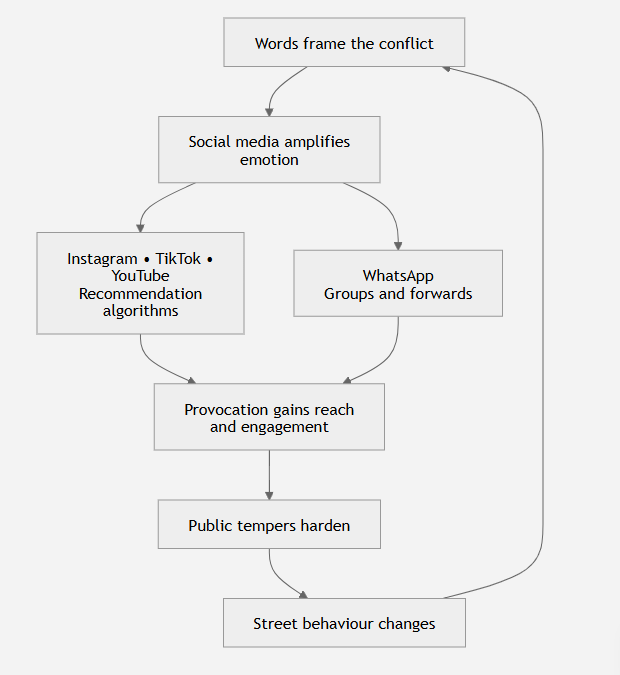
The protest may begin offline. But its emotional temperature is increasingly determined online.
Signal versus Noise
SIGNAL
NOISE
- The underlying student grievance
- Verified events and complete statements
- Peaceful representation and institutional response
- Language that separates conduct from identity
- Clear information on demands, negotiations and outcomes
- Decontextualised video clips
- Unverified claims of violence or conspiracy
- Provocative hashtags and edited speeches
- Treating one extreme participant as representative of all students
- Political actors using the protest to mobilise unrelated constituencies
System Lens
The real risk is not one objectionable statement. It is the interaction between inflammatory language, selective social-media visibility and algorithms designed to reward reaction.
A reckless sentence once had a limited audience. Today, it can be clipped, stripped of context, amplified across platforms and returned to the street as apparent proof that the other side is misguided, immoral or hostile.
Words become inputs into behaviour.
Political leaders can also benefit from this loop. Every provocative post may generate more followers, greater influence and stronger group identification. Over time, ideological bubbles harden and loyalty can begin to displace critical judgement.
The leader is no longer evaluated merely on policy, competence or institutional performance. The leader becomes an identity. Criticism of the leader is then experienced as an attack on the group itself.
This is how the belief that “the leader can do no wrong” begins to acquire social force.
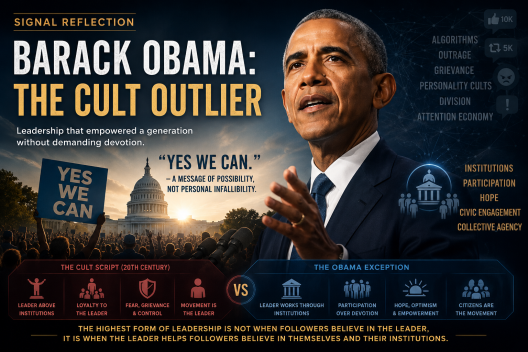
Across modern political movements, slogans often reveal the underlying psychology of leadership. Many are rooted in fear, grievance, threat perception, nationalism, identity, or personal loyalty. The leader sets the tone and depending on his passion and aggression to emerge popular or devoted, the climate of the nation so evolves.
In Uncle Sam 2.0, I explore this phenomenon via the 3S (Symbol-Soldier-Saviour) framework that leaders tend to adopt for themselves.
Leadership or Cult?
Not every charismatic leader creates a cult, and not every devoted following becomes one. Great leaders, thinkers, artists and cultural figures can inspire admiration, loyalty and emotional attachment. A cultic dynamic begins when devotion displaces critical thinking, loyalty becomes more important than truth, and a leader, movement or ideology is elevated above institutions, norms and accountability.
The relevant test is therefore not the size or passion of the following. It is what that following produces:
Did the leader strengthen institutions, civic participation, democratic resilience and the system’s capacity to adapt? Or did the surrounding ecosystem gaslight, divide and polarize society, reinforcing ideological bubbles while concentrating greater authority in one personality?
The irony is that the same communication loop can operate on both sides. Governments and protesters can each interpret only the most provocative version of the other. Algorithms then reinforce these selective perceptions, producing forms of collective belief that are subtle, scalable and pervasive.
Cult scholar Janja Lalich said it best as "One Nation, Under Influence. Welcome to the Congregation of Conviction."The Operating Code
CHAOS: Clickbait, Hashtags, Algorithms, Outrage and Spectacle
Chaos and C.H.A.O.S have become increasingly powerful operating loops for capturing attention, organizing identity and harvesting political power. Breaking that loop will require more than asking students to moderate their language or dismissing them as kids.
It will require political leaders, institutions, television networks, social platforms and citizens to recognize their respective roles in creating and sustaining it.
Because words do not remain online. They frame identities, harden attitudes, legitimize conduct and eventually acquire consequences on the street.
Signal Take
- History does not repeat itself merely because people protest. Tragedy becomes more likely when governments interpret dissent as disloyalty, media convert confrontation into spectacle, and algorithms ensure that the angriest version of events becomes the most visible.
- Students are responsible for the words they use and the actions they take. But governments, political leaders and media institutions carry an even greater responsibility: they possess the power not merely to join the escalation loop, but to interrupt it.
When Language Becomes a Security Lens and When Protest Crosses the Violence Threshold
History is replete with warnings about protests that moved from grievance and mobilization to confrontation, repression and death. History repeatedly also warns what can happen when governments stop treating protesters as citizens expressing grievances and begin framing them as misguided and or enemies of the state. Three recent examples, from three different regions, offer a sobering reminder:
- Bangladesh, 2024: What began as student protests over public-sector job quotas expanded into a nationwide movement. A UN investigation estimated that as many as 1,400 people may have been killed between 15 July and 5 August 2024, with the former government and its security apparatus implicated in systematic repression.
- Iran, 2022: The death of Mahsa Jina Amini triggered the Woman, Life, Freedom protests across the country. A UN fact-finding mission found that state forces killed at least 551 protesters, including 49 women and 68 children.
- Colombia, 2021: Protests that began over proposed tax reforms developed into a broader national strike. UN proceedings subsequently recorded 46 protesters killed, alongside reports of indiscriminate tear-gas deployment, lethal weapons and other excessive uses of force.
These events (and more Nepal, US, China, Sri Lanka etc.) arose from different grievances and political systems. They are not equivalents, and words alone did not cause the deaths. But each demonstrates how quickly a protest can cross the violence threshold when grievances remain unresolved, protesters are collectively portrayed as threats, rumors outrun verified information, and force replaces dialogue.
The Responsibility to Lower the Temperature: Government and Media
The answer is not to absolve students of responsibility. It is to recognise that responsibility travels upward as well. Those who command the largest platforms carry the greatest obligation to lower the temperature and behave as leaders ought to: with empathy for the grievance, restraint in their language, openness to dialogue, and the vision to prevent today’s confrontation from becoming tomorrow’s tragedy.
Governments have a duty to preserve public order. Protesters remain accountable for threats, destruction and violence. But the state carries the greater burden of restraint because it commands the police, intelligence machinery, official communication channels and coercive power.
Government communication should therefore distinguish between peaceful protesters and violent individuals, respond to the grievance rather than stigmatise the group, publish verified information quickly, preserve channels for negotiation and ensure that any use of force is necessary, proportionate and accountable. And avoid manipulating the media at all costs.
The media carries a parallel responsibility. A provocative clip may be newsworthy, but playing it repeatedly can turn one angry voice into the perceived face of an entire movement. Labels, speculative headlines, combative panels and unverified casualty claims do not merely report the temperature. They can raise it.
Algorithms then complete the loop by giving the most emotionally charged version of events the greatest reach.
Students may be holding the microphone, but they did not write the entire script. A generation learns, from those with power and visibility, which words receive the loudest applause.

The measure of authority is not how loudly it answers anger, but how effectively it prevents anger from becoming tragedy.
Signal Reflection: SR 002/ Words Matter – When Language Raises the Temperature
NV Subba Rao is the author of Uncle Sam 2.0 — a social media and systems-level exploration of power, media, and democracy in the algorithmic age. Uncle Sam 2.0 is more than a book about America. It offers a framework for understanding how modern societies hold, drift and attempt to recalibrate themselves in the age of algorithms.
Available on Amazon
Website: UncleSam2.com