


The previous Signal Reflection asked what those who lead an institution inherit beyond its businesses. This reflection takes the question one step further: when ownership, board authority and accountability intersect, who really decides?

Together, these questions are beginning to form a three-part reflection on the Tata institution.

THE TATA REFLECTIONS

1 | THE NAME
What Does the Name Stand For?
Trust, legacy and social capital ✓

2 | THE DECISION
Who Really Decides?
Ownership, authority and accountability ← THIS REFLECTION

3 | THE FUTURE (UPCOMING)
To List or Not to List?
Markets, ownership and institutional purpose
Signal Reflection – 007-2: Tata remains in the news, now around questions of leadership, succession, Tata Sons, Tata Trusts, boardroom differences and listing. Most recently, the Tata Sons board has reappointed N. Chandrasekaran as Chairman for another five-year term, even as Tata Trusts contests the validity of that decision.
Ownership. Authority. Accountability: There will surely be plenty of legal and corporate analysis around the Articles of Association, shareholder rights, boardroom votes, regulatory requirements and the personalities involved. Much of what an outside observer can presently know about the disagreement necessarily comes from public statements and news reports. This reflection does not attempt to adjudicate those competing interpretations. What interests me instead is the larger and perhaps more enduring question that sits beneath them: when a controlling shareholder, a board and an institution’s governance architecture do not necessarily point in the same direction, who really decides? And who ultimately remains accountable for what is decided?
Consequently, this second Tata reflection moves from what the name stands for to how authority within the institution actually works, prompted by a question that has hijacked my attention: when ownership, authority and accountability intersect, who really decides? The more I looked, the less straightforward the answer appeared.
23 Sept 2026 | SR-007.2 | NV Subba Rao | Read time: 10 minutes
(Signal Reflections examines ideas, speeches, books and public moments that reveal deeper signals beneath the headlines.)
NV Subba Rao is the author of Quo Vadis? Uncle Sam 2.0 — a social media and systems-level exploration of power, media, and democracy in the algorithmic age.
Available on Amazon
Website: UncleSam2.com
OWNERSHIP, AUTHORITY & ACCOUNTABILITY
When ownership is concentrated and authority may not be, what happens when the two point in different directions?
In my previous Signal Reflection, “TATA: What Does the Name Stand For?”, I reflected on something largely intangible: the extraordinary social capital accumulated around the Tata name over generations. But custodianship inevitably raises another question: Who gets to decide?
Ordinarily, the answer might seem straightforward. Shareholders own the company. The board governs it. Management runs it. Corporate governance exists precisely for those three statements do not always point in the same direction.
Apropos, Tata today presents a fascinating case.
- Tata Trusts owns approximately 66% of Tata Sons. Yet on two enormously consequential questions, the reappointment of N. Chandrasekaran as Chairman and the possible listing of Tata Sons, serious differences have emerged between the majority shareholder and decisions or positions at the Tata Sons board level.
- Tata Trusts has publicly challenged the validity of Chandrasekaran’s reappointment and has also said it has not agreed to a listing.
That raises a deceptively simple question: When the board and the controlling shareholder disagree, who really decides?
OWNERSHIP IS NOT MANAGEMENT
Modern corporations deliberately separate ownership from management.
Shareholders provide capital and exercise ownership rights. Boards provide oversight, approve major decisions and owe duties to the company. Management runs the enterprise.
That separation matters.
If every large shareholder could simply instruct directors how to vote on every decision, why have a board at all?
But turn the question around. If a shareholder owns approximately two-thirds of a company and possesses specific rights written into that company’s Articles of Association, including Article 121, how far can a board legitimately proceed when that shareholder believes those rights have not been observed? Tata Trusts has publicly argued that precisely such affirmative rights apply to its nominee directors, while the validity and application of those rights in the present circumstances are contested.
And there is another wrinkle. What happens when a director nominated by the controlling shareholder sits on the board, but the position he takes as a director differs from the position subsequently expressed by the shareholder that nominated him? Does his primary responsibility lie with the nominating shareholder, with the company on whose board he sits, or with both in different ways? And at what point, if any, does recusal or resignation become the appropriate governance response?
These are not merely questions about who has power. They go to the more difficult distinction between ownership, representation, fiduciary responsibility and independent judgment.
That is what makes the Tata situation more interesting than an ordinary disagreement between a chairman and a shareholder.
WHEN THE ARTICLES MEET THE BOARDROOM
At the centre of the current dispute is Article 121 of Tata Sons’ Articles of Association.
Tata Trusts argues that no Tata Sons board decision can be taken without the affirmative support of a majority of its nominee directors. There are currently two such directors. The Trusts’ interpretation is therefore simple: a majority of two means two. Since one nominee opposed the resolution concerning Chandrasekaran, the Trusts says the required condition was not satisfied, and the resolution hence has no legal effect.
The Tata Sons side disputes that conclusion, and the disagreement may ultimately require legal resolution. Reuters describes the episode as a rare confrontation between the board and Tata Sons’ dominant shareholder.
It would therefore be presumptuous for an outside observer to pronounce on which legal interpretation should prevail. But the governance question sitting above the legal one is fascinating and merits exploring, at least as a case study.
What are Articles of Association actually for?
Surely, they are not merely rules for occasions when everybody agrees. Governance structures reveal their real purpose precisely when people do not.
BOARD INDEPENDENCE OR SHAREHOLDER SUPREMACY?
And therein likely lies the tension. Boards need independence. Directors cannot simply be reduced to delegates carrying voting instructions from whoever nominated them. A board must be capable of exercising judgement about the interests of the company.
But shareholders also need protection, particularly when specific rights have been incorporated into the constitutional documents governing the company.
The historical context makes the present dispute even more intriguing.
In the Cyrus Mistry litigation, Article 121 and the affirmative voting rights of Tata Trusts’ nominee directors were themselves examined by the Supreme Court. The Court’s 2021 judgment discussed the tension between Tata Sons being a board-managed company and the special affirmative rights associated with the Trust nominees.
Those same governance arrangements are now being interpreted differently in a very different dispute.
Which raises the larger question: Where does legitimate board independence end and legitimate shareholder authority begin?
AN OLD GOVERNANCE QUESTION IN A NEW FORM
This is possibly not a new or unique problem.
Almost a century ago, Adolf A. Berle Jr. and Gardiner C. Means*, in their seminal 1932 work The Modern Corporation and Private Property, examined what became one of the foundational questions of modern corporate governance: the separation of ownership and control.
*Adolf A. Berle Jr. and Gardiner C. Means published The Modern Corporation and Private Property in 1932. The original work was prepared under the auspices of Columbia University’s Council for Research in the Social Sciences (Berle, A. A., Jr., & Means, G. C. (1932). The Modern Corporation and Private Property. New York: The Macmillan Company).
Their concern arose largely from dispersed ownership. Shareholders could own a corporation economically while professional managers acquired considerable practical control over it.
Further reading: Smith, Tennent & Russell (2019), Berle and Means’s The Modern Corporation and Private Property: The Military Roots of a Stakeholder Model of Corporate Governance.
Tata presents an intriguing variation. Here, ownership is anything but dispersed. It is highly concentrated. Yet authority is distributed through shareholders, trustees, nominee directors, independent directors, the board and management.
So perhaps the contemporary Tata question is not simply about separating ownership from control. It is about what happens when concentrated ownership meets distributed authority.
TATA IS NOT ALONE
Corporate history offers many examples of tension between owners, founders and boards, although few precisely mirror the Tata structure.
Infosys provides an interesting Indian comparison.
In 2017, founder N.R. Narayana Murthy publicly questioned aspects of governance, executive compensation and management decisions while the Infosys board defended its CEO and its own decisions.
But there was an important difference. The Infosys founders no longer possessed anything resembling controlling ownership. Their influence arose substantially from something else: founder legacy, reputation and moral authority.
Tata today poses almost the inverse question.
What happens when the shareholder possesses overwhelming economic ownership, yet decision-making authority is mediated through a board and a distinctive constitutional structure?
Volkswagen provides another variation: Its governance has long distributed influence among the Porsche-Piëch families, the state of Lower Saxony, labour representatives and other shareholders. In 2015, even Ferdinand Piëch, one of the most powerful figures in Volkswagen’s history, discovered that ownership influence and personal authority did not automatically translate into supervisory-board support when he challenged CEO Martin Winterkorn.
The structures differ, but the principle travels well.
Ownership does not always translate neatly into boardroom authority.
AND THEN THERE IS TATA’S OWN HISTORY
Perhaps the most revealing comparison comes from Tata itself.
In 2016, when Cyrus Mistry was removed as Chairman of Tata Sons, Tata Trusts and the Tata Sons board were substantially aligned. The resulting dispute travelled all the way to the Supreme Court. A decade later, the configuration is strikingly different.
This time, the disagreement is not principally between a chairman and the controlling shareholder.
It is between the controlling shareholder and decisions taken at the board itself.
Same institution, with much of the same governance architecture, but a very different alignment of interests.
Which perhaps tells us something important about governance. Rules that appear straightforward when interests are aligned can look very different when they are not.
AND THEN THERE IS LISTING
The same underlying tension appears in another form around the possible listing of Tata Sons.
Tata Trusts has publicly said it has not agreed to listing and has asked Tata Sons to explore other options. The Trusts also says the Tata Sons board unanimously concluded in March 2024, under Ratan Tata’s guidance, that Tata Sons should remain unlisted, and that the two principal Trusts subsequently passed resolutions to the same effect in July 2025.
The regulatory circumstances have since evolved. RBI requirements have made the question considerably more complicated, and Tata Sons has indicated that it will examine available paths.
But put aside for a moment whether listing is desirable and consider instead the governance question.
Can a board fundamentally alter the ownership architecture of an institution when the shareholder owning approximately two-thirds of it opposes that change?
Now reverse it. If regulation, access to capital or the long-term interests of the company require structural change, should a controlling shareholder be able to prevent the board from pursuing it?
Neither question produces a comfortable answer. Which is precisely why governance exists.
BACK TO OWNERSHIP, AUTHORITY AND ACCOUNTABILITY
Perhaps the three words need separating:
Ownership, Authority & Accountability. They overlap, but they are not synonymous. For typically, Ownership confers rights, Board exercises authority and Management executes. But then somebody must ultimately remain accountable for the consequences.
Good governance therefore requires not that ownership and authority always agree, but that the boundaries between them remain sufficiently clear.
Friction itself is not necessarily evidence of failure. Indeed, disagreement can demonstrate that checks and balances are working.
The problem begins if and when the system cannot clearly answer:
Who has the authority to decide, who has the responsibility to execute, and who ultimately bears accountability when the decision goes wrong?
And perhaps therein lies the Tata paradox.
THE TATA PARADOX
The governance architecture that helped protect the Group’s long-term orientation, philanthropic ownership and institutional independence may now also be the architecture through which competing interpretations of authority are being expressed.
Tata Trusts itself argues that the Group’s ownership structure has enabled Tata Sons to take decisions that a purely commercial calculus might not have supported, with dividends ultimately funding philanthropic activity in areas such as hospitals, universities and research. That is the Trusts’ case for preserving the model; others may reasonably place greater weight on board autonomy, regulatory compliance or the transparency that listing could bring.
So this is neither an argument for freezing the Tata structure in time nor for dismantling it.
It is a more fundamental institutional question:
Can a governance architecture designed to protect continuity also govern change?
DEKHTE DEKHTE
And here an unlikely ‘Sufi poetry line’ comes to mind from the iconic rendition of Nusrat Fateh Ali Khan that reflects on the transience of allegiance, and how even things once thought steadfast can change before one’s very eyes.:
“Yeh hai duniya yahan kitne ahl-e-wafa, bewafa ho gaye dekhte dekhte…” (Such is the nature of the world: how many of those pledged to loyalty ultimately turned away…)
In corporate governance and legacy institutions, ‘loyalty’ (wafa) is often assumed to be clear-cut. But when institutional alignment shifts or fractures, and high-stakes decisions split the room, who decides who stayed true to the vision, and who strayed?And, so the definition of loyalty itself becomes contested. Did the institution drift from its founders, or did the custodians drift from the institution? Who decides who stayed true to the vision, and who strayed?
In this sequel episode, we look beyond the personalities to the underlying mechanics of authority: TATA – Who decides?
Nusrat Fateh Ali Khan sang memorably of how even things once thought steadfast can change dekhte dekhte, before one’s very eyes. And I invoke the thought carefully. This is certainly not to suggest bewafai, or disloyalty, on anyone’s part. It’s the larger human observation that is more interesting.
Institutions can change in real time (dekhte dekhte) too.
Rarely because of one dramatic decision but more often through a succession of individually explicable ones.
A board resolution here; An interpretation of an Article there; A leadership transition; A regulatory requirement; A restructuring. Perhaps a listing;
Each decision may be perfectly defensible on its own. The systems question is what they add up to?
That may be particularly important for Tata because, as I argued in the previous reflection, its inheritance is not merely a collection of businesses or a balance sheet. It includes social capital accumulated over generations. So, that introduces another dimension to it’s governance.
Decisions can be legally permissible, financially rational and even be strategically sensible. Yet good governance must sometimes ask one more question:
What does the cumulative effect of decisions do to the institution, that was meant to be governed?
FROM POWER BACK TO TRUST
Governance is usually discussed in the letter of language of Articles, fiduciary duties, voting rights, boards and shareholders. But eventually governance when operating on the spirit of law essence, produces something much less tangible: Trust.
For, employees need to trust that leadership can make decisions, boards need to trust that they possess sufficient authority to govern, shareholders need to trust that their rights will be respected, and management needs clarity about whose decisions it is expected to execute.
And at a meta level society needs to trust that an institution carrying the Tata name can accommodate disagreement without diminishing the institution itself.
Perhaps, therefore, Who Really Decides? is not ultimately a question about who possesses the greater power. It is a question about whether the governance system makes sufficiently clear who has the authority, who carries the responsibility and who bears the accountability.
Because power without accountability is dangerous. But accountability without authority is equally dysfunctional.
The Signal Reflection
Governance is a feedback system too.

Ownership → Rights → Authority → Decision → Accountability → Trust

When these remain aligned, governance can almost disappear into the background. It becomes visible when they do not.

Boards need sufficient independence to govern. Shareholders need sufficient rights to protect ownership. Institutions need rules capable of resolving disagreement without damaging the institution those rules were designed to protect.

Perhaps that is the real test of governance. Not how smoothly it works when everyone agrees, but how clearly, it decides when they do not. And perhaps there is an even larger lesson from the Tata moment.

Good governance is not merely about whether each individual decision is permissible. It is about whether the cumulative effect of those decisions preserves, strengthens or diminishes the institution they were meant to govern.

Which brings us back to the deceptively simple question:

Who really decides? And perhaps an even more important one:

Who remains accountable for what those decisions ultimately create? Because for an institution such as Tata, the consequence of governance is not measured only in resolutions passed, businesses built or value created. It is also reflected in something accumulated far more slowly across generations: Social Capital.

Ownership may determine who holds the shares. Governance may determine how decisions are made. But over time, those decisions also determine something less tangible and perhaps harder to rebuild: the trust carried by the name.
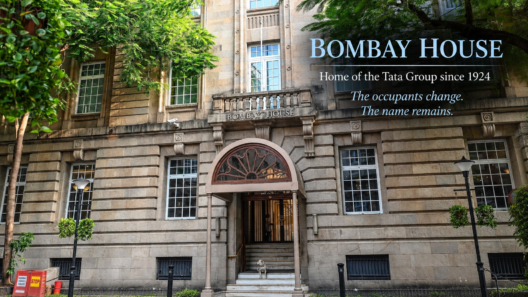
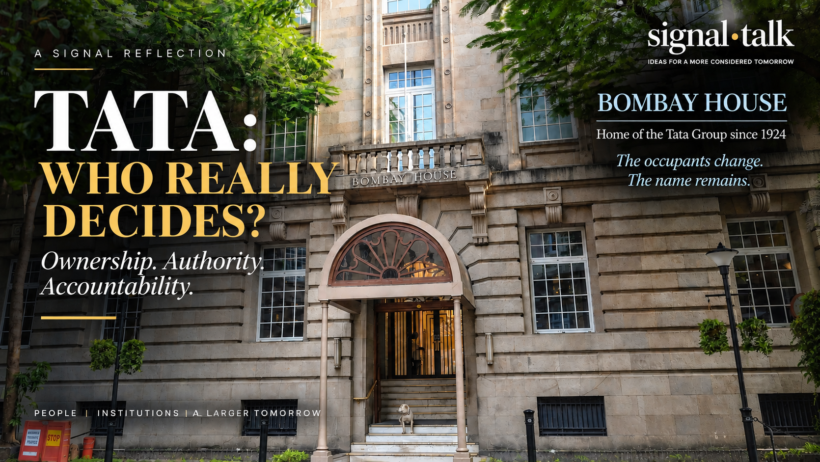
The occupants change. The decisions change. The name remains. But the social capital carried by that name must be earned, protected and replenished by every generation entrusted with it. For what has been built is truly rare and unparalleled.
Signal Reflection: SR 007.2/ TATA – Who really decides?
NV Subba Rao is the author of Uncle Sam 2.0 — a social media and systems-level exploration of power, media, and democracy in the algorithmic age. Uncle Sam 2.0 is more than a book about America. It offers a framework for understanding how modern societies hold, drift and attempt to recalibrate themselves in the age of algorithms.
Available on Amazon
Website: UncleSam2.com