



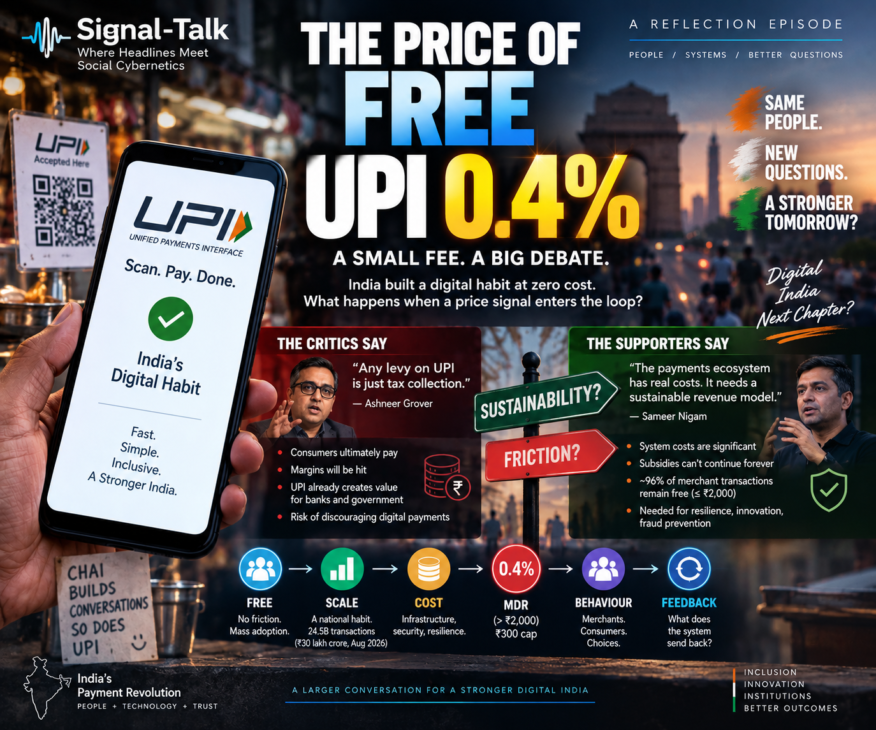

India built a digital habit at zero cost. UPI's 0.40% fee has triggered an argument about who pays. The more interesting question is what happens when a price signal enters India's largest digital habit.Signal Reflection – 006: For years, one of UPI’s most powerful propositions could be expressed in a single word: Free. It was a simple Scan -> Pay -> Go: No counting currency. No searching for change. No card machine. No visible transaction charge. From the neighborhood chai stall to supermarkets, taxis, hospitals and online commerce, the QR code became part of India’s everyday landscape. And somewhere along the way, UPI stopped being merely a payment technology. It became a behavior. That is why the latest change deserves attention beyond the immediate headlines. Ahead, from 15 October 2026, a MDR (Merchant Discount Rate) of 0.4% will apply to specified person-to-merchant (p-m) UPI transactions above ₹2,000, subject to a ₹300 cap on high-value transactions. Person-to-person (p-p) transfers remain free. Also, merchant transactions up to ₹2,000 remain free. Small merchants meeting the prescribed criteria are protected, and special categories receive lower rates. So, this is neither a blanket UPI charge nor, strictly speaking, a tax on every transaction. Yet the more interesting question may lie elsewhere: What happens when a system built around zero visible transaction cost introduces a price signal after the behavior has already become deeply embedded? This signal reflection episode examines that aspect.
17 Sept 2026 | SR-006 | NV Subba Rao | Read time: 9 minutes(Signal Reflections examines ideas, speeches, books and public moments that reveal deeper signals beneath the headlines.)
NV Subba Rao is the author of Quo Vadis? Uncle Sam 2.0 — a social media and systems-level exploration of power, media, and democracy in the algorithmic age.
Available on Amazon
Website: UncleSam2.com
SIGNAL OR NOISE?
The public argument is rapidly dividing into two narratives.From Payment Technology to Digital Infrastructure
Narrative 1: Someone has to pay.
UPI is no longer an experiment. At its present scale, banks, payment companies, fraud systems, cybersecurity infrastructure and dispute mechanisms cost real money. Why should taxpayers indefinitely subsidise an ecosystem that includes large commercial transactions and profitable private companies? This is essentially the sustainability argument being made by parts of the payments industry (Sameer Nigam, etc).
Narrative 2: We already pay.
Critics like Ashneer Grover, etc., counter that digital payments generate savings and economic value elsewhere: less cash handling, lower currency-management costs, greater formalization and transaction visibility, and benefits to banks and government. Grover goes further, stating UPI to be the only govt. success story in last 14 years, and argues that calling MDR a merchant charge does not settle who ultimately bears its economic incidence. He may well be very right …
Both contain signal. Both can also generate noise. And so, what are the elements of Signal and Noise and what’s the likely S-N-R (Signal to Noise Ratio)?
- S — SIGNAL: Running UPI at enormous scale has a real cost. Merchant margins also have a real cost.
- I — INTEGRITY: Who receives the 0.4%? How is it distributed? What additional investment in reliability, fraud prevention and infrastructure actually results?
- N — NOISE: “UPI is now chargeable” is misleading because most transactions remain outside the MDR. Equally, “consumers pay nothing” can obscure economic incidence if merchants eventually incorporate the cost into prices.
- D — DISTORTION: Calling MDR simply a “tax” may blur the distinction between government revenue and an ecosystem charge. But saying it has “no impact on consumers” could also overstate what can be known before merchant behaviour is observed.
- O — OPENNESS: Publish the data. Show MDR collections, distribution, system costs, fraud reduction, uptime, merchant behaviour and transaction migration. Then India can evaluate whether the intervention actually strengthened the ecosystem.
UPI’s numbers are extraordinary (and that’s still an understatement).
In August 2026 alone, the system processed roughly 24.5 billion transactions worth nearly ₹30 lakh crore (or ₹30 trillion/ $312.5 billion)
Now, numbers of that scale tell us something beyond adoption. They tell us that UPI has crossed an important threshold of usage and acceptance (~ 600 mm users). So, it is increasingly difficult to think of it simply as another payment product. For hundreds of millions of Indians, it has become part of the country’s everyday digital infrastructure. But infrastructure has a paradox, and we notice it most when it fails.
Twenty-four billion transactions cannot simply travel through an invisible, costless pipe. Behind every QR scan sits an ecosystem of banks, payment service providers, switching infrastructure, cybersecurity systems, fraud monitoring, dispute resolution, customer support and technology investment.
All of that cost’s money. Which creates the first feedback loop.
FREE → ADOPTION → SCALE → COST → SUSTAINABILITY
Free (Zero pricing) indeed helped accelerate adoption, and Adoption created extraordinary Scale.
Scale increased the importance, complexity and resilience requirements of the system. And eventually the question becomes unavoidable: Who pays to keep “free” running?
THE 0.40% QUESTION
Consider a simplified transaction.
A ₹10,000 purchase at an eligible merchant could attract an MDR of ₹40. At ₹50,000, that becomes ₹200. At higher transaction values, the ₹300 cap limits the charge. For an individual transaction, these numbers may appear modest. But then merchants rarely think in individual transactions.
They typically think in margins. So, the business operating at a 20% gross margin experiences ₹40 differently from one operating at 5%. And once millions of merchants begin making millions of individual decisions, a small price signal can produce surprisingly large behavioral consequences.
That is where this story becomes interesting.
WHO ACTUALLY PAYS?
Technically and officially, MDR is a merchant-side charge. That answers the accounting question only. It does not necessarily answer the economic one (as economics typically has an inconvenient habit of ignoring labels).
The merchants facing the additional transaction cost now have several choices.
- Absorb it.
- Raise prices.
- Offer a cash discount.
- Encourage another payment method.
- Restrict UPI for larger transactions.
- Or find some combination of these.
Ashneer Grover has become one of the more vocal critics of the change, arguing that the consumer ultimately bears such costs, and questions why UPI, after becoming central to India’s digital economy, needs this levy at all.
On the other side, PhonePe CEO Sameer Nigam argues that the payments ecosystem itself is losing money, that government subsidies cannot indefinitely finance a network operating at UPI’s enormous scale, and that a sustainable commercial model is necessary.
Both positions point toward a more useful question: The consumer may therefore never see a line on the bill saying: UPI fee: ₹40. And yet still bear some part of its economic cost, if not the full amount. This may not necessarily be what could happen, but it is very likely and precisely what needs watching.
Merchants forsaking their margins is unheard of In India (or in any part of the world), so the whole transaction is likely to be on cost+ terms to consumer or on alternative formats involving cash.
So, where does the 0.40% eventually travel?Because the relevant loop now becomes:
MDR → MERCHANT RESPONSE → CONSUMER RESPONSE → PAYMENT CHOICE → UPI ECONOMICS → POLICY RESPONSE
The 0.4% does not end the story. It starts another feedback loop.
THE ₹2,000 CLIFF
There is another interesting system feature hiding inside the policy, which is the ₹ 2000 threshold. So, ₹1,999 sits on one side, while ₹2,001 sits on another.
Economists have long understood that whenever policy creates thresholds, human behavior sometimes begins reorganizing itself around them.
- Will merchants absorb the difference without hesitation? Unlikely
- Will some encourage split transactions? Likely
- Will cash discounts reappear? Likely
- Could invoices mysteriously begin clustering below ₹2,000? Very likely
- Will consumers even notice? Sure, they will and if not, social media will ensure same in quick time.
- Or will UPI’s convenience prove so powerful that 0.4% produces almost no meaningful behavioral change?
We don’t exactly know, yet. And that may be the most important point. The policy only tells us where the charge begins. But, only behavior will tell us where the cost finally ends.
That distinction matters. Because the real incidence of a price is not determined only by regulation. It emerges from the bargaining power, margins, competition and choices of everyone inside the system.
THE CYBERNETICS OF ₹2,000
Seen through a social cybernetics’ lens, the government and NPCI have not merely changed a payment rule. They have introduced a new variable into a complex adaptive system.
The system will now respond: Merchants will respond to incentives -> Consumers will respond to merchants -> Payment companies will respond to consumers – > Banks will respond to transaction economics -> Competitors may respond with alternative propositions -> And policymakers may eventually respond to all of them, or simply ignore them all, as feedback loops are weak, non-existent, or it simply doesn’t matter to them.
In other words:
Policy changes behavior -> Behavior generates feedback- > Feedback changes policy (may or may not or run its course like farm laws etc.)
That is the loop worth observing.
The success or failure of the new MDR structure therefore cannot be judged simply by how much money it generates. A better dashboard might ask:
What happens to UPI transactions above ₹2,000?
- Does cash usage change?
- Do merchant acceptance patterns change?
- Does transaction splitting increase?
- Do digital-payment providers invest more in reliability and fraud prevention?
- Does the economics of the payment ecosystem become healthier?
- And, importantly, does consumer trust remain intact?
Those signals will likely tell us considerably more than the headline number.
SIGNAL REFLECTION
The 0.40% is a new signal entering the system: Supporters see sustainability. Critics see a tax by another name. Merchants see margin. Fintech’s see economics. Government sees a system that must eventually finance itself. And, consumers may still simply see the QR code they have become accustomed to scanning.
Who is right will not be decided by the loudest argument. It will be revealed by what happens next.
Do transactions above ₹2,000 decline? Does cash return? Do prices change? Does fraud fall? Does reliability improve? Does innovation accelerate? And does UPI continue its extraordinary growth?
In a feedback system, behavior is the answer. The 0.4% is simply the input.
Now lets watch the signal that comes back as October 15 implementation approaches, for UPI 0.4%: What Did the System Send Back?” follow-up episode.

There is a larger leadership question here too.
In Uncle Sam 2.0, I explore the widening gap that can emerge between institutions, policy and the people they are intended to serve. While the book examines this primarily through the American experience, the underlying systems question travels well beyond national borders.

India's UPI debate now offers a very different but useful lens.
A policy can be economically rational, technologically sound and institutionally well-intentioned, yet still produce unexpected outcomes if it does not sufficiently anticipate how people will perceive, interpret and respond to it. That is where policy fit becomes as important as policy intent.

The real test of the 0.4% MDR may therefore not be whether the arithmetic works on paper, but whether the policy fits the behavior of the ecosystem it seeks to sustain.

There is a behavioral economics dimension here too. Nobel Laureate Richard Thaler's work on Nudge reminds us that "seemingly small changes in the environment in which people make choices can alter behavior, often without anyone being compelled to change."

Which makes 0.4% rather more interesting than its size suggests.

For UPI, the question is not simply whether 0.4% is economically large or small. It is whether introducing it changes the choice architecture around a behavior that millions of Indians have already learned, repeated and turned into habit. At ₹1,999, nothing changes. Above ₹2,000, something does.

As Thaler and Sunstein put it, “The best way to help Humans improve their performance is to provide feedback.”

Perhaps policymakers should apply the same principle to policy itself. Pilot the intervention, watch the behavior, read the feedback, and be prepared to adjust.

Good policy asks: Does the arithmetic work? Good leadership must also ask: Will the system behave as we expect? And there is an uncomfortable question between the two: how much of the technology, economics and behavioral complexity behind such decisions do those making the final policy choices really understand?

In increasingly complex digital ecosystems, leadership cannot be expected to master every technical detail. But it must know which questions to ask, which voices to hear, and, importantly, how quickly to recognize when the feedback from the system differs from what was intended. That is where policy fit becomes as important as policy intent.

Leadership designs the intervention. People complete the feedback loop.
So, Leaders must Listen -> Adapt-> Lead
{S-N-R (Signal-to-Noise Ratio) survey based on SINDO framework is underway, and the scores of same will be published soon}.
Signal Reflection: SR 006/ The Price of Free – UPI Grows Up
NV Subba Rao is the author of Uncle Sam 2.0 — a social media and systems-level exploration of power, media, and democracy in the algorithmic age. Uncle Sam 2.0 is more than a book about America. It offers a framework for understanding how modern societies hold, drift and attempt to recalibrate themselves in the age of algorithms.
Available on Amazon
Website: UncleSam2.com