

Tata has been in the news rather a lot lately... and maybe not for the reasons it would prefer.
So, when a name becomes an institution, should those who lead it inherit it more than the businesses?
Signal Reflection – 007: Tata has been in the news a lot; for Leadership, Succession, Tata Sons, Tata Trusts, Boardroom differences and Listing. And now, N. Chandrasekaran’s reappointment by the Tata Sons board for another five-year term, even as Tata Trusts contests the validity of that decision. There will surely be plenty of analysis around the Articles of Association, shareholder rights, boardroom votes, regulatory requirements and the personalities involved. I cannot add much to that conversation.
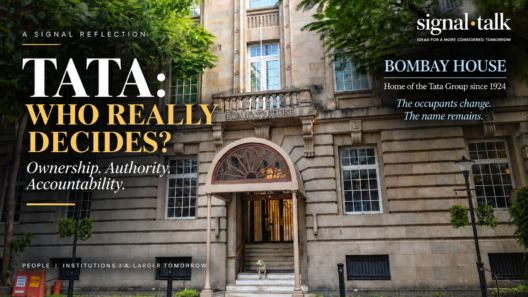
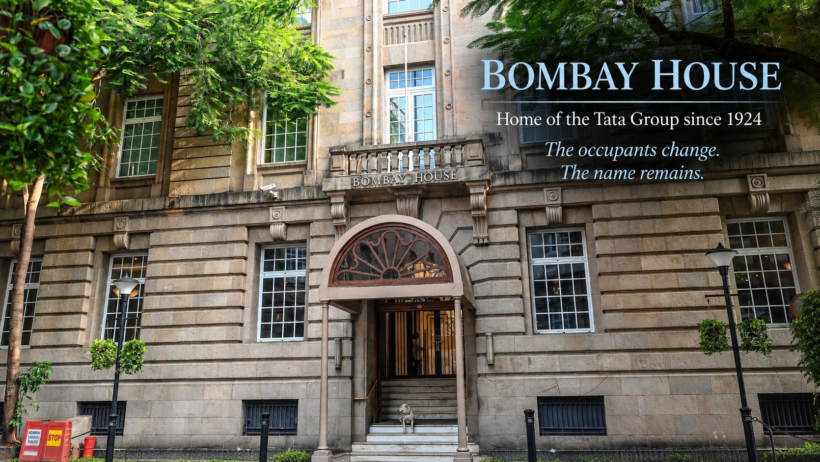
But the headlines have taken me back more than two decades, to my own relatively brief association with the Tata Group, and to a few visits to Bombay House that have somehow stayed in my memory.
21 Sept 2026 | SR-007 | NV Subba Rao | Read time: 7 minutes(Signal Reflections examines ideas, speeches, books and public moments that reveal deeper signals beneath the headlines.)
NV Subba Rao is the author of Quo Vadis? Uncle Sam 2.0 — a social media and systems-level exploration of power, media, and democracy in the algorithmic age.
Available on Amazon
Website: UncleSam2.com
MY FIRST INDIAN COMPANY
I joined Tata Teleservices in 2001 as General Manager, Marketing.
There was something personally significant about that move. This was my first professional stint with an Indian company, after having spent much of my earlier career working with multinational corporations. So, I arrived not just at a new company, but in some ways at a different corporate world.
And let me establish my vantage point clearly. At that stage, I was not sitting at the apex of the Tata system or privy to the deliberations of those who did. I was one among the many professional managers who at different points in their careers, had the privilege and responsibility of carrying the Tata name on their visiting card.
I visited Bombay House only a few times. Yet some images remain surprisingly vivid.
THE PORTRAITS AND THE TABLE
I remember entering the boardroom and noticing the large portraits of earlier generations of the Tata family looking solemnly down upon the room. And then there was the long boardroom table, large enough to bring together the senior leadership of several Tata companies. At the time, I likely saw it simply as an impressive corporate boardroom.
Looking back today, I see something else: The portraits represented inheritance and the table represented stewardship. Generations had built the name. Those seated around that table at any particular moment were its temporary custodians. Perhaps that is why the current headlines brought those images back to me. Because beneath today’s questions of leadership, succession, governance and ownership lies a much older question: What exactly is being handed from one generation of custodians to the next? The obvious answer is an extraordinary collection of businesses. But I suspect the more important inheritance is something that does not appear neatly on any balance sheet. The Tata name itself.
WHEN A NAME BECOMES MORE THAN A BRAND
Coming as I did from MNCs then this was something I gradually came to appreciate. Every large corporation has a brand. Many have formidable reputations. But Tata seemed to occupy a somewhat different space in India.
Mention that you worked for Tata, and somehow the name seemed to arrive before you did. I remember, for instance, how a Tata ID card would often elicit a subtle nod of recognition at airport security checks and elsewhere. Nothing dramatic, just a small gesture of familiarity and acceptance.
What exactly did the name convey? It was difficult to put a finger on it. Reliability perhaps. Respectability certainly. Or was it something simpler and deeper: trust?
Trust not merely in the businesses bearing the name, but in a certain expectation of how business ought to be conducted and how those carrying the name ought to behave?
Perhaps that was the real distinction. Tata was not simply a name one worked for. It was, in some small way, a name one was expected to live up to.
Were we always perfect embodiments of those ideals? Of course not. No institution employing hundreds of thousands of people across multiple businesses, countries and generations possibly could be. But the expectation was there. And expectations matter.
Perhaps what Tata had accumulated over more than a century was not merely brand equity, but something closer to social capital.
Robert Putnam, in his influential work on social capital (Bowling Alone), drew attention to the value embedded in networks, norms, reciprocity and, importantly, trust. The context was different, but the lens is an interesting one through which to view an institution such as Tata.
For trust is a rare and peculiar corporate asset. It cannot simply be bought. It cannot be advertised into existence. It cannot be transferred by a board resolution. It accumulates slowly through behavior, institutions, employees, customers and thousands of decisions repeated across generations.
In that sense, Tata inherited more than financial capital, physical assets or brand equity. It inherited social capital.
And inherited trust comes with an unusual liability: The greater the trust, the greater the expectation.
AND THAT BRINGS US TO TODAY
The current Tata story is still unfolding.
The Tata Sons board has backed N. Chandrasekaran for another term. Tata Trusts, the majority shareholder of Tata Sons, has challenged the validity of that decision. There are also differences around the possible listing of Tata Sons and, behind these immediate questions, larger issues of governance, ownership and institutional authority.
I have neither the information nor the inclination to adjudicate who is right. Perhaps that is not the most interesting question anyway. And, disagreement itself is not evidence of institutional failure.
Boards are supposed to debate. Shareholders are entitled to protect their rights. Trustees have fiduciary responsibilities. Management must make difficult operating and capital-allocation choices. Any strong institution should be capable of accommodating such disagreements. And TATAs in future could well view this as a storm in their teacup.
The more interesting signal is: Can the disagreement remain smaller than the institution? Because when internal differences become the public story, employees, investors, partners, customers and eventually society begin asking questions that extend beyond the immediate dispute.
- What does this tell us about the institution?
- What does it tell us about its governance?
And, eventually:
Does the name still mean what we thought it meant?
WHO OWNS TATA?
That raises an even more intriguing question. Who owns TATA?
Legally, there are answers involving shareholding, trusts, companies, Articles of Association and governance structures. But socially and institutionally, the answer is more complicated.
After more than 150 years, perhaps part of the Tata name resides somewhere no shareholder register can completely capture: In public memory. Generations of employees have carried it, customers have trusted it, and investors have placed capital behind it.
Then there are communities that have encountered it through philanthropy and institutions. And successive leaders have inherited the responsibility of adding to, or potentially subtracting from, that accumulated reservoir of trust.
That makes leadership of an institution like Tata fundamentally different from leadership of an ordinary corporation. The people occupying its boardrooms do not inherit a blank sheet of paper. They inherit history.
WHEN ICONS LEAVE, INSTITUTIONS ARE TESTED
Jamsetji Tata gave the enterprise its founding imagination. J.R.D. Tata came to embody another era. Ratan Tata became, for a generation of Indians, almost inseparable from the values associated with the group.
But perhaps the ultimate test of an institution arrives precisely when there is no single towering personality around whom its identity can comfortably coalesce. That is when governance matters most. That is when institutional memory matters. And that is when the difference between personality and institution becomes visible. A great institution cannot depend indefinitely upon a great individual. Its values must eventually reside in its systems, culture, governance and collective behavior.
Otherwise, they were never truly institutionalised.
BACK TO THAT TABLE
More than two decades later, I find myself thinking again about that long table at Bombay House. And about those portraits looking down upon it. The people sitting around the table will inevitably change. The portraits themselves remind us that they always have.
Perhaps the responsibility of each generation occupying those chairs is therefore not to preserve everything exactly as it was. For institutions must change, businesses must adapt, and governance structures too need to evolve.
The responsibility is more difficult: to change what must change without losing what must not. Companies inherit assets, families inherit wealth, and boards inherit responsibilities. But institutions such as Tata inherit something considerably more fragile: a name whose meaning was built by generations they can no longer consult. Which is likely why, beneath all the current noise around appointments, listings, votes and boardrooms, I find myself returning to a much simpler question.
Not: Who inherits Tata?
But: What will the next generation inherit when it hears the name TATA?
Perhaps the responsibility of today’s custodians is not merely to preserve the businesses they inherited, but to ensure that the extraordinary social capital accumulated around the name is passed on undiminished.
For businesses can be rebuilt, capital can be raised, but social capital built over generations is far harder to replace once diminished.
The Signal Reflection

Institutions are feedback systems too.

Name → Trust → Expectation → Behavior → Reputation → Trust: Repeated over time, that loop can create something rare: Social Capital.

Legacy creates expectations. Leadership produces behavior. Behavior, in turn, builds, reinforces or draws down trust.

Tata has accumulated extraordinary social capital over generations. Few Organizations around the world can lay claim to that. The challenge for each generation of custodians is not merely to inherit it, but to replenish it. The occupants change as the name remains. But trust must be earned again by every generation that inherits it.

And as Tata Sons confronts perhaps one of the most consequential questions in its history, to list or not to list, perhaps the question is larger than valuation, liquidity or ownership?

Would listing simply change Tata Sons capital structure, or would it subtly alter the balance between shareholder value, stakeholder stewardship and philanthropy that has long distinguished the House of Tata?
{S-N-R (Signal-to-Noise Ratio) survey based on SINDO framework is underway, and the scores of same will be published soon}.
Signal Reflection: SR 007/ TATA – What does the name stand for?
NV Subba Rao is the author of Uncle Sam 2.0 — a social media and systems-level exploration of power, media, and democracy in the algorithmic age. Uncle Sam 2.0 is more than a book about America. It offers a framework for understanding how modern societies hold, drift and attempt to recalibrate themselves in the age of algorithms.
Available on Amazon
Website: UncleSam2.com