


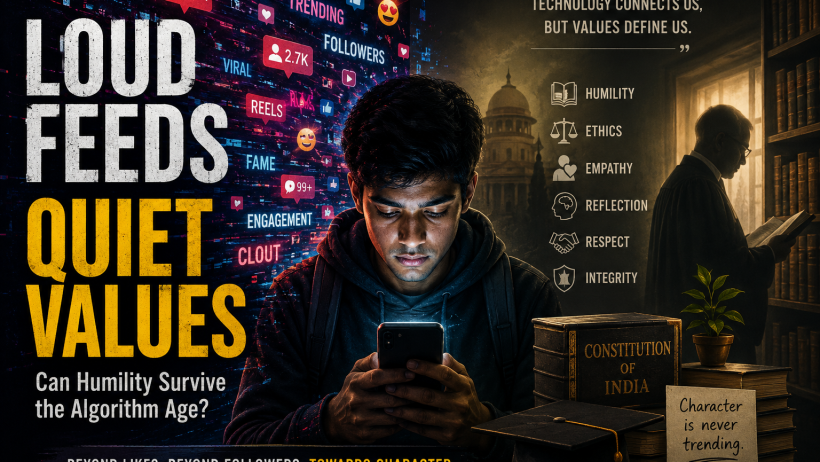

Can Humility Survive the Algorithm Age?
Signal-Talk Analysis · India’s Chief Justice, Surya Kant, recently urged students to remain humble, grounded, and ethically anchored in an evolving digital era. He could easily have spoken about startups, AI, innovation, careers, or India’s technological rise. Instead, he chose to speak about ethics, compassion, humility, and constitutional values. On the surface, it sounds like a familiar message from an elder statesman to the next generation. But from a systems perspective, the remarks point toward something deeper. Because the concern may no longer be merely about technology itself — but about what digital systems and AI/ social media platforms are quietly doing to human behavior, public discourse, and societal norms as algorithms continuously feed, amplify, reward, and loop attention at scale.
While the remarks were addressed to Indian students, the underlying concern is increasingly global. Across the world, young people are growing up inside algorithm-driven ecosystems that shape attention, aspiration, identity, and behavior. The real challenge may no longer be technological. It may be cultural and, or behavioral.
For in a world where algorithms shape attention, attention shapes behavior, and behavior shapes society, an important question emerges: Can humility, ethics, empathy, and reflection still survive in an age optimized for visibility, virality, and outrage? That’s the signal being read in this episode; 24 May 2026; ST-034 / NV Subba Rao (read time: 11 mins).
NV Subba Rao is the author of Quo Vadis? Uncle Sam 2.0 — a social media and systems-level exploration of power, media, and democracy in the algorithmic age.
Available on Amazon
Website: UncleSam2.com
LOUD FEEDS, QUIET VALUES…
India’s Chief Justice, Surya Kant recently emphasized the importance of constitutional values, ethical conduct, integrity, and compassion in today’s rapidly evolving technological world. At first glance, it sounds like a conventional convocation speech. But beneath it seems to lie a much deeper ‘systems’ warning to today’s AI/ digital era students.
Today’s students are not merely growing up with technology. They are growing up inside algorithmic societies — run by digital platforms. And this signals a deeper anxiety about identity formation, emotional conditioning, and the long-term social effects of attention-driven digital culture.
The algos appear optimized to a framework of Social Cybernetics Synthesis – derived from multiple theories of persuasive technology, social learning theory, social connectedness theory, and surveillance capitalism research via a framed path:
algorithms → attention → behavior → society
(Wiener, Fogg, Bandura, Zuboff, Subbarao et al).
Today, more young people are growing up inside algorithms than ever before. Algorithms that not only know you but increasingly begin to shape you and even “become you“.
The real battle, therefore, may no longer be technological, but behavioral, as social media platforms quietly mediate and moderate human conduct.
It converts the argument from:
“social media may be influencing youth”
to
“Hundreds of millions are spending hours daily inside algorithmic ecosystems.”
The platforms powered by algorithms do not merely distribute information. They subtly condition behavior, status, aspiration, and even social values.
Consequently, humility rarely trends, and reflections rarely go viral, if ever.
India’s next generation too is growing up in a world where algorithms reward visibility more than wisdom, reaction more than reflection, and performance more than character. The concern is no longer simply what young people consume online. It’s what digital systems are gradually teaching society to admire.
So, in a platform world rewarding visibility, virality, and outrage, can humility, ethics, and empathy still survive?
From a systems perspective, this increasingly appears to be a clash between:
- traditional values vs algorithmic culture
- reflection vs stimulation
- human character vs digital validation
- education vs the attention economy
On balance, the resulting signal is subtle but important: societies shaped increasingly by algorithmic validation may still appear technologically advanced, hyperconnected, and globally aspiration— while simultaneously experiencing a widening ethical, emotional, and psychological divergence between visibility and values.
India may still be digitally accelerating. But the system also appears to be quietly recalibrating behavior itself — as humility, ethics, restraint, and reflection suddenly re-enter institutional discourse in response to an increasingly performative attention economy.
Prompting a deeper question:
What happens to a society when humility becomes invisible in the algorithm economy?
Because when platforms begin shaping not just attention, but aspiration itself, the issue is no longer technological disruption.
It becomes a civilizational signal.
Context – Growing Up Inside Algorithms
- The Scale of the Algorithmic Environment
| Metric | India | Global |
| Internet users | ~ 1.03 billion | ~7 billion |
| Social media users | ~ 500 million | ~ 5.5 billion |
| Avg daily social media usage (hrs/ day) | ~ 3.2 | ~ 2.3 |
| Gen Z usage (hrs/ day) – Heavy usage (hrs/ day) | ~ 5.0 ~ 8.5+ | ~ 2.8 ~ 5+ |
| Most used platforms | WhatsApp, YouTube, Instagram, Facebook/ meta | YouTube, WhatsApp, ,Instagram |
2. India Platform Reach (2025)
| Platform | Users (million) ~ approx. |
| You Tube | 500 |
| 481 | |
| Facebook/ meta | 403 |
| 505 | |
| Snapchat | 213 |
| 170 |
3. Daily Social Media Usage Patterns (Global)
| Daily Usage (hrs) | Approx. share of users (%) | Gen Z & Young Adults# |
| < 1 | 10-15 | Significant minority |
| 1-3 | 35-40 | Dominant |
| 3-5 | 20-25 | Very Common |
| 5-10 | 15-20 | Significant minority |
| +10 | 2-5 | Common among heavy users |
Average global usage: ~2 hours 20 minutes/day
# Indian users engage across an average of 7–8 platforms per month, creating one of the world’s largest algorithmically mediated attention environments. India user and usage patterns are estimated to be ~ 20% higher than global usage patterns. Many studies show global Gen Z users often spend 4–6+ hours daily across social media, messaging, video, gaming, and content platforms combined.
Sources: DataReportal 2025, Digital 2025: India, Reuters 2026, Kepios.
4. Putting it in Perspective
| Daily Usage (hrs/ day) | Equivalent / Year (hrs) |
| 2 | 730 |
| 4 | 1460 |
| 6 | 2190 |
| 8 | 2920 |
| 10 | 3650 # |
# 3,650 hours/ year = more than 150 full days.
These numbers are not merely technology statistics. They represent one of the largest social and behavioral environments ever created in human history.
5. The Scale of the Attention Economy
If a young person spends 5 hours a day on algorithmically curated platforms, that amounts to nearly 1,800 hours a year.
For comparison:
- A full-time employee works ~2,000 hours annually.
- A typical 2-3 credit university course involves ~30-45 hours of instruction.
- A typical 4-year engineering degree involves roughly 2,500–3,000 classroom instruction hours over the entire program | A 2-year MBA typically involves 900–1,200 classroom hours | A 3-year law degree often comprises 1,200–1,500 classroom hours.
- In other words, a young person spending 5 hours a day on social media accumulates more attention-hours in a single year than an MBA, Law or 3year degree student typically receives in formal classroom instruction over their entire degree.
- At 8 hours a day, annual exposure approaches 3,000 hours, equivalent to the classroom instruction of an entire engineering degree
In effect, social media platforms have become one of the largest educators, entertainers, influencers, and behavioral conditioning systems in modern society.
Which is perhaps why the remarks about humility, ethics, empathy, and conduct from institutional leaders deserve closer attention.
They may also be in direct response to one of the most powerful social systems ever created.

SIGNAL
What actually matters?

NOISE
What distracts and distorts?
1. Concern that rapid digital immersion may weaken ethical anchors among young people.
2. Recognition that social media shapes identity formation far beyond entertainment.
3. Institutional voices beginning to acknowledge algorithmic influence on behavior.
4. Growing need for emotional resilience, humility, and civic maturity in AI-driven societies.
5. Reminder that education is not merely skill acquisition — but character formation.
1. Social media ecosystems rewarding outrage, vanity metrics, and performative lifestyles.
2. “Success signaling” replacing substance: followers becoming proxies for self-worth.
3. Short-form dopamine culture shrinking patience for nuance and deep thinking.
4. Echo chambers amplifying tribal identity over empathy and dialogue.
5. Ethical conversations dismissed as “old school” while algorithmic addiction normalizes itself.

SYSTEM LENS The deeper structural view
In cybernetic systems, institutional warnings often emerge only after behavioral shifts become visible beneath the surface. Because societies increasingly shaped by algorithms do not merely change how people communicate — they gradually reshape what people admire, reward, imitate, aspire toward, and seek to become.
The Digital Economy Monetizes Attention:
Many recent viral phenomena across social platforms further illustrate how algorithmic systems increasingly reward emotional provocation, ridicule, tribal signaling, and performative aggression over nuance or reflection.
The rapid rise of labels, memes, and identity-driven digital tribes — including episodes such as the “Cockroach Janata Party” phenomenon garnering millions of followers within days — may appear humorous or satirical on the surface. But from a systems perspective, they also reveal how virality itself can normalize dehumanizing language, emotional polarization, and spectacle-driven discourse at scale.
Because algorithms do not necessarily reward what is ethical, reflective, or socially constructive. They reward what captures attention. And increasingly, outrage captures attention faster than empathy.
So, the algos trigger the feeds first and the identity formation follows soon enough.
The Social Cybernetics Feedback Loop
Algorithmic Amplification
↓
Validation Seeking
↓
Performative Identity
↓
Reduced Reflection
↓
Polarization / Anxiety / Comparison
↓
More Platform Dependence
↓
More Algorithmic Control
Attention rewards visibility
↓
Visibility rewards extremity
↓
Extremity gradually reshapes identity.
↓
Identity then feeds politics, culture, aspiration, and even morality
↓
Polarization / Anxiety / Comparison
↓
Over time, the platform stops being merely a tool
↓
It becomes a behavioral operating system (BOS)
And once platforms become the BOS, they not only know you, but they also shape you — to become you. The real issue then is:
That ‘feeds’ are increasingly shaping identity, and they just keep coming-24×7. In earlier generations though the ‘institutions’ shaped the character- 24×7

SIGNAL – NOISE – RATIO (SNR)
Editorial Score: 7.8/ 10
SNR scores are on scale of 1-10 (1; System depleting – CJI’s message has no relevance, and 10; System forming CJI’s message has high (total) relevance)
1 = Moral panic / technological determinism. The CJI’s remarks are viewed largely as symbolic or generational concern, with little relevance to the broader impact of digital platforms on behavior, identity, or society.
10 = Strong societal signal. The CJI’s remarks are interpreted as an early warning about the behavioral, ethical, and cultural effects of algorithm-driven ecosystems, highlighting the need for stronger guardrails around attention, discourse, and social norms.
Interpretation:
At an SNR of 7.8, this emerges as a strong signal — suggesting the CJI’s remarks reflect more than a ceremonial or symbolic appeal. His emphasis on constitutional values, ethical conduct, integrity, humility, and compassion in today’s rapidly evolving technological environment points toward a deeper institutional concern around the behavioral and ethical effects of an increasingly algorithm-driven social order.
The signal becomes even more significant when viewed alongside the recent backlash surrounding remarks comparing individuals to “cockroaches” and the broader normalization of aggressive, hyper-emotive public rhetoric. From a systems perspective, the concern may no longer be about isolated words alone — but about how repeated exposure to dehumanizing language, performative aggression, and virality-driven discourse gradually reshapes social behavior, public culture, and the ethical boundaries of what younger generations begin to perceive as acceptable, or even ideal.
The resulting signal suggests a growing need for humility, ethical conduct, integrity, and compassion, regardless of how powerful public figures, influencers, or institutions may speak or behave in their pursuit of visibility, virality, or political theater(s). Because in an algorithm-driven world, repeated exposure eventually normalizes behavior. And when outrage, humiliation, and aggression become performative currency, the real danger is no longer merely that algorithms begin to know you — but that, over time, the algorithms begin to become you, and society itself slowly begins to behave like the algorithm.
CAST YOUR VOTE
Comparative Signal-to-Noise (SNR) Scores
How different actors frame the same issue—measured using the same Signal-to-Noise logic.
Editorial (Signal-Talk)
7.8
Strong Signal: Alert and a warning of societal distress in digital age
Student survey score Studying any degree (base= 74))
4.4
Gen AI-5 (LLM ‘s synthesis – Avg. score) #
8.1
# Gen AI-5 is average score of 5 LLM’s (Chat Gpt 8.3, Grok 8.6, Perplexity 7.7, Gemini 8.0, Claude 7.9)
Reader’s Pulse (Poll)
[weighted_SNR_score id=”2810″]
# Methodology Note: Reader Pulse and Gen AI-5 scores are independent inputs. Reader Pulse captures public sentiment, while Gen AI-5 reflects a synthesized assessment from five leading AI models using the Signal-Talk EQ Path framework. Together, they provide a comparative view of human and machine interpretation of the same signal. Full methodology: EQ Path Model.
Signal-Talk Insight: Every episode compares three lenses: Editorial View, Reader Pulse, and Gen AI-5. Divergences between the three are often signals in themselves.
CAST YOUR VOTE - Please take the poll below
* Poll scores are dynamic- changes with responses. (P
Ater reading this episode of Signal-Talk, What’s your view of the CJI’s Remarks to Students?
Cast your vote and see how your score compares with Community and Gen AI scores.
Rate the signal, not the sentiment (Your rating and email are kept confidential and not shared with anyone)
Your take: Is society merely adapting to technology — or are algorithms quietly reshaping human behavior itself?
[totalpoll id=”2810″]
[weighted_SNR_score id=”2810″]
System Response: How should the system respond?
The overt response cannot simply be “use social media less.” The challenge is now systemic, not individual.
Because today’s digital ecosystems are shaping attention, identity, aspiration, and behavior at population scale. Especially among younger generations growing up inside algorithmic environments.
The need, therefore, is not to reject technology, but to build stronger ethical, educational, and regulatory counterweights around it.
That may require:
- embedding digital ethics, media literacy, and emotional resilience into education systems,
- encouraging deeper reading, reflection, debate, and civic dialogue beyond short-form stimulation,
- strengthening family, community, and institutional anchors that cultivate empathy and humility,
- and creating social environments where character, competence, and contribution matter more than performative visibility.
But increasingly, regulation too may need to evolve beyond privacy and data protection alone. Possibly towards behavioral transparency and user agency.
Much like public health systems eventually acknowledged the long-term risks of tobacco consumption through warning labels, awareness campaigns, and usage restrictions, societies may eventually need more explicit acknowledgment of the psychological and behavioral effects of algorithm-driven digital environments.
That could include:
- clearer disclosures around addictive engagement design,
- optional “attention dashboards” showing time spent and behavioral patterns,
- user-controlled feed settings limiting content intensity or notification frequency,
- voluntary filters allowing users to cap exposure by time, volume, or emotional category,
- and easier opt-in/opt-out mechanisms that return greater control to the individual rather than the algorithm.
From a systems perspective, societies eventually become what they repeatedly reward.
If algorithms continuously reward outrage, vanity, tribalism, and instant validation, those behaviors gradually normalize socially. But if institutions, educators, regulators, families, and platforms consciously reinforce reflection, empathy, humility, and ethical conduct, different feedback loops can emerge.
The real challenge of the AI and social media era may therefore not be technological advancement alone, but preserving human depth, autonomy, and character inside increasingly optimized digital systems.
And finally, in algorithmic societies, leadership signaling matters more than ever. Because young minds do not merely consume content, they absorb cues.
They watch how public figures speak, argue, behave, reward loyalty, treat dissent, prep jokes, display apathy or empathy, or normalize aggression. Over time, repeated exposure quietly shifts the boundaries of what society begins to accept as “normal.”
Perhaps this is also what underlies the concern voiced by India’s Chief Justice, Surya Kant, when he cautioned against the coarsening of public discourse and referred to dehumanizing expressions entering mainstream rhetoric.
Whether it is phrases invoking enemies as “cockroaches,” or muscular slogans such as “ghar mein ghuss ke marenge | Will break into your house and bash you,” the deeper systems issue is not merely political language itself, but how repeated normalization of hostility, humiliation, and performative aggression gradually conditions social behavior, especially among younger and more impressionable audiences.
In the digital age, leaders, influencers, celebrities, creators, and institutions are no longer just communicators. They are behavioral reference points inside the social feedback loop.
Because in the algorithm economy, words travel faster, amplify wider, and persist longer than ever before.
Which is why “Words matter. Actions matter.” And the words and actions of leaders, influencers, creators, and institutions matter even more now.
For in a virality-driven ecosystem, public language does not merely shape opinion — it quietly shapes culture, behavior, and eventually, the social norm itself.
And the algos help program it – 24×7, whence social media tends to become social contagion

Signal-Talk Take / Behind the Signal: Editorial interpretation based on system behavior, not sentiment
Historically, civilizations have depended on a simple triad: humility, reflection, and ethics. These have been the foundations of peace, progress, and prosperity.
In today’s platform-driven world, however, this trio appears to command far less relevance. Humility does not trend. Reflection seldom goes viral. Ethics rarely optimize engagement. Because in the algorithm economy, human focus is no longer merely being captured. It is being conditioned.
The real risk is not that young people use social media. The real risk is that platforms quietly begin to redefine what society admires, rewards, and ultimately seeks to emulate – and so monetize attention.
The challenge before India — and much of the world — is no longer simply digital literacy. It is algorithmic maturity.
No society or leader can thus sustain trust, when attention and visibility become more important than basic values (- as the algos keep feeding and prioritizing attention and visibility 24 x 7). And that is likely true of even mature and technologically advanced democracies.
Consequently, this increasingly requires users to become more consciously aware of not just what they consume online, but also how much they consume, how platforms shape their emotional states, and how repeated exposure gradually influences behavior, attention spans, identity, and even social values. And so, regulators, governments, educators, platforms, and societies may eventually need to move beyond viewing social media merely as a communication tool. They must begin to recognize it as a behavioral environment with deep psychological and cultural effects.
Much as public health systems eventually acknowledged the risks of tobacco through warning labels, awareness campaigns, and usage restrictions, the algorithm age could also require its own set of digital guardrails.
That could include:
- greater transparency around engagement algorithms and recommendation systems,
- stronger user controls over feeds, notifications, and content intensity,
- easy opt-in and opt-out settings for algorithmic personalization,
- mandatory “attention dashboards” showing daily and weekly consumption patterns,
- user-selectable limits (10, 20, 30, or 60 minutes) with visible interruption prompts,
- periodic wellness alerts after prolonged scrolling sessions,
- age-specific protections for adolescents and young users,
- independent audits of behavioral and mental-health impacts,
- and public awareness campaigns on the long-term effects of compulsive platform exposure.
Imagine if, after 30 minutes of continuous scrolling, a platform displayed a full-screen prompt:
- Extended social media consumption may affect attention, mood, sleep, and well-being. Consider taking a break.
Or if users were required to consciously choose their preferred daily attention limits when setting up an account, much like privacy settings today.
These interventions may sound intrusive today. But so once did seat belts, speed governors, tobacco warnings, and drink-driving regulations.
From a systems perspective, the question is not whether algorithms influence behavior. That is already evident.
From Orlowski’s The Social Dilemma to B. J. Fogg’s work on persuasive technologies, to Shoshana Zuboff’s concept of surveillance capitalism, to Jonathan Haidt’s warnings on the psychological effects of smartphone culture, to Twenge’s work on iGen: youth behavior and mental health, the signal has become increasingly difficult to ignore: Excessive social media usage causes anxiety, compulsive behavior, polarization, and reduced attention spans.
The findings are also broadly consistent with our own research on social media usage behavior and social connectedness, which found that emotional gratification, self-image, belongingness, and perceived enjoyment significantly influence engagement and platform usage behavior among users (Subbarao et al., 2023, 24)
The algorithms do not merely distribute information, they influence behavior.
In cybernetics speak: Users are not merely consuming information; they are responding to a network of social, emotional, and behavioral feedback signals, as targeted by algorithms.
The debate is no longer whether algorithms influence behavior and society. That signal has already been well established.
The question now is whether societies can build the guardrails and regulatory frameworks needed to influence the algorithms back, ensuring that humans remain in control of their attention rather than attention becoming the product being optimized by algorithms.
Signal Note: In 1971, psychologist Philip Zimbardo (Stanford University) demonstrated how environments can shape behavior. Half a century later, social media platforms have arguably become the largest behavioral environments ever created.
The next great legal and regulatory challenge may not be protecting data. It may be protecting attention, for attention shapes behavior, behavior shapes culture, and culture shapes society.
Axiom: A society cannot sustain trust if attention and visibility become more important than values
Signal-Talk: Making sense of what really matters
One Signal at a Time
Signal-Talk Analysis: ST 034/ CJI message: Loud Feeds – Quiet Values.
NV Subba Rao is the author of Uncle Sam 2.0 — a social media and systems-level exploration of power, media, and democracy in the algorithmic age.
Available on Amazon
Website: UncleSam2.com