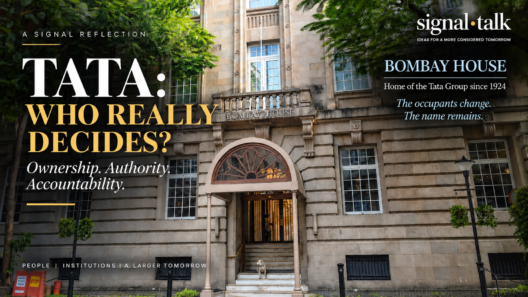



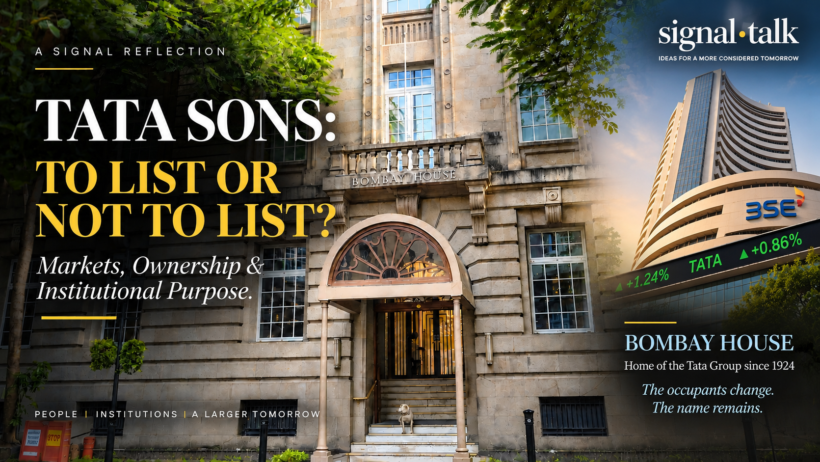

Tata Sons continues to be in the news... Leadership, Succession, Tata Sons, Tata Trusts, Boardroom differences, Ownership, Litigations, Resignations, Governance, and more.
And now, the question of listing. The first two Tata Reflections explored the "Name - What does the name stand for?" and the "Decision - Who really decides?" This third reflection turns to what comes next with the "listing issue - How it affects markets, ownership and the institutional purpose." For listing is simply not about shares becoming tradable alone. It raises questions galore about ownership, liquidity, valuation, transparency, governance and, for TATA TRUST most importantly, it's institutional purpose.
Signal Reflection – 007.3: Tata Sons is not an ordinary holding company. It sits at the center of one of India’s largest business groups, owns significant stakes in some of its most valuable listed companies, controls a portfolio of major unlisted businesses, and is itself approximately 66% owned by Tata Trusts.
For years, Tata Sons has remained privately held and has avowed that they would like to remain so. That status is now under serious pressure following the Reserve Bank of India’s rejection of its application to surrender its registration as a Core Investment Company. Tata Trusts has argued that listing is not the only available route and has proposed a restructuring that could potentially allow Tata Sons to retain its unlisted status. Consequently, the debate is no longer simply about whether Tata Sons should conduct an IPO. It is about something much larger: What happens to the Tata model when the institution at its center acquires a public-market price? Would listing bring transparency, liquidity, price discovery and market discipline? Or would it introduce pressures that gradually alter the balance between shareholder returns, long-term stewardship and philanthropy? And perhaps there is an even more fundamental question: Is listing the issue, or has it become the arena in which deeper questions of ownership, authority and institutional purpose are being contested?
3 Nov 2026 | SR-007.3 | NV Subba Rao | Read time: 20 minutes
(Signal Reflections examines ideas, speeches, books and public moments that reveal deeper signals beneath the headlines.)
NV Subba Rao is the author of Quo Vadis? Uncle Sam 2.0 — a social media and systems-level exploration of power, media, and democracy in the algorithmic age.
Available on Amazon
Website: UncleSam2.com
FROM THE NAME TO THE MARKET
In the first reflection, I asked what the name TATA stands for. That led to trust, legacy and the extraordinary social capital accumulated around the name over generations.
The second reflection asked a more complicated question: Who really decides when ownership, authority and accountability do not necessarily point in the same direction?
The more I looked, the less straightforward the answer appeared. The paradox being, Tata Trusts, which owns approximately 66% of Tata Sons, finds itself at odds with the position reportedly taken by the Tata Sons Chairman and sections of its board. More intriguingly, the divergence appears to extend to directors nominated by the Trusts themselves, raising questions about the relationship between shareholder representation, board independence and fiduciary responsibility.
How does a controlling shareholder find itself at odds with a board on which its own nominees serve? And when those nominees exercise independent judgment, where does representation end and fiduciary responsibility begin?
These are not merely questions about personalities or boardroom disagreements. They go to the heart of how ownership, authority and accountability are meant to work together.
And now, with the question of listing, another dimension enters the equation: the market itself, prompting the third question: What happens when the institution at the center of the Tata Group itself becomes subject to the expectations, disciplines and judgments of the public market? Apropos, associated with this is the larger question: Should Tata Sons list, or should it remain privately held?
The more one examines the structure, the regulatory context and the recent developments, the less this resembles a conventional IPO decision. Because Tata Sons is not merely another company contemplating a listing. It is the institution through which much of the House of Tata is held together.
And that makes the question considerably more consequential.
FIRST, LET’S CONSIDER WHAT IS BEING LISTED
An ordinary company contemplating an IPO might ask how much capital it needs, what valuation investors might assign, and whether public ownership would help finance its next stage of growth.
Tata Sons however presents a different proposition. It is simultaneously a holding company, as a significant investor in listed businesses, an owner and incubator of unlisted enterprises, and an institutional link between commercial activity and philanthropic ownership.
Tata Trusts holds approximately two-thirds of Tata Sons. The Shapoorji Pallonji Group owns approximately 18.4%, with the remaining shares held by other shareholders. So, while the scale of the underlying businesses is enormous, the value of Tata Sons is not simply the arithmetic sum of the market capitalizations of the companies in which it holds stakes. There are questions of ownership percentages, holding-company discounts, taxation, liquidity, control, unlisted investments and future capital commitments.
And there is another complication. Much of the Tata Group is already publicly listed. Investors can buy shares in Tata Consultancy Services, Tata Motors, Tata Steel, Titan and several other Tata companies. What is not publicly traded however is the institution that sits above much of this architecture.
So, the proposed listing is not about introducing the Tata Group to the stock market. It is more likely about introducing the market into Tata Sons itself. And that is a completely different proposition.
HOW DID LISTING BECOME A REGULATORY QUESTION?
The immediate trigger is regulatory. Tata Sons falls within the Reserve Bank of India’s framework governing Core Investment Companies and non-banking financial companies classified in the Upper Layer. The rationale for this framework extends beyond the individual balance sheet of an institution. The core argument being large financial entities, including investment companies with complex group relationships, could create risks that extend across businesses, lenders and the wider financial system.
In March 2024, Tata Sons applied to surrender its CIC (core investment company) registration. In September 2026, the RBI rejected that application. The consequence was significant. Tata Sons could no longer proceed on the assumption that surrendering its registration would resolve the listing question.
But an important distinction needs to be preserved. The RBI’s regulatory requirements and the Tata Trusts’ interpretation of the available compliance options are not the same thing. The Trusts have argued that the RBI’s earlier (September) communication did not prescribe listing as the only possible course of action. The regulatory framework nevertheless places listing obligations on Upper Layer NBFCs, and the RBI Governor has subsequently reiterated the importance of compliance with those requirements.
The issue, therefore, is not simply whether the regulator has used the word listing in a particular communication. It is whether Tata Sons can lawfully alter its structure or regulatory classification in a manner that satisfies the RBI.
And that brings us to the alternative now being proposed.
THE ALTERNATIVE: CHANGE THE COMPANY, NOT ITS OWNERSHIP
On September 28, Tata Trusts proposed a strategic reorganization of Tata Sons. The proposal involves merging Tata Electronics Systems Solutions and Tata Consulting Engineers into Tata Sons.
The underlying logic is to change the nature and composition of Tata Sons’ activities so that the reorganized entity would, according to the Trusts, no longer qualify as an NBFC or CIC. In other words, rather than list Tata Sons in response to its existing regulatory classification, change the structure of Tata Sons so that the classification may no longer apply.
It is indeed an interesting proposition. Historically, Tata Sons has not always been exclusively a holding company. The Trusts argue that operating businesses have long been part of its institutional evolution. But the proposal raises several questions.
(i) Would the proposed combination genuinely alter the company’s economic character, or primarily its regulatory classification? (ii) What would be the consequences for the operating businesses being merged? (iii) How would governance, capital allocation and risk management change? (iv) and, above all would the RBI accept the resulting structure? For the restructuring is still a proposal, and not an accomplished solution, that will require appropriate corporate and regulatory approvals too.
The distinction matters because regulatory compliance should be assessed by substance, not merely by the form of a corporate structure.
There is also the larger systems question. If an institution changes its structure primarily to avoid a particular regulatory consequence, does the resulting structure strengthen the institution in its own right? Or does it solve one problem by introducing several others? That question deserves examination regardless of whether one favors listing.
AND THEN THERE is THE BOARD
The listing question has not remained confined to regulatory compliance. It has become entangled with disagreements over the respective roles of Tata Trusts, Tata Sons’ board and its leadership. The recent September board meeting exposed differing positions over how Tata Sons should respond to the RBI. Subsequently, trustees themselves reportedly differed over the process and authority through which the Trusts’ position had been articulated. By late October, reports indicated that attempts to resolve differences between Noel Tata and N. Chandrasekaran had not produced a settlement. Further correspondence sought consideration of restructuring, minority-shareholder liquidity and other governance matters at the Tata Sons board meeting now scheduled for November 26.
There have also been disagreements concerning leadership continuity and the manner in which board decisions have been taken.
These developments are important, but they should not be confused with evidence that one side is necessarily right and the other wrong, given the myriad stake holders.
(i) A controlling shareholder has legitimate rights and interests. However,
(ii) The board has fiduciary responsibilities and must exercise judgment in the interests of the company.
(iii) The regulator has obligations that extend beyond the preferences of individual shareholders.
(iv) And minority shareholders have economic interests that cannot simply be wished away.
Each occupies a different position in the governance architecture. The difficulty emerges when those positions produce competing interpretations of what is best for the institution.
Which brings us back to the second Tata reflection: When ownership, authority and accountability intersect, who really decides?
And, perhaps more importantly, what happens when a decision about the institution’s future becomes entangled with the authority to make that decision?
WHAT DOES LISTING ACTUALLY CHANGE?
A public listing would not automatically transfer control of Tata Sons away from Tata Trusts. Depending on the size and structure of the offering, the Trusts could remain the controlling shareholder. Nor would listing automatically eliminate the philanthropic character of Tata ownership.
Many publicly traded companies operate under controlling shareholders, foundations or other long-term ownership structures.
What listing changes is the institutional environment in which decisions are made: (i) Public shareholders acquire an economic interest (ii) The market establishes a continuously observable price (iii) Disclosure requirements become more extensive (iv) Management performance becomes subject to wider scrutiny (v) Capital allocation decisions acquire another audience (vi) and decisions that might previously have been assessed primarily through internal governance processes become more visible to investors, analysts and the public.
These changes can be beneficial, for Transparency can strengthen accountability, Price discovery can reduce uncertainty, Market discipline can challenge inefficient capital allocation, and Liquidity can make ownership more flexible.
But there are also costs: Public markets can amplify short-term expectations, encourage comparisons that are not always appropriate, and place pressure on management to justify investments whose benefits may take years to materialize.
The important distinction is that these are potential effects, not inevitable outcomes. Just as listing does not guarantee better governance, neither does remaining private guarantee long-term thinking. Both public and private institutions can be exceptionally well governed. and both can also fail.
The question is really about “what governance architecture is appropriate for the institution’s purpose.”
PRICE IS A SIGNAL. BUT WHAT DOES IT MEASURE?
One of the most interesting consequences of listing would be the emergence of an observable market price for Tata Sons. For the first time, investors could collectively express a continuously updated judgment about the value of the holding company. That price would reflect expectations about earnings, dividends, investments, capital allocation, risk, governance and future growth.
But market prices are not complete measures of institutional value, (and seldom do they capture the value of social capital). They are at best estimates of financial value under prevailing market conditions.
Consider a simple distinction: A company may be worth more financially because investors expect it to distribute more cash. Yet that same decision could reduce its capacity to invest in long-horizon businesses. Conversely, an investment that depresses near-term earnings may create considerable value over a decade. Markets may or may not be capable of recognizing such value consistently or immediately.
While the time horizon matters, so does the quality of information. and behavior of the investors. This is not an argument against market valuation. It is a reminder of what valuation can and cannot tell us.
A market price is a powerful signal of financial expectations. It is not a complete verdict on institutional purpose.
For an institution such as Tata Sons, that distinction may be particularly important.
TWO CLOCKS, ONE INSTITUTION
Its well established that public markets and long-established institutions often operate on different clocks. The market clock measures quarterly results, annual performance, capital efficiency, valuation multiples and investor expectations. The institutional clock measures something more extended: (i) Businesses created over decades, (ii) Capabilities accumulated across generations, (iii) Reputations built through repeated behavior, and (iv) Trust earned slowly, sometimes over a century
Neither clock is inherently superior. The challenge is synchronization. While a market-driven institution that ignores long-term consequences can consume its future to improve its present, the privately controlled institution that invokes long-term purpose without sufficient accountability can protect inefficiency under the language of stewardship.
Both are governance failures. The question is how to combine the discipline of the first clock with the patience of the second.
Tata has historically demonstrated an unusual capacity to invest in businesses, technologies and markets whose eventual value was not always immediately apparent. But history does not automatically guarantee that future capital allocation will be equally effective, and nor does public ownership automatically prevent it.
The real test is whether Tata Sons can preserve the capacity to think in decades while remaining accountable for decisions made today.
THE MINORITY-SHAREHOLDER QUESTION
There is another dimension that cannot be ignored. The Shapoorji Pallonji Group’s approximately 18.4% holding in Tata Sons represents a substantial economic interest in an unlisted company. It’s a valuable but illiquid asset. And a shareholder requiring liquidity may view the advantages of public listing quite differently from a controlling shareholder committed to maintaining private ownership.
The Trusts however have supported exploration of a transaction intended to provide the SP Group with approximately ₹25,000 crore of liquidity through a proposed share transaction and selective capital reduction. That proposal, too, raises questions: (1) What constitutes a fair valuation? (ii) Who provides the cash? (iii) What happens to Tata Sons’ balance sheet? (iv) Would the transaction affect its ability to finance emerging businesses? and, (v) what precedent might it establish for other shareholders?
A private company with concentrated ownership can be a remarkably effective vehicle for long-term stewardship. But concentrated ownership also creates obligations toward shareholders whose interests and time horizons may differ. The problem hence cannot be reduced to a simple contest between institutional preservation and financial opportunism.
Liquidity is a legitimate economic consideration. So is preservation of institutional control. The challenge is to reconcile them fairly.
A governance structure that protects the majority but cannot accommodate legitimate minority interests may eventually weaken the very institution it seeks to preserve.
THE BERLE AND MEANS QUESTION RETURNS
Almost a century ago, Adolf Berle and Gardiner Means examined one of the defining problems of modern corporate governance in The Modern Corporation and Private Property. Their central concern involved the separation of ownership and control positing. They posited that when corporate ownership became dispersed, professional managers could exercise substantial authority over assets economically owned by shareholders.
Tata presents an intriguing variation, whence ownership is not dispersed, but rather highly concentrated. Yet the authority is distributed across trustees, shareholders, nominee directors, independent directors, the Tata Sons board, management and regulators. And listing would introduce an additional dimension through public shareholders and market scrutiny. But it would not necessarily resolve the underlying governance tensions. Indeed, it could and would make them more visible.
The conventional question asks how shareholders can hold management accountable. The Tata question is likely more complex: How does an institution reconcile concentrated ownership, distributed authority, independent judgment and a purpose that extends beyond financial returns?
And this is not simply a question about Tata. for it is relevant to many family-controlled enterprises, foundation-owned companies, large conglomerates and other institutions whose economic significance extends beyond their immediate shareholders.
CAN PURPOSE BE LISTED?
The Tata Trusts’ opposition to listing is frequently presented in terms of preserving the Tata model. That model deserves serious consideration.
A substantial part of the ownership of Tata Sons rests with charitable trusts whose activities have contributed to education, healthcare, research and wider social development. Commercial success and philanthropic purpose are therefore linked through an unusual ownership architecture.
The concern thus is understandable. Could public-market pressures gradually change capital allocation, dividend expectations or the balance between commercial returns and philanthropic commitments?
Possibly yes, and the reverse question deserves equal attention too. Does remaining privately held necessarily protect the Tata model?
More likely, not by itself alone. Private ownership can preserve continuity, but it can also concentrate power. It can encourage patient capital, but it can also reduce external scrutiny. It can support institutional purpose, but it can also make disagreements over that purpose harder to resolve.
The Tata model should therefore not be confused with any single legal structure. Its deeper character and foundation of social capital lies in how ownership, governance, commercial performance and social responsibility reinforce one another.
And thus, if the Tata model is genuinely resilient, should it depend entirely on remaining unlisted? And if remaining unlisted is essential to preserving that model, what precisely is it about public ownership that the existing governance architecture cannot accommodate?
These are questions worth answering before the institution makes a structural decision of such consequence.
PRESERVING THE MODEL OR PRESERVING THE STRUCTURE?
This may be the most important distinction in the entire debate. Institutions often develop structures that serve them well over long periods. Over time, those structures become associated with the values and achievements of the institution itself. Eventually, preserving the structure can begin to feel synonymous with preserving the institution.
But the two are not always identical. A structure is a means, while institutional purpose is the end it is meant to serve. Sometimes continuity requires preserving the structure. At other times, continuity requires changing it. The difficulty lies in knowing which is which.
Tata Sons has evolved repeatedly over more than a century. Its businesses, ownership relationships, operating models and strategic priorities have changed. And even more so post the RNT era.
What has endured is the larger expectation attached to the name, centering largely on trust and social capital. That suggests a different way of evaluating the present options. Not simply as: Which route better preserves the current structure? But: Which route best preserves the institution’s capacity to create economic and social value over the next generation?
The answer may or may not be in listing and could be a carefully designed alternative or arrangement that has not yet fully emerged. And the answer should be determined more by a coherent institutional rationale, than merely by the desire to win a particular governance disagreement.
WHAT IF, THE LISTING IS NOT THE DESTINATION
One concern with the current debate is that listing risks becoming the destination rather than one possible means to an institutional objective. For those favoring listing, it may represent regulatory compliance, liquidity, transparency and market discipline. While for those opposing it, remaining private may represent continuity, control, patient capital and protection of the Tata model.
Both positions contain legitimate considerations. Neither is a complete strategy by itself. An IPO does not automatically produce superior governance. Avoiding an IPO does not automatically preserve institutional integrity.
The larger questions thus remain: What should Tata Sons be? What businesses should it own? How should it allocate capital in future How should the Trusts exercise their rights as controlling shareholders? How should the board exercise independent judgment? How should minority shareholders be treated? How should philanthropic purpose be sustained? And how should all these interests remain aligned when personalities, markets and circumstances change?
Those questions could enable more whichever decision is eventually taken on listing. That is why the listing issue may be less about the transaction than about the institutional design behind it.
TWO FEEDBACK LOOPS
There is a useful way to examine this through the lens of social cybernetics, by considering two simplified feedback loops.
The financial-value loop:
Capital → Governance → Decisions → Performance → Valuation → Capital
A well-functioning loop rewards sound decisions, enables efficient capital allocation and provides feedback on performance. But the same loop can become dysfunctional when valuation becomes the dominant objective and short-term financial signals overwhelm other considerations.
The second loop, i.e., the institutional-value loop:
Purpose → Behavior → Trust → Social Capital → Resilience → Purpose
Here, institutional value is accumulated through repeated behaviour over time.
Trust supports legitimacy -> Legitimacy strengthens relationships with employees, customers, investors, communities and society -> Relationships that contribute to resilience -> And resilience enables the institution to sustain its purpose.
The two loops are not independent. While Commercial performance provides resources for institutional commitments, Institutional trust can improve commercial performance too.
The difficulty arises when the feedback signals become misaligned. For example, a decision may improve short-term financial performance while weakening long-term institutional trust. Or an institution may defend an established practice in the name of tradition even when that practice has ceased to serve its intended purpose. And likely the misaligned signals are present at TATA’s, as much as in many large conglomerate structures. And so, this is where governance becomes important.
It must interpret competing signals, manage tensions and maintain the institution’s capacity to adapt.
The challenge for Tata Sons is not to choose between financial value and institutional value. It is to design a system in which the two reinforce rather than undermine one another.
Likely the non-listing route arrangement may enable TATA SONS better on these aspects
DEKHTE DEKHTE
In the previous reflection, I invoked dekhte dekhte, the familiar expression meaning before one’s very eyes, recalling Nusrat Fateh Ali Khan’s memorable Sufi rendition* of how relationships, loyalties and even seemingly unshakeable bonds can change, sometimes in ways that leave one wondering whether it was circumstance, shifting allegiance or something less innocent.
*yeh hai duniya yahan kitne ahle wafa, bewafa ho gaye dekhte dekhte…
Institutions, too, can change dekhte dekhte. And when positions shift, commitments are questioned and erstwhile alignments begin to unravel, the line between independent judgment and perceived disloyalty can become uncomfortably thin.
Institutions rarely change through one dramatic decision alone. More often through a succession of individually explicable choices: A board resolution, An interpretation of shareholder rights, A leadership transition, A regulatory requirement, A restructuring, A change in capital allocation, or, perhaps even a listing.
Each decision may be defensible on its own. But the systems question is what they add up to. And this is where the recent Tata developments become particularly relevant.
The proposed restructuring, the minority-shareholder liquidity question, the disagreements over the board authority and the listing issue may appear to be separate matters. They are not entirely separate. Each has implications for the future distribution of power, responsibility, financial resources and institutional accountability.
The cumulative consequences may be more significant than any single decision.
The Tata model is unlikely to be defined by one IPO decision. It will be defined by the pattern of decisions that surrounds it.
SO, TO LIST OR NOT TO LIST?
Tata Sons has yet to articulate a compelling case for why listing would make it a better institution, beyond the necessity of complying with the RBI’s regulatory framework. Compliance is, of course, non-negotiable. But for a board entrusted with the stewardship of an institution as distinctive as Tata Sons, surely the responsibility extends beyond identifying a regulatory obligation. It must also examine the alternatives, weigh their long-term consequences and demonstrate why the chosen course best serves the institution.
That raises an uncomfortable question. Should a board of such distinguished individuals, entrusted with an institution of such extraordinary legacy, be content with regulatory compliance as the principal justification for a decision of this magnitude (as evinced via media reports and discussions)? Pedigree and professional accomplishment may inspire confidence, but ultimately, the quality of a board must be judged by the independence, rigor and institutional wisdom of its decisions.
On the arguments and evidence presently available, I therefore lean towards a particular conclusion. Tata Sons should preferably remain unlisted.
Not because public markets are inherently undesirable. Nor because private ownership is inherently superior. But because, in the particular case of Tata Sons, the case for changing its ownership architecture has yet to demonstrate a compelling institutional advantage.
The question is not whether listing would create a market price. It certainly would. The question is whether that price, and the market discipline accompanying it, would make Tata Sons a better-governed, more resilient and more purposeful institution.
There are lessons from elsewhere.
When Google went public in 2004, its founders, Larry Page and Sergey Brin, were acutely conscious of the pressures that public ownership could introduce. Their response was not to avoid listing but to create a dual-class share structure that would preserve substantial founder control and allow the company to pursue longer-term objectives.
Google Founders’ Letter (2004). An illuminating primary source on long-term thinking, founder control and public ownership. Alphabet investor relations.
Michael Dell took a different route. In 2013, he took Dell private, arguing for the flexibility to transform the business away from the relentless scrutiny of quarterly market expectations. Five years later, Dell returned to public markets, having substantially reshaped its business.
Dell’s privatization and return to public markets (2013–2018). A useful comparative case on ownership structure and corporate transformation. Forbes case analysis
The lesson from these contrasting experiences is not that public ownership is good or private ownership is bad. It is that ownership architecture should serve strategy, rather than strategy being subordinated to ownership architecture.
Academic research too offers some good support for this concern. In a 2015 study published in The Review of Financial Studies, John Asker, Joan Farre-Mensa and Alexander Ljungqvist, compared the investment behavior of observably similar public and private American companies. They found that publicly listed firms invested substantially less and responded less strongly to investment opportunities, particularly where stock prices were sensitive to earnings announcements.
Asker, John, Joan Farre-Mensa, and Alexander Ljungqvist. “Corporate Investment and Stock Market Listing: A Puzzle?” Review of Financial Studies 28, no. 2 (February 2015): 342–390.
Their findings were consistent with the possibility that short-term market pressures can influence long-term investment decisions. And also, that they do not establish that all private companies are better managed. But they do suggest that the ownership environment can materially influence corporate behavior.
And that matters for Tata Sons. For more than a century, Tata’s institutional architecture has combined commercial ambition, patient capital and a distinctive relationship between business ownership and philanthropy. It has also allowed the Group to develop new businesses while supporting established ones through periods of considerable uncertainty.
One could reasonably ask what additional institutional advantage would be gained by introducing public shareholders at the Tata Sons level, particularly when much of the Group’s commercial activity is already accessible to public investors through its listed companies.
There may be advantages in transparency, liquidity and external accountability. Those should not be dismissed. Also, transparency does not require an IPO as its only instrument. Independent governance, credible disclosure, rigorous capital allocation and stronger accountability can all be pursued within a privately held institution. Nor should the legitimate liquidity requirements of minority shareholders be treated as incidental. They require a fair, financially sustainable and independently evaluated solution.
And regulatory compliance is not optional. If Tata Sons is to remain unlisted, it must establish a legally sound and economically substantive pathway acceptable to the RBI, not merely a restructuring designed to avoid an inconvenient requirement.
That is the critical qualification. Remaining unlisted should not mean remaining unchanged. Indeed, preserving the Tata model may require strengthening precisely those aspects of governance that recent events have brought into question.
The Trusts must exercise their ownership rights responsibly. The Tata Sons board must retain the independence necessary to discharge its fiduciary obligations. Minority shareholders must receive fair treatment. And disagreements must be resolved through institutions and processes that can withstand changes in personalities.
Otherwise, the argument for preserving private ownership risks becoming an argument for preserving the present distribution of power. And that would be a poor substitute for institutional stewardship.
So, my preference is for Tata Sons to remain privately held, if it can demonstrate regulatory compliance, credible governance reform, fair treatment of minority shareholders and a compelling long-term institutional rationale.
If those conditions cannot be met, listing should remain a serious and legitimate alternative, not an outcome to be resisted at any cost.
Ultimately, the question is not whether Tata Sons should have a publicly quoted price. It is whether public ownership would improve the institution sufficiently to justify changing an ownership model that has served a distinctive purpose for generations. On the evidence presently available, that case has not yet been convincingly made.
To list or not to list? Preferably, not to list. But certainly not to preserve the status quo. Because the real obligation of those entrusted with Tata Sons is not to defend a particular structure. It is to ensure that the structure, whatever it may be, continues to serve the institution, its stakeholders and the larger purpose carried by the Tata name.
FROM PRICE BACK TO TRUST
Which brings us back to the beginning of these three reflections. The first asked what the Tata name stands for. The second asked who really decides. And now, the third asks what happens if and when the market gets a voice.
The three are not unrelated questions: The name carries expectations. Governance translates those expectations into decisions. And the cumulative consequences of those decisions determine whether the institution’s financial and social capital grow together or drift apart.
A market valuation can tell us what investors believe Tata Sons is worth financially at a particular moment. It cannot, by itself, tell us what the name TATA ought to stand for. That responsibility remains with those entrusted with its stewardship.
And perhaps that is the larger question behind the listing issue. Not simply: What price will Tata Sons command? But: What should Tata Sons continue to be worth?
The occupants change. The decisions change. The ownership structures may change. The name remains.
And with every structural decision, the social capital carried by that name is either replenished or drawn down.
The Signal Reflection Viewpoint

Institutions are feedback systems too.

Financial value: Capital → Governance → Decisions → Performance → Valuation

Institutional value: Purpose → Behavior → Trust → Social Capital → Resilience

Listing does not automatically break the second loop. Remaining private does not automatically protect it.

The real test of governance is whether the institution can preserve long-term purpose while remaining responsive to legitimate demands for accountability, transparency and economic value.

Perhaps that is what makes the present Tata moment so consequential.

The listing issue has brought several questions into sharper focus: ownership, authority, minority-shareholder rights, regulatory compliance, institutional purpose and the future of the Tata model itself.

But these are not questions that an IPO, or the avoidance of one, can settle on its own.

What does the name stand for?

Who really decides?

And what happens when the market gets a voice?

Perhaps the three questions finally converge in one: Is Tata Sons deciding whether to list, or deciding what kind of institution it wants to become?

The occupants change. The decisions change. The name remains. But the social capital and trust carried by that name and business must be earned again by every generation entrusted with it.

This Signal Reflection is an independent examination of publicly reported developments and broader questions of corporate governance. It does not attempt to adjudicate disputed interpretations of board decisions, shareholder rights or regulatory requirements. The discussion reflects information publicly available as of 3 November 2026.
Signal Reflection: SR 007.3 / TATA SONS – To list or not to list?
NV Subba Rao is the author of Uncle Sam 2.0 — a social media and systems-level exploration of power, media, and democracy in the algorithmic age. Uncle Sam 2.0 is more than a book about America. It offers a framework for understanding how modern societies hold, drift and attempt to recalibrate themselves in the age of algorithms.
Available on Amazon
Website: UncleSam2.com