



A computer scientist makes a medical claim. A politician responds with a label. Academics close ranks. Television panels debate the insult, social media chooses sides, and the evidence that should have settled the question on evidence and peer review process quietly disappears from view.Signal Reflection – 003: Words matter, actions matter, and so does the evidence behind them. Congress MP Priyanka Gandhi’s description of IIT Madras Director Prof. V. Kamakoti as a “gau-mutra (cow piss) expert” was undoubtedly mocking. It reduced a long academic and administrative career to a politically loaded label. More than 200 academics subsequently signed an open letter condemning the remark, arguing that such characterization diminished academic dignity and undermined scientific temper. But their response raises an equally important question: Does scientific temper require us only to protect the dignity of a scientist, or also to examine the scientific validity of what the scientist says? This signal reflection episode examines that aspect.
04 August 2026 | SR-003 | NV Subba Rao | Read time: 6 minutes
(Signal Reflections examines ideas, speeches, books and public moments that reveal deeper signals beneath the headlines.)
NV Subba Rao is the author of Quo Vadis? Uncle Sam 2.0 — a social media and systems-level exploration of power, media, and democracy in the algorithmic age.
Available on Amazon
Website: UncleSam2.com
The claim beneath the controversy
The controversy did not emerge from nowhere.
On 15 January 2025, while addressing a Go Samrakshana Sala event in Chennai during Pongal, the IIT Madras Director spoke about protecting indigenous cattle and promoting organic farming. During the speech, he narrated an anecdote about a sanyasi (ascetic) whose fever allegedly disappeared after consuming cow urine and went on to describe it as having antibacterial, antifungal, digestive and medicinal properties. He subsequently defended the remarks by referring to published studies and patents.
Patent context
The frequently cited patent
Patent: US6896907B2
Assignee: Council of Scientific and Industrial Research, India
Granted: 24 May 2005
Legal status: Expired (recorded as Expired – Fee Related. Implying it lapsed due to non-payment of mandatory USPTO maintenance fees prior to its full term, and its term has naturally ended regardless).
US6896907B2 was a divisional application arising from the parent application that produced US6410059B1. Its claims cover pharmaceutical compositions combining an anticancer agent with cow-urine distillate or a processed fraction known as GM-IV.
The patent lapsed on 24 May 2013 following non-payment of maintenance fees. Had it remained in force, Google Patents records its adjusted expiration date as 30 March 2021. Patent record
What the patents do not establish
A patent grants time-limited legal rights over a claimed invention. It does not constitute FDA approval or clinical proof that a treatment is safe and effective. The USPTO explicitly recognises that patent-law utility can be established well before an invention is ready to be administered to humans. USPTO guidance
These patents relate to processed distillates, extracted fractions and specific pharmaceutical combinations. They do not establish that drinking raw cow urine can cure fever or IBS.
A patent protects an invention. It does not prescribe a treatment.
Because US6896907B2 has expired, it can no longer be enforced to prevent others from practising its specific claims. That does not automatically authorize unrestricted manufacture or sale: other patents, drug approvals and regulatory requirements may still apply.
The scientific issue is not whether cow urine contains compounds that might demonstrate some activity under laboratory conditions. Many naturally occurring substances do as per scientific reports .
The real questions are considerably more demanding:
- Were the claims tested through properly designed human clinical trials?
- Were dosage, toxicity and contamination risks established?
- Were the findings independently replicated?
- Does laboratory activity justify recommending or endorsing human consumption?
- Can an anecdotal recovery reasonably be presented as medical evidence?
Scientific temper begins with these questions. It does not end with the authority or title of the person making the claim.
Prestige is not proof
Prof. Kamakoti has made recognised contributions to computer architecture and indigenous processor development. His Google Scholar profile currently reports an h-index of 25 and approximately 2,086 citations. His IIT Madras institutional profile reports an h-index of 19 and 1,326 citations, illustrating how bibliometric results vary across databases. Google Scholar, IIT Madras Research Profile
DBLP lists 143 authored research publications: 5 as first author and 98 as last author
- Note: Authorship positions nor the conventional h-index can independently establish the extent of one’s intellectual contribution.
Bibliometric context: Google Scholar h-index of 25 represents a substantial and respectable publication record. In his original formulation of the h-index, Jorge Hirsch suggested that, after approximately 20 years of research, an h-index of around 20 might indicate a successful scientist, 40 an outstanding scientist and 60 a truly exceptional one. These were broad heuristics rather than field-specific rankings, and citation practices differ significantly across computer-science subfields and databases. An h-index of 25 therefore demonstrates recognized scholarly impact, but does not, by itself, establish global scientific pre-eminence.
Bibliometric Reality: A Google Scholar H-index of 25—while respectable for an early-to-mid career academic—places an individual in the lower percentile ranges globally for full professors and institute directors at top-tier international Computer Science institutions (where global benchmarks routinely range between 40 and 70+).
Taken together, these figures indicate a substantial and modestly respectable research record. They do not, by themselves, establish global scientific pre-eminence.
More importantly, expertise in computer architecture does not automatically confer authority in medicine, pharmacology or clinical science. Claims in those fields must stand on relevant evidence, irrespective of the claimant’s academic position or accomplishments elsewhere. More importantly, even a Nobel laureate’s medical claim would still require evidence – even if it was Albert Einstein.
Credentials may earn a claim for our attention. They cannot earn it exemption from scrutiny.
The Open Letter: When institutions close ranks
The academics’ letter appears to defend institutional dignity. But by concentrating almost entirely on the political label, it risks avoiding the more uncomfortable scientific question.
Why did so many academics mobilise against the description, but seemingly not with equal force to demand rigorous substantiation of the underlying health claims?
That raises another uncomfortable question. What is the research output, citation impact, international standing and record of scientific inquiry of the institutions whose leaders signed the letter? Titles and institutional positions cannot, by themselves, serve as proxies for scientific authority. If academic leaders invoke scientific temper, the research culture of the institutions they lead, including their commitment to evidence, research integrity, open inquiry and intellectual dissent, becomes relevant too.
This is not to suggest that only highly cited academics have the right to speak. It is to ask whether institutional authority is being used to advance scientific scrutiny or to avoid it.
This is where institutional solidarity can become institutional insulation.
When seniority protects claims from scrutiny, when designations substitute for evidence, and when professional networks defend the office before examining the argument, mediocrity begins to reproduce itself. People appoint people who resemble them.
Institutions start to reward conformity. Questioning to understand becomes disrespect. And reputation gradually replaces verification.
Mediocrity does not always arrive through incompetence. Sometimes it arrives through unquestioned deference. Systems theorist W. Ross Ashby’s Law of Requisite Variety holds that only variety can absorb variety: a complex system needs sufficient internal diversity to recognize and respond to the complexity around it. Institutions that suppress intellectual variety lose their ability to detect and correct error. Once deference displaces dissent, mediocrity becomes self-replicating. It selects, protects and reproduces more of itself.
Variety absorbs variety. But when conformity takes over, mediocrity absorbs dissent and breeds more mediocrity.Scientific temper is not selective
Article 51A(h) of the Indian Constitution calls upon citizens to develop scientific temper, humanism, and the spirit of inquiry and reform.
That obligation applies in every direction.
Priyanka Gandhi’s language can be criticized for being reductive and politically theatrical. Parliament should be capable of making a rigorous argument without converting a person into a punchline.
But scientific leaders must also recognise that public claims carry institutional weight. When the head of a premier technological institution makes a health-related assertion, the public may interpret it not merely as a personal belief, but as a scientifically validated position.
The standard must therefore be higher, not lower.
The larger signal
This episode is not ultimately about cow urine. Nor is it only about one professor or one parliamentarian.
It is about how a country defines excellence. Do we measure institutional leaders by titles, committees, awards and networks? Or do we also examine research quality, international standing, intellectual independence and willingness to submit personal beliefs to evidence?
Do academic institutions encourage inquiry? Or do they close ranks when one of their own is questioned?
And are we building institutions where the best ideas rise, or systems where authority decides what may be questioned?
A nation aspiring to scientific leadership cannot afford either political ridicule or academic defensiveness. It needs something more difficult:
The freedom to question without humiliation, and the humility to be questioned without invoking status or hierarchy.
Signal Reflection
Priyanka Gandhi’s words may have lowered the tone. But an academic establishment that defends credentials without adequately interrogating claims lowers the standard.
In the spirit of the Royal Society’s “Nullius in verba”(take nobody’s word for it), scientific temper is not demonstrated by respecting every scientist’s assertion. It is demonstrated by subjecting every assertion, including those made by celebrated scientists and powerful institutional leaders, to the same discipline of evidence.
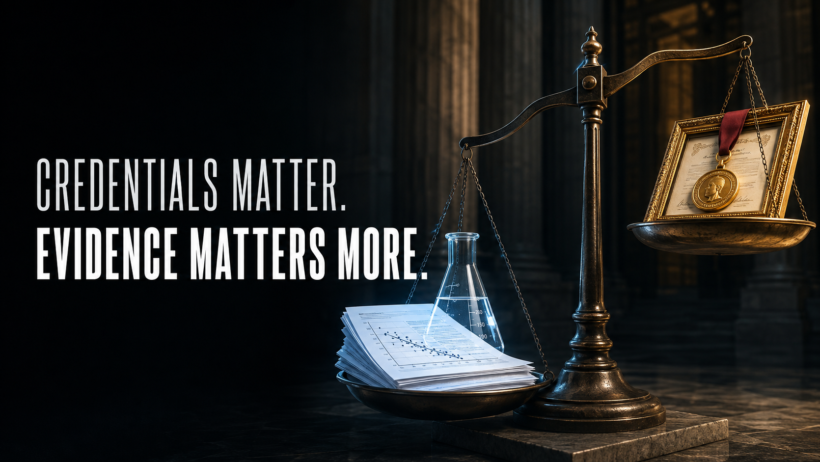
Words matter. Credentials matter. But “evidence” must matter most.
Across modern democracies, scientific disputes increasingly reveal the underlying psychology of institutions and politics. Scientists can be elevated as symbols, recruited as soldiers in ideological battles, or recast as villains when their conclusions challenge a preferred narrative. Gradually, the person becomes the argument and science becomes spectacle.

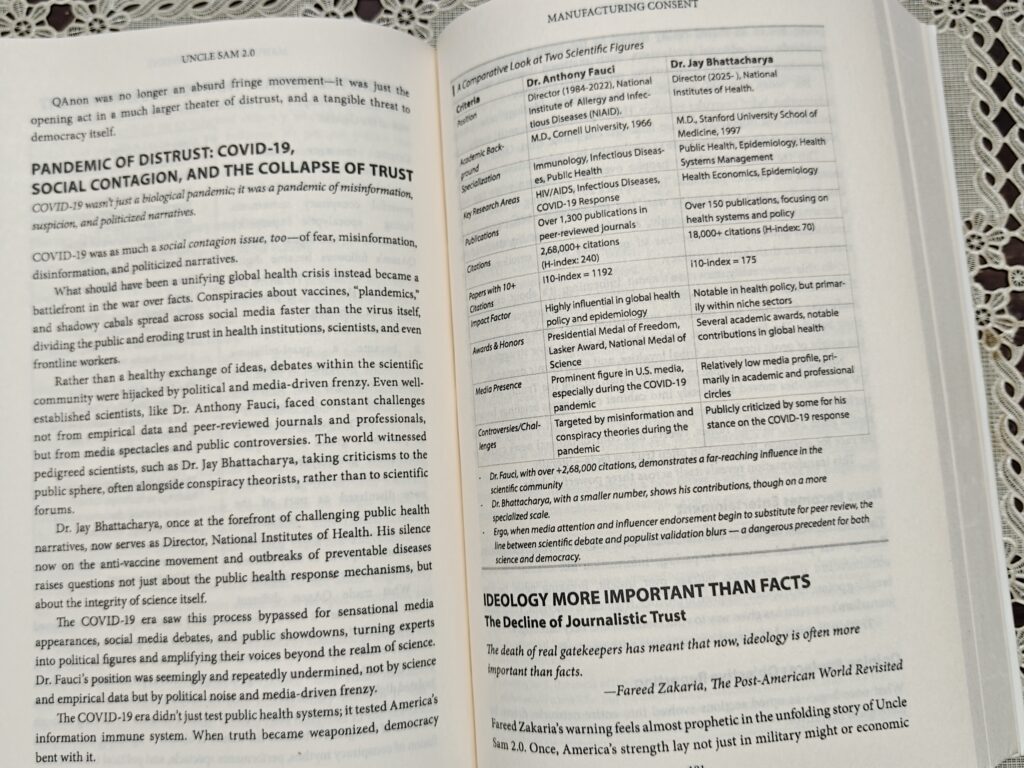
In Uncle Sam 2.0, I explore this through COVID-19 and America’s pandemic of distrust, including the contrasting trajectories of Dr. Anthony Fauci and Dr. Jay Bhattacharya. The recent Fauci hearing is another reminder that even in one of the world’s most scientifically advanced nations, the line between legitimate scientific accountability and political theatre can quickly blur.
When Science Becomes a Spectacle
- Different country, same systems warning: when the person becomes the argument, evidence struggles to be heard.
From Uncle Sam 2.0: Scientific authority, political spectacle and America’s pandemic of distrust.
Signal Reflection: SR 003/ Credential Matter – Evidence Matters
NV Subba Rao is the author of Uncle Sam 2.0 — a social media and systems-level exploration of power, media, and democracy in the algorithmic age. Uncle Sam 2.0 is more than a book about America. It offers a framework for understanding how modern societies hold, drift and attempt to recalibrate themselves in the age of algorithms.
Available on Amazon
Website: UncleSam2.com