
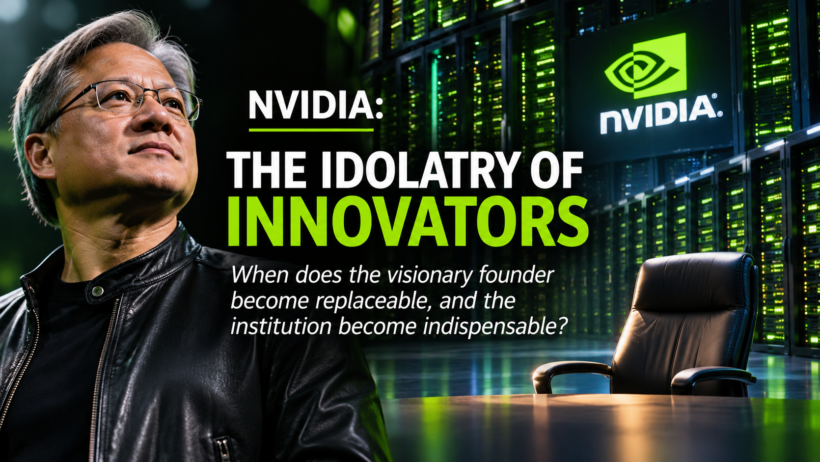

Jensen Huang resigned as NVIDIA's CEO on November 12, 2026. NVIDIA's official announcement confirms that CFO Colette Kress has become interim CEO and that the board is searching for a permanent successor, considering both internal and external candidates. The question is no longer simply could Jensen Huang be replaced? It's now: Can NVIDIA demonstrate that the extraordinary enterprise Jensen Huang built is greater than its founder?Signal Reflection – 010 The world’s most celebrated technology companies are often inseparable from the visionaries who created them. From Microsoft and Apple to Google, Meta and now NVIDIA, founders have shaped not just enterprises but entire industries. Yet, as these companies evolve, grow and mature, a fundamental question emerges: When does entrepreneurial genius give way to institutional capability, and when can professional leadership take the reins? NVIDIA, with Jensen Huang at its helm, offers a compelling lens through which to examine the idolatry of innovators, the evolution of leadership, and the delicate transition from founder dependence to institutional resilience. After all, the ultimate test of a great innovator may be whether the institution can thrive without them.
17 Nov 2026 | SR-010 | NV Subba Rao | Read time: 20 minutes(Signal Reflections examines ideas, speeches, books and public moments that reveal deeper signals beneath the headlines.)
NV Subba Rao is the author of Quo Vadis? Uncle Sam 2.0 — a social media and systems-level exploration of power, media, and democracy in the algorithmic age.
Available on Amazon
Website: UncleSam2.com
NVIDIA: An Extraordinary Enterprise at a Crossroads – Announces CEO Transition
NVIDIA has emerged as a pivotal institution in the global AI ecosystem, connecting computing power, infrastructure investment, financing arrangements and the ambitions of technology companies racing to build the next generation of artificial intelligence. Its influence now extends far beyond supplying advanced chips and is often described as “the central bank for AI.” Yet this extraordinary enterprise now finds itself at an equally extraordinary crossroad.
On November 12, 2026, NVIDIA announced the resignation of Jensen Huang, its co-founder and CEO for 33 years, marking a defining moment for one of the world’s most consequential technology companies. The board appointed CFO Colette Kress as interim CEO, while initiating a search for a permanent successor.
The timing could hardly be more striking. NVIDIA’s third-quarter fiscal 2027 results, announced on November 17, reportedly exceeded already remarkable analyst expectations of approximately 91% year-on-year revenue growth ($115.84 b vs. $ 109.10 b) and 90% earnings-per-share growth ($2.68 vs. $2.48). Outstanding performance by almost any measure.
Yet the stock market tells a contrasting story. From its October 6 peak, NVIDIA has reportedly shed approximately $2 trillion in market capitalization, a decline of nearly 35%, reflecting a combination of concerns surrounding AI valuations, investment sustainability, regulatory pressures and, more recently, the uncertainty surrounding Huang’s departure.
The circumstances of Huang’s exit have attracted intense scrutiny, with allegations involving personal relationships, national security, potential Chinese intelligence links and semiconductor export controls. Investigations and allegations continue to unfold, and their eventual implications remain uncertain.
But these controversies, however consequential, are not the central subject of this reflection. Rather, they provide the backdrop to a much larger question about entrepreneurial leadership, institutional maturity and corporate resilience.
Context: Jensen Huang has been more than NVIDIA’s CEO. He has been its visionary, technological evangelist, strategic architect and public face. His leadership helped transform NVIDIA from a graphics-chip company into an enterprise at the epicenter of the global AI revolution. And therein lies the paradox:
Jensen Huang helped build an enterprise that has become indispensable to the emerging AI economy. But does that make Huang himself indispensable to NVIDIA and to the AI industry at large?
The question is no longer merely whether he can be replaced. He has been, at least for now. The more consequential question is whether NVIDIA can demonstrate that the extraordinary enterprise he built is greater than the individual who created it.
The Idolatry of Innovators
Innovation has always had its heroes. From Thomas Edison and Henry Ford to Bill Gates, Steve Jobs, Mark Zuckerberg, Larry Page, Sergei, Elon Musk, Jensen Huang, Jeff Bezos and more. Extraordinary individuals who have shaped industries, challenged conventional wisdom and created enterprises that transformed how the world lives and works.
But somewhere along the journey, admiration for innovation can turn into idolatry of the innovator. The founder becomes more than a visionary or business leader. He becomes the identity of the enterprise, the embodiment of its success and, increasingly, the presumed guarantor of its future. This mythos is rarely created by the founder alone. It is reinforced by an entire ecosystem.
Financial markets often attach a founder premium to companies, rewarding not merely their performance but the perceived genius, foresight and charisma of their leaders. A founder’s pronouncements can move markets, sometimes more dramatically than the underlying business fundamentals.
Investors and analysts reinforce this perception through narratives of exceptional leadership. Success becomes personalized, while the contributions of engineering teams, organizational systems, supply chains, customers and favorable market conditions receive comparatively less attention. The extraordinary individual becomes the explanation for extraordinary outcomes.
Media and social platforms amplify the phenomenon. Keynote presentations become spectacles, product launches become cultural events, and founders acquire followings extending far beyond their companies. The black leather jacket of Jensen Huang, the black turtleneck of Steve Jobs and the public persona of Elon Musk become recognizable symbols of technological leadership. Complex institutional achievements are condensed into compelling personal stories, readily amplified by algorithms that favour personalities, emotion and spectacle.
Employees and corporate cultures, too, can contribute to the mythology. A founder’s vision provides purpose, direction and a powerful sense of belonging. Yet when loyalty to the individual begins to overshadow institutional values, independent judgment and constructive dissent may weaken. What begins as inspirational leadership can gradually become organizational dependence.
None of this diminishes the extraordinary contributions of these innovators. Indeed, their ability to imagine possibilities that others could not, mobilize talent and capital, and persevere through uncertainty is precisely what distinguishes entrepreneurial leadership.
The difficulty arises when the founder’s exceptional contribution is confused with permanent indispensability.
There is also a less visible dimension. Successful founders rarely operate in isolation. Their achievements depend on technological advances, institutional capabilities, access to capital, timing, competitive circumstances and, sometimes, extraordinary market advantages. NVIDIA’s ascent, for example, reflects not only Huang’s strategic foresight but also decades of investment in accelerated computing, the CUDA software ecosystem, the emergence of generative AI and a period when demand for advanced AI chips far exceeded available supply.
In such circumstances, it becomes difficult to disentangle the contribution of visionary leadership from the advantages of market position and organizational capability. How much of the success belongs to the innovator, how much to the institution, and how much to the circumstances in which both operate?
This is where the idolatry of innovators becomes more than a cultural curiosity. It can become a governance challenge. Boards may hesitate to question celebrated founders, investors may discount succession risks, and organizations may defer building leadership capabilities beyond the individual at the top.
The paradox is striking. The very qualities that make a founder indispensable during an enterprise’s formative years may, if never institutionalized, become sources of vulnerability as the enterprise matures.
The question, therefore, is not whether extraordinary innovators deserve admiration. They do. It is whether the institutions they create should remain permanently dependent on them.
And that leads to the next distinction: Are the capabilities required to create a breakthrough enterprise the same as those required to lead it through maturity, complexity and institutional renewal?
The Founder and the Professional Manager:
Different Skills, Different Challenges?
There is a familiar narrative in business: founders innovate, professional managers execute. Founders imagine the future, challenge conventions and take risks. Professional managers bring structure, discipline, processes and predictability. It is a convenient distinction, but possibly an overly simplistic one.
| Company | Founder-to-manager transition | Lesson |
|---|---|---|
| Microsoft | Bill Gates → Steve Ballmer → Satya Nadella | A professional leader can reinvent the company’s growth engine |
| Apple | Steve Jobs → Tim Cook –> John Ternus (09/2026) | Operational excellence can sustain a founder’s legacy, though innovation remains debated |
| Larry Page and Sergey Brin → Eric Schmidt –> Sundar Pichai | Professional management can coexist with founder influence | |
| Meta | Mark Zuckerberg remains CEO | Founder control can persist long after institutional maturity |
| NVIDIA | Jensen Huang → Colette Kress (interim) | A live test of whether institutional capability can replace founder dependence |
Some of the most consequential innovations have emerged under professional leadership, while some founders have demonstrated exceptional managerial capabilities long after their enterprises achieved global scale. Satya Nadella’s transformation of Microsoft, Tim Cook’s expansion of Apple’s global ecosystem and Jensen Huang’s three-decade stewardship of NVIDIA illustrate why the distinction is not so easily drawn.
The difference may lie less in who innovates and more in the nature of the challenges confronting an enterprise at different stages of its evolution.
From Creating Markets to Sustaining Institutions
In an enterprise’s formative years, the founder’s contribution can be disproportionately important. There may be no established market, proven business model or organizational infrastructure. Decisions are made under uncertainty, resources are scarce, and survival often depends on the founder’s conviction, adaptability and willingness to take risks that established organizations might avoid.
As the enterprise grows, however, the leadership challenge changes. The task increasingly involves managing complex operations, allocating substantial capital, developing leadership talent, navigating regulatory environments, balancing competing stakeholders and sustaining innovation across multiple businesses and markets.
The founder who once made decisions with a small team may now lead an organization employing tens of thousands, serving millions of customers and influencing entire industries.
The question is no longer simply whether the founder can make the right decisions, but whether the institution can consistently make good decisions without depending on the founder.
Entrepreneurial Vision Versus Institutional Capability
The differences are better understood as shifting leadership priorities rather than mutually exclusive competencies.
| Dimension | Entrepreneurial leadership | Institutional leadership |
|---|---|---|
| Strategic focus | Discovering opportunities and creating markets | Sustaining advantage and renewing markets |
| Risk orientation | Taking calculated, often existential risks | Managing a portfolio of risks and opportunities |
| Decision-making | Founder conviction, speed and intuition | Distributed judgment, evidence and accountability |
| Innovation | Breakthrough ideas and experimentation | Repeatable innovation across teams and businesses |
| Capital allocation | Securing resources for growth and survival | Balancing investment, returns and resilience |
| Talent and culture | Attracting believers and building founding teams | Developing leadership depth and succession |
| Governance | Founder-led authority and concentrated control | Institutional checks, transparency and oversight |
| Measure of success | Creating and scaling the enterprise | Sustaining and renewing the institution |
These dimensions often tend to be tendencies, not rigid categories. Exceptional founders can become outstanding institutional leaders, just as professional managers can be visionary innovators.
Indeed, the most successful leadership transitions may occur not when one type of leader replaces another, but when the enterprise develops capabilities that no longer depend on either type of individual.
The Hidden Challenge: Letting Go
There is, however, a deeper psychological and organizational dimension. For founders, the enterprise is often more than a business. It represents years of personal sacrifice, conviction, identity and emotional investment. Delegating operational responsibilities may be relatively straightforward but relinquishing strategic authority may not be.
For boards and investors, the challenge is different. How does one assess whether a ‘celebrated founder’ continues to be the best person to lead the enterprise? And who has the authority, independence and confidence to make that judgment?
Success itself can complicate the answer. The more extraordinary the founder’s achievements, the harder it becomes to distinguish sound strategic judgment from unquestioned personal authority.
Yet succession need not mean displacement. Founders may evolve into executive chairs, technology visionaries, mentors or strategic advisers, preserving their distinctive contributions while professional leadership assumes broader operational responsibilities.
Equally, there is no universal rule that founders must eventually step aside. The appropriate leadership model depends on the company’s competitive environment, governance arrangements, organizational capabilities and future strategic challenges.
Lessons from Technology’s Giants: Four Companies, Four Leadership Models
History offers no universal formula for when founders should step aside, or professional managers should take over. Some enterprises have flourished after their founders relinquished executive control. Others have struggled, while some continue to thrive under founder-led leadership.
Microsoft, Apple, Google and Meta offer four contrasting models of how entrepreneurial vision, professional management and institutional maturity can coexist, evolve or come into conflict.
- Microsoft: Reinvention Beyond the Founder: Bill Gates -> Steve Ballmer (2000) -> Satya Nadella (2014)
- Under Satya’s leadership, Microsoft embraced cloud computing, subscription-based services, strategic partnerships and, subsequently, artificial intelligence.
- Nadella was neither a founder nor an outsider. He was a professional manager who understood the institution yet demonstrated the capacity to challenge its established assumptions.
- The lesson: Professional management need not merely preserve a founder’s legacy. It can reinvent it.
- Apple: The Institution After Steve Jobs ->Steve Jobs (1997 return) – > Tim Cook (2011)
- Under Cook came a different leadership emphasis, building on Apple’s operational capabilities, expanding its global ecosystem, strengthening services and overseeing the development of new product categories.
- The lesson: Replacing a visionary does not necessarily require replicating the visionary. It may require complementing the capabilities already embedded in the institution.
- Google: The Hybrid Model Larry Page + Sergey Brin – >Eric Schmidt (2001) ->Larry Page (2011) -> Sundar Pichai (2015) – > Sundar Pichai (Also Alphabet 2019)
- The arrangement combined entrepreneurial vision with experienced professional management during a period of rapid expansion.
- Sundar Pichai assumed leadership of Google in 2015 and Alphabet in 2019.
- The founders retained substantial influence through Alphabet’s voting structure, even as day-to-day management became increasingly professionalized.
- Google illustrates that succession need not be a clean separation between founder and institution. Strategic influence, ownership control and executive responsibility can be distributed differently.
- The lesson: Founder influence and professional management can coexist, provided their respective roles and accountability are sufficiently clear.
- Meta: The Continuing Founder-Led Model Meta is a contrasting case. Mark Zuckerberg (2004) -> Facebook /Meta, since inception.
- Mark’s leadership has spanned the transition from social networking to mobile advertising, acquisitions such as Instagram and WhatsApp, major investments in virtual reality and the metaverse, and the company’s subsequent emphasis on artificial intelligence.
- Meta’s dual-class share structure has allowed Zuckerberg to retain substantial voting control, even as the enterprise has grown into a global technology institution.
- This continuity has enabled bold, long-term strategic decisions, but has also raised persistent questions about governance, accountability and the concentration of corporate power.
- The lesson: Founder-led enterprises can remain innovative and commercially successful at scale. But continued success does not eliminate the need for independent governance or credible succession planning.
What Do These Experiences Tell Us?
| Company | Leadership model | Institutional lesson |
|---|---|---|
| Microsoft | Founder → professional managers | Professional leadership can drive strategic reinvention |
| Apple | Visionary founder → operational successor | Different leadership strengths can sustain and expand an institution |
| Google / Alphabet | Founder–professional hybrid | Strategic founder influence can coexist with professional management |
| Meta | Continuing founder control | Long-term founder leadership offers continuity but concentrates authority |
| NVIDIA | Founder-led for 33 years; succession under scrutiny | Tests whether technological leadership and institutional resilience can be separated |
These experiences suggest that neither founder leadership nor professional management is inherently superior. The effectiveness of either depends on the enterprise’s stage of development, competitive environment, governance structure and capacity for renewal.
There is also an important distinction between leadership succession and institutional independence. A founder may relinquish the CEO position while retaining substantial influence through ownership, board representation or strategic authority. Conversely, a founder who remains CEO may have already built a highly decentralized and professionally managed institution.
The more revealing question is therefore not simply who occupies the CEO’s chair, but how much of the enterprise’s strategic judgment, innovation capability and organizational resilience depends on that individual.
For NVIDIA, the distinction is particularly consequential. Its technological dominance, ecosystem relationships and influence over the emerging AI economy were developed under Jensen Huang’s extraordinary stewardship. But how much of that advantage has become institutional capability, and how much remains dependent on the founder himself?
That brings us to the central analytical question of this reflection:
Is there a point in an enterprise’s evolution when institutional capability overtakes founder dependence? And if so, how would we recognize it?
The Founder-Institution Crossover: When Does Dependence Become Resilience?
The crossover is not necessarily determined by revenue, valuation, company age, or headcount. It may instead depend on milestones such as whether strategic decisions are distributed, whether the innovation pipeline survives leadership changes, whether customers depend on the product rather than the founder, and whether governance can operate independently. The experiences of Microsoft, Apple, Google and Meta indicate that there is no predetermined age, revenue threshold or market capitalization at which a founder should hand over the reins.
Some founders step aside relatively early, others remain for decades, and some continue to exercise considerable influence long after relinquishing executive responsibilities.
Yet there is a larger pattern worth exploring. As enterprises mature, their dependence on individual leadership should ideally decline, while their institutional capabilities strengthen.
And so, the Founder–Institution Crossover.
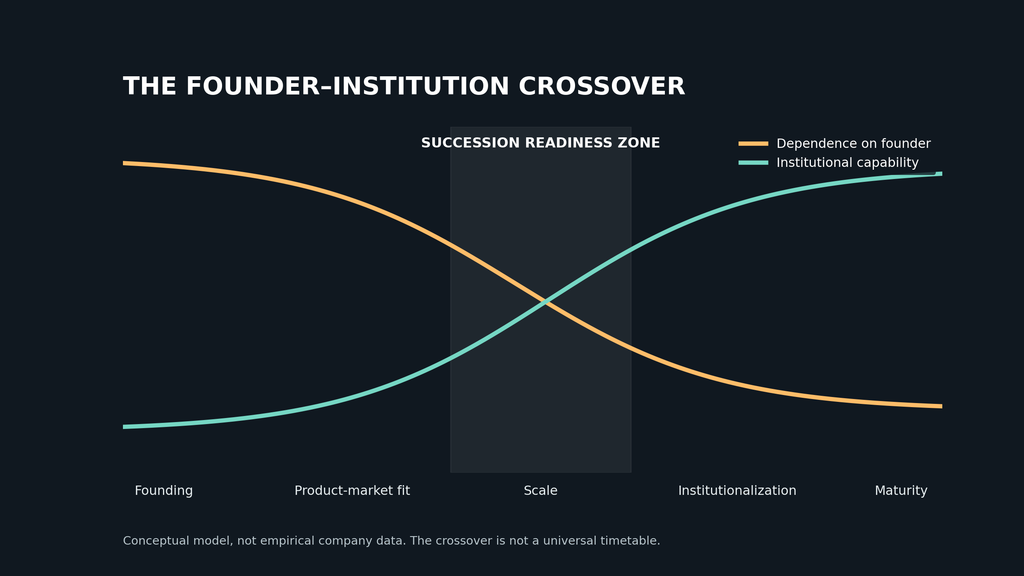
Source: Author’s own – Conceptual synthesis, drawing upon published research on founder succession, organizational maturity and dynamic capabilities, together with the author’s experience as a startup founder, angel investor and mentor, and informed by research on founder succession, organizational maturity and dynamic capabilities (Wasserman, 2003; Teece, Pisano and Shuen, 1997; LeCounte, 2024). Conceptualization and visualization developed with ChatGPT (OpenAI) assistance.
Note: The crossover curve is an illustrative conceptual framework, not an empirically validated model, yet.
From Founder to Institution
Indicative historical comparison. Years are rounded; industry maturity is a qualitative assessment.
The founder–institution crossover may be determined less by the age or size of the company than by the maturity of its core business relative to the emergence of its next growth engine.
Accordingly, Corporate, Industry and Leadership maturity matter:
- Corporate maturity: Years from founding to IPO, first $1 billion in annual revenue, and profitability.
- Industry maturity: Whether the company was operating in an emerging, growing or established market when professional leadership took over.
- Leadership maturity: Whether the transition involved a founder, an internal professional manager or an external executive.
An important distinction: a company can be institutionally mature while its next major technology market is still emerging. Microsoft under Nadella is a particularly good example.
| Company | Founded → IPO* | Leadership milestone | Industry maturity at transition |
|---|---|---|---|
| Microsoft | 1975 → 1986 (11 yrs) | Gates → Ballmer (2000); Nadella (2014), b oth professional managers | Mature PC/software industry; cloud and mobile emerging |
| Apple | 1976 → 1980 (4 yrs) | Jobs → Cook (2011) -> John Ternus (09/ 26), internal professional (joined apple 2001) | Mature PC industry; smartphones growing rapidly |
| 1998 → 2004 (6 yrs) | SB + LP -> Schmidt (2001), external professional; -> Sundar Pichai (2015), internal professional | Search emerging in 2001; mature by 2015; mobile/cloud expanding | |
| Meta | 2004 → 2012 (8 yrs) | Zuckerberg remains founder-CEO | Mature social media/advertising; AI and immersive computing evolving |
| NVIDIA | 1993 → 1999 (6 yrs) | Huang, founder-CEO for 33 years; reported 2026 transition | Mature semiconductor industry; AI infrastructure expanding rapidly |
* IPO dates are as corroborated by Nasdaq
The comparisons suggest that conventional indicators such as IPO timing, revenue growth, profitability and corporate age tell us something about commercial maturity, but relatively little, on their own, about institutional independence.
Back to NVIDIA: After 33 years of Jensen Huang’s leadership, NVIDIA seemingly possesses extraordinary technological assets, a vast developer ecosystem, established customer relationships, deep engineering capabilities and substantial financial resources – triggering a market cap of ~$4 trillion, at 6% weight on S&P.
But it also faces an evolving AI market, complex geopolitical pressures, enormous infrastructure commitments and strategic relationships that may have depended significantly on Huang’s personal influence. The question is whether NVIDIA has already crossed the threshold of institutional independence, or whether the current leadership transition will reveal capabilities and dependencies that were previously obscured by its founder’s extraordinary success.
Thus, NVIDIA is an excellent test because it is simultaneously a mature enterprise and a company operating at the frontier of a rapidly evolving technology. Possibly similar to Google in more ways
NVIDIA’s next chapter may offer one of the most revealing contemporary tests of the Founder–Institution Crossover.
SIGNAL REFLECTION: Beyond the Innovator
Beyond the Innovator

NVIDIA's leadership transition raises a question that extends well beyond Jensen Huang, the semiconductor industry or even artificial intelligence. It challenges how we understand entrepreneurial success, celebrate extraordinary individuals and assess the institutions they create.

There is little doubt that visionary founders play an exceptional role in shaping industries. Without their imagination, conviction and willingness to challenge conventional wisdom, many of today's technological revolutions might never have occurred. But creating an extraordinary enterprise and creating an enduring institution are not necessarily the same achievement.

The experiences of Microsoft, Apple, Google and Meta suggest that there is no single formula for leadership succession. Professional managers can reinvent enterprises, founders can remain effective institutional leaders, and hybrid arrangements can combine entrepreneurial vision with managerial discipline.

What matters is not whether the CEO is a founder or a professional manager, but whether the enterprise possesses the capabilities to innovate, compete, govern itself and adapt independently of any one individual.

NVIDIA adds another dimension to this question: Its technological dominance has made it a central institution in the emerging AI economy, with influence extending across computing infrastructure, capital investment, supply chains and geopolitical relationships. Its extraordinary growth has also been supported by a period of unprecedented demand and constrained supply, conditions that may not persist indefinitely.

The true test of NVIDIA's institutional maturity may therefore emerge not during continued technological dominance, but when competition intensifies, supply constraints ease, customers acquire alternatives and difficult strategic choices become unavoidable.

And there is a broader systems concern. When an enterprise becomes indispensable to an industry, while remaining heavily dependent on an individual, corporate succession can become a source of systemic vulnerability.

That is the paradox at the heart of this reflection.

Jensen Huang helped create an enterprise that became indispensable to the AI revolution. Whether NVIDIA itself remains indispensable to that revolution will depend on its ability to continue innovating, competing and evolving. Whether Huang remains indispensable to NVIDIA is a different question altogether.

NVIDIA today represents far more than the AI revolution. It sits at the crossroads of an emerging economic order, with enormous technological, financial and strategic stakes for corporations, industries and nations alike. And the stakes extend well beyond direct shareholders. Through pension funds, retirement savings, mutual funds, index investments, employment, public finances and the growing dependence of industries on AI infrastructure, millions of individuals are, directly or indirectly, stakeholders in NVIDIA's future, often without even realizing it.

Given the complexities of technological evolution, geopolitical tensions, capital commitments and interconnected dependencies, the question may not be whether Jensen Huang should stay or go, but how best to preserve his extraordinary vision and strategic insights within a framework of shared institutional responsibility.

Google offers an interesting precedent. Its founders, Larry Page and Sergey Brin, brought in professional leadership through Eric Schmidt while retaining significant influence over the company's technological and strategic direction. The arrangement was likely not without its challenges, but it demonstrated that entrepreneurial vision and professional management need not be mutually exclusive.

A comparable model may be worth considering for NVIDIA, with Huang's strategic counsel complementing independent executive leadership, subject to appropriate governance and accountability. Until NVIDIA's Founder–Institution Crossover can be credibly established, retaining access to his insights may be as important as developing institutional independence. After all, institutional maturity is not achieved simply by replacing a founder. And for an enterprise so central to the emerging global economy, prematurely severing that connection could carry consequences far beyond NVIDIA itself.
Academic Perspectives and Further Reading
The questions explored in this reflection draw upon established research in entrepreneurial succession, executive leadership and organizational capabilities.
The Founder–Institution Crossover presented here is an exploratory conceptual synthesis informed by these perspectives, rather than an empirically validated model. Its purpose is to raise a practical question: at what stage does an enterprise’s institutional capability become sufficiently developed to sustain innovation and strategic renewal beyond its founder?
References
Boeker, W. and Karichalil, R. (2002) ‘Entrepreneurial transitions: Factors influencing founder departure’, Academy of Management Journal, 45(4), pp. 818–826. https://doi.org/10.5465/3069314
Chen, C.-J., Song, Y.-X. and Chow, B.-K. (2025) ‘Outside vs. inside succession: Environmental and organizational contexts, strategic decision, and firm performance’, Long Range Planning, 58(1), Article 102485. https://doi.org/10.1016/j.lrp.2024.102485
Hambrick, D.C. and Mason, P.A. (1984) ‘Upper echelons: The organization as a reflection of its top managers’, Academy of Management Review, 9(2), pp. 193–206. https://doi.org/10.5465/amr.1984.4277628
Kannan-Narasimhan, R., Wang, R. and Zhu, P. (2023) ‘Founder versus agent CEOs: Effects of founder status and power on firm innovation and cost of capital’, Journal of Business Research, 167, Article 114180. https://doi.org/10.1016/j.jbusres.2023.114180
LeCounte, J.F. (2024) ‘A theory of Founder-CEOs succession: Governance implications for mature family firms amidst strategic successes and failures’, International Journal of Organizational Analysis, 32(3), pp. 451–475. https://doi.org/10.1108/IJOA-09-2022-3433
Teece, D.J., Pisano, G. and Shuen, A. (1997) ‘Dynamic capabilities and strategic management’, Strategic Management Journal, 18(7), pp. 509–533. https://doi.org/10.1002/(SICI)1097-0266(199708)18:7%3C509::AID-SMJ882%3E3.0.CO;2-Z
Wasserman, N. (2003) ‘Founder-CEO succession and the paradox of entrepreneurial success’, Organization Science, 14(2), pp. 149–172. https://doi.org/10.1287/orsc.14.2.149.14995
Yoo, S.H., Kim, D. and Jin, B. (2025) ‘CEO turnover and innovation: Exploring the advisory role of inventor top management team members’, Technovation, 142, Article 103190. https://doi.org/10.1016/j.technovation.2025.103190
Signal Reflection: SR 010/ NVIDIA -The Idolatry off innovators
NV Subba Rao is the author of Uncle Sam 2.0 — a social media and systems-level exploration of power, media, and democracy in the algorithmic age. Uncle Sam 2.0 is more than a book about America. It offers a framework for understanding how modern societies hold, drift and attempt to recalibrate themselves in the age of algorithms.
Available on Amazon
Website: UncleSam2.com