


America’s axes of leadership and governance are shifting, while Brand America faces a deepening trust deficit, both at home and abroad. In Quo Vadis? Uncle Sam 2.0, I traced America’s journey from the post-war dream of prosperity and global leadership to an increasingly fractured republic, where institutions, political power, social media and algorithms compete to shape public perception and political reality. The book also introduced the System Integrity Score (SIS), an AI-assisted, five-dimensional composite assessment model designed to examine the changing coordinates of American power and institutional integrity. It evaluates twenty attributes, grouped into five constructs: Political, Economic, Military, Cultural and Technological, with four attributes under each. Each attribute is assessed on a ten-point scale, producing a composite score out of 200, allowing comparative assessments across successive U.S. presidencies.
The 2026 midterms provide a timely occasion to revisit those scores. Have voters merely rejected a political leadership, or are they beginning to challenge the algorithmically reinforced narratives, loyalties and institutional dysfunction that helped sustain it? The SIS assessments had already signalled deep systemic vulnerabilities. Was the electoral reckoning an early manifestation of those warning signs, or merely another political swing in a system struggling to correct itself?
Signal Reflection – 008: The American electorate has delivered a remarkable verdict. Democrats have regained both chambers of Congress, overturned Republican majorities and delivered a sharp rebuke to President Donald Trump. Was it a rejection of tariffs and economic anxiety, the Iran war, immigration excesses, the growing influence of billionaires, allegations of corruption and conflicts of interest, political patronage, questionable appointments, the dispensing of favors, or the increasingly casual disregard for institutional norms and accountability? Or was it simply the cumulative fatigue of a nation worn down by political arrogance, polarization and the relentless manufacture of outrage? Perhaps all of these. Or perhaps something more fundamental: an electorate whose disillusionment has finally turned into anger, and whose anger has found expression at the ballot box.
The 2026 midterm verdict offers a timely occasion to revisit the System Integrity Scores (SIS) introduced in Quo Vadis? Uncle Sam 2.0, particularly the contrasting trajectories of Trump 1.0 and Trump 2.0. The book’s assessment of Trump 2.0 was necessarily a snapshot as of August 2025, before it went into production. This Signal Reflection revisits the same framework to reassess Trump 2.0 as of November 9, 2026, and to examine what may have changed in America’s institutional and systemic coordinates. But the larger question extends beyond the scores, and indeed beyond the election itself. In social cybernetic terms, an election is a powerful feedback mechanism, but feedback does not necessarily produce correction. Has the American system begun to correct itself, or has the electorate merely rejected the latest manifestation of a much deeper problem?
9 Nov 2026 | SR-008 | NV Subba Rao | Read time: 19 minutes
(Signal Reflections examines ideas, speeches, books and public moments that reveal deeper signals beneath the headlines.)
NV Subba Rao is the author of Quo Vadis? Uncle Sam 2.0 — a social media and systems-level exploration of power, media, and democracy in the algorithmic age.
Available on Amazon
Website: UncleSam2.com
1. The Verdict: GOP Gets Its Karma?
Elections have a peculiar way of reminding political leaders that power is borrowed, not owned.
The November 2026 midterms delivered an emphatic rebuke to the Republican Party. Democrats won control of both the House and Senate, making significant gains even in traditionally Republican territories. For a party that had increasingly aligned its identity, policies and political fortunes with Donald Trump, the verdict is difficult to separate from the president himself. There is thus perhaps that touch of political karma here.
The Republican Party had ample opportunities to question executive overreach, challenge policy inconsistency and assert its institutional independence. Instead, much of its leadership chose to abdicate their role and responsibilities in favor of loyalty, accommodation or silence.
The issues accumulating along the way were hardly inconsequential: tariffs and their economic consequences, affordability, the influence of concentrated wealth, conflicts of interest, the Iran war, institutional independence and the growing personalization of political power. Much to the point of negating voice of people with voice of billionaires.
None of these issues necessarily explains every vote. Nor should the results be interpreted as a wholesale rejection of every Republican policy or every MAGA supporter. But collectively, they suggest a significant loss of public confidence.
The more consequential question is how a political party, historically associated with limited government, constitutional conservatism and institutional restraint, came to subordinate so much of its identity to one individual. And whether the American electorate has now begun to push back.
2. The Dream: When America Was More Than a Superpower
The American Dream was never simply about becoming rich. It represented opportunity, individual liberty, scientific ambition, economic mobility and a belief that institutions could protect citizens from arbitrary power.
Following World War II, the United States built an extraordinary architecture of influence. Its economic power, military capabilities, universities, technological innovation, cultural appeal and international alliances helped shape the global order.
From Roosevelt and Truman to Eisenhower, Kennedy and subsequent administrations, the American system evolved through periods of prosperity, conflict, reform and institutional stress. It was never a perfect system though. Vietnam, Watergate, racial injustice, economic inequality and repeated foreign-policy failures exposed deep contradictions between American ideals and American conduct.
Yet, US remained a top gun on global stage for one of its enduring strengths was its capacity for self-correction. Presidents could be challenged, governments could be investigated, policies could be reversed, and institutions could resist, adapt and even reinvent themselves at times.
That capacity to receive feedback, recognize dysfunction and correct course lies at the heart of social cybernetics. In Uncle Sam 2.0, I examined this through a broader question:
What happens when a powerful nation’s institutions gradually lose their ability to distinguish feedback from noise, loyalty from accountability, and leadership from control?
3. The Chaos: From Followers to Fanatics
Political loyalty is hardly new. Neither is populism, charismatic leadership or the manipulation of public opinion. What is different today is the architecture through which political identities are created, reinforced and defended – a phenomenon that is worldwide similar with the advent of social media.
Social media and algorithmic platforms have transformed the speed, scale and intensity of political communication. People no longer seem to merely consume political information. They increasingly inhabit digital environments that continuously validate their beliefs, reinforce their grievances and amplify their emotional responses. And platforms in turn via their algorithms have magnified this to a new level giving rise to echo chambers and digital tribes
Consequently, a Political preference becomes an identity -> Identity becomes allegiance-> Allegiance, when reinforced by fear, grievance, repetition and social approval hardens into unquestioning loyalty – > And loyalty can evolve into fanaticism.
This does not mean every die hard or MAGA supporter is a fanatic, nor that these dynamics are exclusive to the political right. The mechanisms can operate across political movements and ideologies.
And as social media engagement has travelled from minutes to hours to more hours, the concern appears to be systemic. For when political leaders become inseparable from political identities, contradictory evidence is increasingly dismissed as hostile propaganda. Institutions that challenge the leader are treated as enemies. A phenomenon that we witness across the world now. The result is a feedback loop in which loyalty becomes its own justification.
This was one of the central themes of Uncle Sam 2.0: the emergence of algorithmically reinforced political communities and the gradual displacement of institutional accountability by personalized political power.
Trump 1.0 (2016-20) offered an early illustration of that social media led narrative creation.
Trump 2.0 (2024- ) raised the possibility that these dynamics were no longer merely challenging institutions from outside, but increasingly reshaping them from within, with cults and loyalty.
4. Measuring the System: The SIS Framework
Can the condition of a national system then be assessed beyond opinion polls, GDP growth, military strength or presidential approval ratings? In Uncle Sam 2.0, I attempted to address this through the System Integrity Score (SIS) framework.
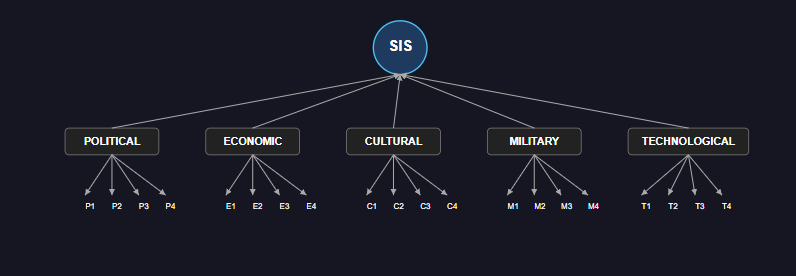
The model and framework examine five dimensions (constructs) each having four attributes (there can be more, but I selected four from each, based on prior published research in academic journals):
- Political (P1-P4): Governance influence, alliances, policy coherence and institutional legitimacy.
- Economic (E1-E4): Trade, infrastructure, currency influence and supply-chain integrity.
- Cultural (C1-C4): Narrative pluralism, cultural reach, media credibility and value resonance.
- Military (M1-M4): Military reach, cyber capability, strategic deterrence and security integration.
- Technological (T): Digital integrity, AI governance, civic technology and regulatory resilience.
5 Dimension * 4 attributes = total 20 attributes. Each attribute variable is assessed on a ten-point scale (with 1 being the lowest, and 10 the highest possible score) and added to produce a composite score out of 200.
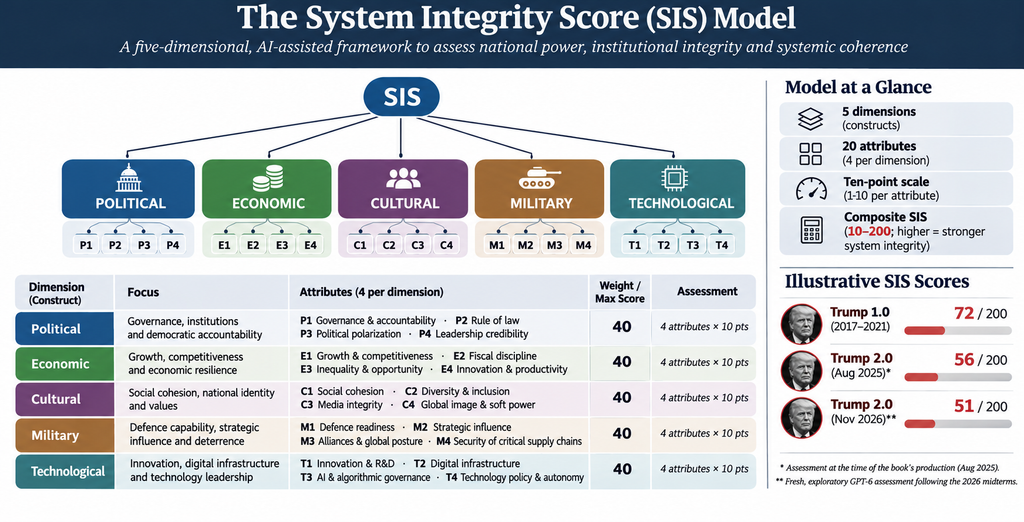
- The central distinction is between possessing power and exercising it through coherent, accountable and resilient institutions. A country may possess immense economic, military or technological capabilities while simultaneously experiencing deterioration in the integrity of the systems governing those capabilities – and so have lower SIS scores.
The SIS framework in (Uncle Sam 2.0) used AI-assisted simulations, averaging assessments from ChatGpt-4o, 2025 model, to construct the directional presidential profiles. And these are interpretive estimates rather than independently validated scientific measurements.
Their value possibly lies in providing a structured framework for comparing systemic strengths, weaknesses and trajectories.
5. The Presidential Ledger: What the Scores Reveal
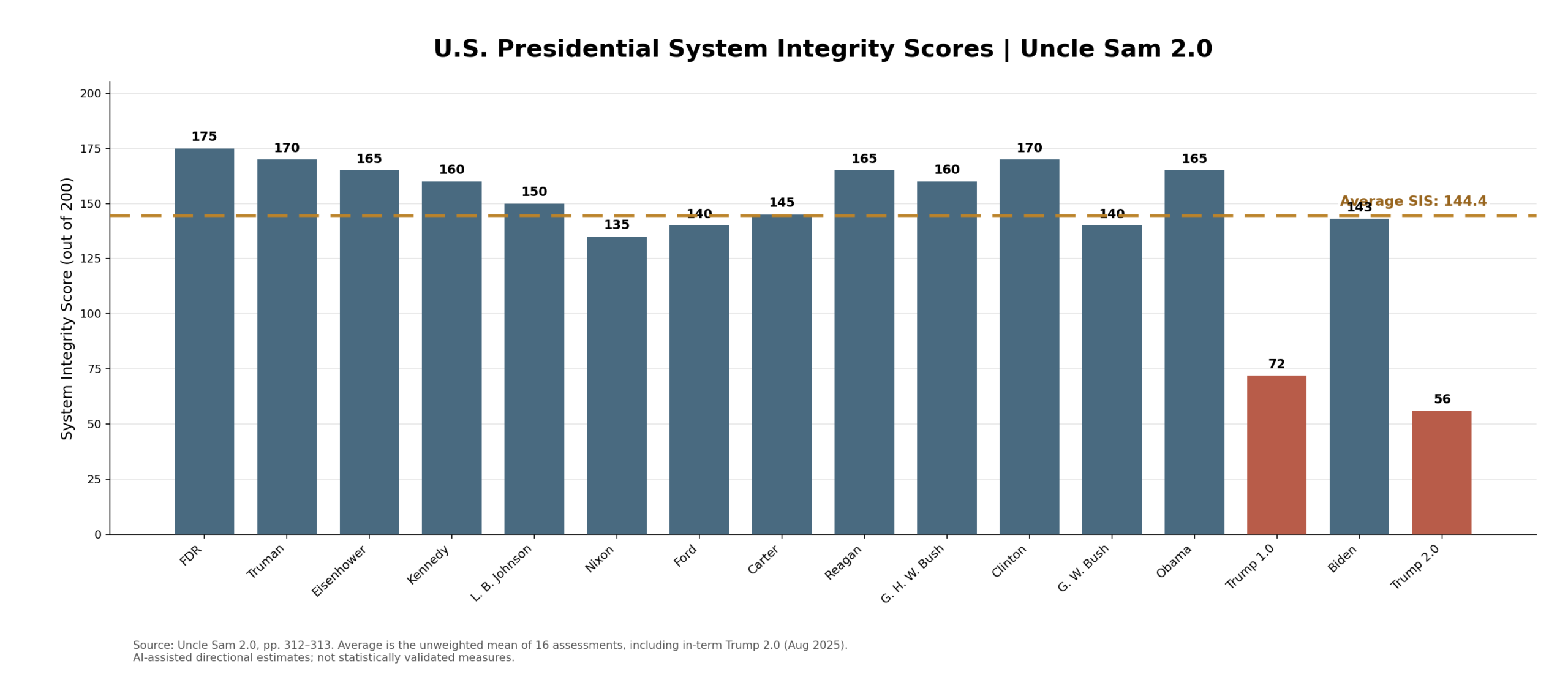
The historical SIS assessments in Uncle Sam 2.0 offer an interesting picture of American institutional development. They do not suggest a continuous decline. Rather, they indicate periods of resilience, institutional stress, recovery and renewed deterioration. But then they also reveal a sharp contrast with Trump 1.0 and even more with Trump 2.0
Presidential System Integrity Scores, as published in Uncle Sam 2.0
| President / Administration | SIS / 200 |
|---|---|
| Franklin D. Roosevelt | 175 |
| Harry S. Truman | 170 |
| Dwight D. Eisenhower | 165 |
| John F. Kennedy | 160 |
| Lyndon B. Johnson | 150 |
| Richard Nixon | 135 |
| Gerald Ford | 140 |
| Jimmy Carter | 145 |
| Ronald Reagan | 165 |
| George H. W. Bush | 160 |
| Bill Clinton | 170 |
| George W. Bush | 140 |
| Barack Obama | 165 |
| Donald Trump 1.0 | 72 |
| Joe Biden | 143 |
| Donald Trump 2.0, Aug. 2025 | 56 |
View Chart: Presidential System Integrity Scores (1944–2026)
(Click to view the SIS comparison across U.S. presidencies).
Source: Uncle Sam 2.0, pp. 312–313. Historical AI-assisted presidential SIS simulations. Scores are directional estimates, not independently validated measurements.
The variations are revealing. Watergate-era institutional stresses appear in Nixon’s lower assessment. Subsequent presidencies show varying degrees of recovery and resilience.
The contrast becomes particularly pronounced with Trump 1.0, whose published score of 72 represented a marked deterioration in the model’s assessment of institutional integrity. Biden’s presidency registered a partial recovery to 143, although the underlying political and cultural divisions remained unresolved.
The original Trump 2.0 assessment, conducted in August 2025, fell to 56 (Vs SIS=72 from Trump 1.0). This incidentally is the lowest score amongst all the US president’s post WW II.
The book characterized the progression from Trump 1.0 to Trump 2.0 as a movement from an emerging controlled political cult toward its ascension. From: Collapsed and controlled cult emerging to Collapsed and controlled cult club formed.
- From systemic retreat to systemic capture of institutions.
Note: Since Trump 2.0 composite SIS score in Aug 2025 dropped to 56 (from Trump 1.0 at 72), I did the same simulated SIS score assessment using an ensemble of LLMs (Gemini, Perplexity and Grok) to gauge model biases and deviations if any from ChatGPT. The respective composite SIS estimates were 53, 48 and 63, yielding an ensemble average of (4 LLMs) as 55/200 (not very different from that of chatGPT-4o). The final calibrated score reported in the book was the GPT-4.o score of 56/200.
5.1 Original August 2025 results – for Trump 2.0
| Model | Political | Economic | Military | Cultural | Technology | Total / 200 |
|---|---|---|---|---|---|---|
| ChatGPT | 9 | 12 | 12 | 10 | 13 | 56 |
| Gemini | 8 | 11 | 12 | 8 | 14 | 53 |
| Perplexity | 8 | 10 | 10 | 8 | 12 | 48 |
| Grok | 12 | 11 | 14 | 10 | 16 | 63 |
| Mean (calculated) | 9.25 | 11 | 12 | 9 | 13.75 | 55 |
Transcribed from Uncle Sam 2.0, p. 314. The four-model mean is approximately 55 either way.
These scores however are not ‘direct’ measures of electoral popularity. At least they were not attempted to be studied on that objective. The attempt was simply to capture and study the condition of the system under successive administrations – so as to gauge influence and effectiveness of respective presidents – as a Hegemon under different presidents.
That distinction becomes especially important when interpreting the November 2026 results.
6. Trump 2.0 (continued…): The November 2026 Re-assessment
Following the midterms, I revisited the SIS framework using a fresh Chat GPT simulation dated November 9, 2026.
(But this time it is ChatGPT-6 Unfortunately, GPT-4o is no longer available as OpenAI has retired it from ChatGPT on February 13, 2026).
The re-assessment exercise used the same path model and framework, i.e., five dimensions and twenty attributes, emphasizing system/ institutional integrity and stewardship – coherence, accountability and resilience. Again, not to be interpreted as America’s accumulated national power. The resulting illustrative assessment was:
Trump 2.0, November 2026 (GPT-6): SIS = 51/200
| SIS dimension | November 2026 | Maximum |
|---|---|---|
| Political | 8 | 40 |
| Economic | 13 | 40 |
| Cultural | 10 | 40 |
| Military | 12 | 40 |
| Technological | 8 | 40 |
| Composite SIS | 51 | 200 |
The new score (51) is five points below the published August 2025 assessment of 56, on a break-up as below.
| Political dimension | Score / 10 | Assessment rationale |
|---|---|---|
| P1. Global Governance Influence | 2 | Reduced multilateral confidence and policy legitimacy |
| P2. Alliance Leadership | 2 | Alliance uncertainty and weakened strategic trust |
| P3. Political-Diplomatic Coherence | 2 | Inconsistent policy direction, tariffs and geopolitical escalation |
| P4. Institutional Legitimacy | 2 | Executive-institutional conflict; elections provide a countervailing corrective mechanism |
| Political subtotal | 8/40 |
| Economic dimension | Score / 10 | Assessment rationale |
|---|---|---|
| E1. Trade Power | 3 | Tariff-driven disruption and reduced policy predictability |
| E2. Technology & Infrastructure Support | 4 | Continuing investment, with uneven institutional coordination |
| E3. Currency Influence | 4 | Dollar resilience, offset by concerns about policy stewardship |
| E4. Supply Chain Control | 2 | Trade fragmentation and uncertain international coordination |
| Economic subtotal | 13/40 |
| Cultural dimension | Score / 10 | Assessment rationale |
|---|---|---|
| C1. Narrative Pluralism | 2 | Polarization and identity-driven information environments |
| C2. Cultural Reach | 2 | Enduring global cultural appeal, weakened by political credibility concerns |
| C3. Media Influence & Credibility | 2 | Fragmented media trust and disinformation |
| C4. Value Resonance | 2 | Tensions between professed democratic ideals and institutional conduct |
| Cultural subtotal | 10/40 |
| Military dimension | Score / 10 | Assessment rationale |
|---|---|---|
| M1. Military Reach | 4 | Extensive reach, but questions about responsible strategic deployment |
| M2. Cyber Warfare Capability | 3 | Strong capability, with governance and coordination concerns |
| M3. Strategic Deterrence | 3 | Iran war and escalation risks weaken strategic predictability |
| M4. AI & Climate Security Integration | 2 | Weak coherence in integrating emerging and long-term security risks |
| Military subtotal | 12/40 |
| Technological dimension | Score / 10 | Assessment rationale |
|---|---|---|
| T1. Digital Sovereignty & Data Integrity | 3 | Substantial capabilities but uneven governance safeguards |
| T2. AI Governance Readiness | 1 | AI development outpacing institutional accountability |
| T3. Platform vs. Civic Technology | 2 | Algorithmic amplification and inadequate civic safeguards |
| T4. Regulation & Cybersecurity Resilience | 2 | Strong technical foundations but fragmented governance |
| Technological subtotal | 8/40 |
The November 2026 simulation thus suggests continued severe institutional strain, particularly in political coherence, cultural trust and technological governance.
Regarding AI-assisted assessments
The November 2026 reassessment, conducted using GPT-6, produced an exploratory score of 51/200, showing continued decline in SIS scores for President Trump – from 56 (Aug 2025) and 72 (Trump 1.0)- both assessed via GPT-4o). Thus, as a further cross-model check, the same twenty-variable framework was also independently evaluated using Claude – Optus 5.5.
Claude yielded a score of 75/ 200 to suggest that system overall is still vulnerable and in breakdown mode.
| Axis (Dimension) | SIS Score |
|---|---|
| Political (P1-P4) | 14 |
| Economic (E1-E4) | 16 |
| Military (M1-M4) | 16 |
| Cultural (C1-C4) | 16 |
| Technological (T1-T4) | 13 |
| SIS | 75 / 200 (avg 3.75): Vulnerable/ Breakdown boundary and Distorted feedback |
Note: Differences across LLMs may arise from their training, reasoning approaches, information access, model calibration and interpretation of institutional integrity. A newer model does not necessarily produce a more reliable or more conservative assessment.
Overall, the Nov ’26 SIS numbers suggest continued severe institutional strain, particularly in political coherence, cultural trust and technological governance. Accordingly, the further downward movement of TRUMP 2.0 SIS from 56 to 51 should be treated at minimum, as a significant indication of persistent institutional deterioration. Likely the election results are corroborating the same.
The more significant and real finding thus is the persistence of severe institutional weakness in the simulated assessment. And this creates an interesting paradox.
The electorate has delivered a powerful corrective signal. But it remains to be seen, if the institutional conditions that contributed to the political crisis will be attended for repair and correction.
7. The System Lens: When Feedback Returns
From a social cybernetics perspective, elections are among the most important feedback mechanisms in a democracy. They allow citizens to evaluate leadership, register dissatisfaction and alter the distribution of political authority. But feedback is useful only when the system is capable of receiving and responding to it.
The 2026 midterms demonstrate that American electoral institutions retain the capacity to deliver consequential outcomes, even against a powerful incumbent administration. That is an important positive signal.
Yet, the larger question is whether the political system can translate that signal into institutional correction. And this raises many more questions;
- Will the institutions recover for their oversight role?
- Will political parties reassert their independence from individual personalities?
- Will economic and foreign-policy decisions become more accountable and coherent?
- Will social media and the digital information environment become less vulnerable to manipulation, disinformation and algorithmically reinforced polarization?
- Or will electoral defeat simply produce another cycle of grievance, retaliation and political mobilization?
The incoming Democratic Congress will acquire stronger legislative and oversight powers in January 2027. Whether those powers translate into effective accountability remains to be seen.
An election can change the balance of power. It cannot, by itself, restore the integrity of the system. For that, only the people in-charge can provide – by doing the right things, in the right way at the right time
8. Beyond America: The Changing Coordinates of Power
The SIS framework also offers a comparative perspective across countries.
In Uncle Sam 2.0, I applied the same five-dimensional approach to examine the relative system profiles of major powers, including China, Russia, the European Union, Japan, Saudi Arabia and India.
The purpose again, was not simply to rank nations. It was to explore how different political, economic, cultural, military and technological systems combine to produce national influence, resilience and vulnerability.
A country can possess considerable economic or military power while suffering weaknesses in institutional legitimacy or social cohesion. Conversely, a smaller power may exhibit greater systemic coherence in particular dimensions.
The United States remains an extraordinary concentration of economic, technological, cultural and military capabilities. But has become severely unpredictable and less trustworthy. It argues and fights with allies and foes as if there is no difference between them.
Brand America today has a trust deficit, severe than ever before. And its long-term position depends not only on what hegemon traits it possesses, but on how effectively those capabilities are governed.
To explore the comparative country profiles and civic dimensions please scroll to SIS scores section at Plot Your Compass – The book (from Unclesam2.com site). The broader question in light of China and Russia, will remain whether America’s changing internal coordinates are also changing the global balance of power.
9. The Signal-Talk Take: A Republic Is More Than Its President
Perhaps the GOP has received its karma. But political karma is not the same as institutional recovery.
The American system has survived wars, economic depressions, scandals, assassinations, social upheaval and repeated crises of confidence. Its strength was never the absence of failure. It was the capacity, however imperfectly, to confront failure and correct course. Cometh the hour and Cometh the man, it was and has been. With Obama as the most recent statesman providing reliable stewardship both at home and on world stage (His SIS scores and compass reflect that very much).
The algorithmic age however presents a different challenge. The emergence of echo chambers, pod casters, and influencers fueled by racy-pacy algorithms towards formation of digital tribes foments new and formidable challenges. Consequently, when political identity becomes inseparable from personal loyalty, when narratives overwhelm evidence, and when institutions themselves become instruments of political combat, elections alone may no longer tell us enough about the health of democracy.
That was one indeed of the central concerns behind Uncle Sam 2.0 (equally applicable to many other nations).
The SIS framework was never intended to predict election winners. It was simply a path diagram drawing on SEM methods as an attempt to understand how leadership, institutions, technology and civic behavior interact to shape the integrity of a national system.
The 2026 midterms provide a new data point. The next two years will provide the more consequential test. And can a country that once offered the world an American Dream rediscover the institutional imagination required to sustain it?
Perhaps the GOP has received its karma. But has Uncle Sam received his wake-up call?
Quo Vadis? Uncle Sam 2.0
Methodology and disclosure
The historical presidential SIS scores are reproduced from Uncle Sam 2.0, pp. 312–313. The November 9, 2026, reassessment is a new exploratory GPT-6 simulation using the same five-factor, twenty-attribute additive structure, but is not a replicated four-LLM consensus or an independently validated empirical measure. No numerical reference-corpus size is claimed for the new assessment. Differences between the 2025 and 2026 simulations should be interpreted cautiously and lead to further in-depth quantitative and qualitative studies.
Further reading: Uncle Sam 2.0 | Plot Your Compass
Signal Reflection: SR 008 / Karma Calling?
NV Subba Rao is the author of Uncle Sam 2.0 – a social media and systems-level exploration of power, media, and democracy in the algorithmic age. Uncle Sam 2.0 is more than a book about America. It offers a framework for understanding how modern societies hold, drift and attempt to recalibrate themselves in the age of algorithms.
Available on Amazon
Website: UncleSam2.com