
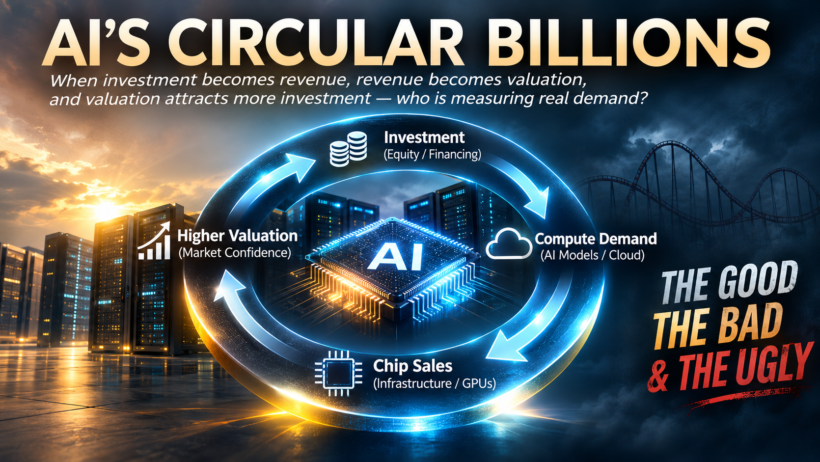

When investment becomes revenue, revenue becomes valuation, and valuation attracts more investment – who is measuring the real demand? Consequently, when the companies financing the AI revolution are also buying, selling and underwriting its future, is it Innovation or Financial Illusion? Welcome to the world of AI circular financing!
Signal Reflection – 011 || Artificial intelligence is likely the most consequential technological transformation of our times. Its promise extends well beyond faster computing, intelligent chatbots or autonomous agents. It has the potential to reshape productivity, scientific discovery, healthcare, education, industry and perhaps the very architecture of economic activity. And it’s taking shape in the form of Physical AI, Consumer AI, Agentic AI and Regional AI. Four parallel shifts all seeking to reshape and transform industries. But beneath the technological excitement, another architecture is taking shape. One built not merely on silicon chips, algorithms and data centers, but on an intricate web of investments, purchase commitments, guarantees, debt and extraordinary expectations.
At the heart of this ecosystem lies an intriguing financial arrangement. Companies developing AI models require enormous computing capacity, while some of the very companies supplying that capacity are also investing in the model developers. Those investments help finance the purchase of computing services, which in turn drive demand for more chips, more data centers and still more capital. As money circulates, orders grow, revenues expand and valuations potentially rise. Thus, reinforcing the expectations that attracted the investments in the first place to ensure Capital fuels demand, demand fuels revenues, revenues fuel valuations, and valuations attract more capital. And the loop continues and grows. Welcome to the world of AI circular financing.
Having spent over a decade in the telecommunications industry, including its transformative years of infrastructure expansion, vendor partnerships and evolving asset-light business models, I find echoes of an earlier technological revolution. Telecom, too, was built on enormous capital commitments, interconnected commercial relationships and expectations of exponential growth. The parallels are intriguing, although the scale, speed and concentration of today’s AI investments introduce an entirely different dimension.
The question is not whether such arrangements are inherently wrong. They may well accelerate innovation, infrastructure development and genuine economic value creation. But they also raise a more fundamental question: Is the financial ecosystem supporting AI increasingly dependent on its own expectations of future success? And what happens when those expectations are not realized? That is the central question explored in this Signal-Talk reflection — through The Good, The Bad & The Ugly of AI’s circular billions.
22 Nov 2026 | SR-011 | NV Subba Rao | Read time: 18 minutes(Signal Reflections examines ideas, speeches, books and public moments that reveal deeper signals beneath the headlines.)
NV Subba Rao is the author of Quo Vadis? Uncle Sam 2.0 — a social media and systems-level exploration of power, media, and democracy in the algorithmic age.
Available on      Amazon
Website:          UncleSam2.com
The Billion Dollar–Money-Go-Round
Follow the Money
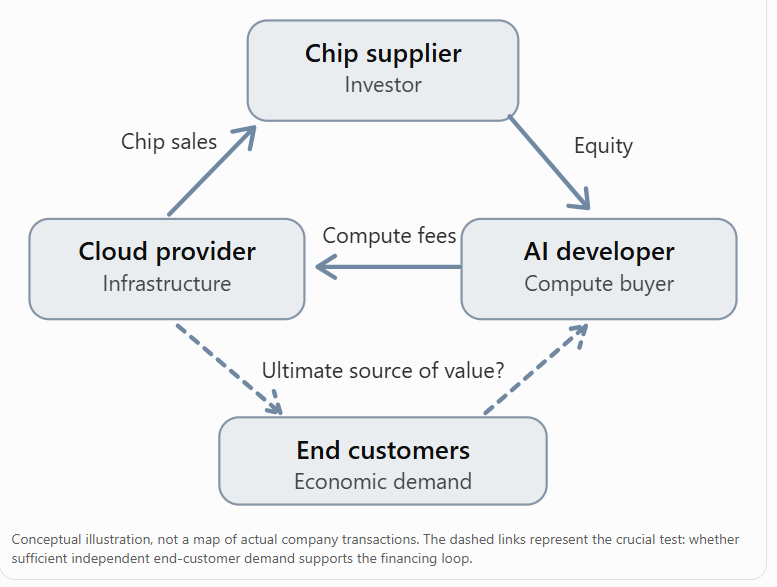
The AI economy is increasingly being financed by companies that also stand to benefit commercially from the expenditure their financing enables. Accordingly, the financial architecture emerging around AI appears to have acquired a predictable pattern with the industry’s most influential companies, depicting circular relationships. Relationships that increasingly suggest a self-referential financial ecosystem, where investments, revenues, valuations and expectations reinforce one another?
Four Financing AI Loops
Here are four circular relationships involving some of the industry’s most influential companies. The financing arrangements of the four are not identical, nor are their economic consequences uniformly beneficial or destructive.
They simply illustrate how investment, computing demand and supplier revenues can reinforce one another. Some loops involve equity investments, others capacity guarantees, cloud contracts or infrastructure commitments.
The existence of a financial loop does not establish wrongdoing or prove that demand is artificial. But collectively they are all likely revealing something significant – a new financial system. They show that the AI economy is increasingly being financed by companies that also stand to benefit commercially from the expenditure, that their financing is enabling.
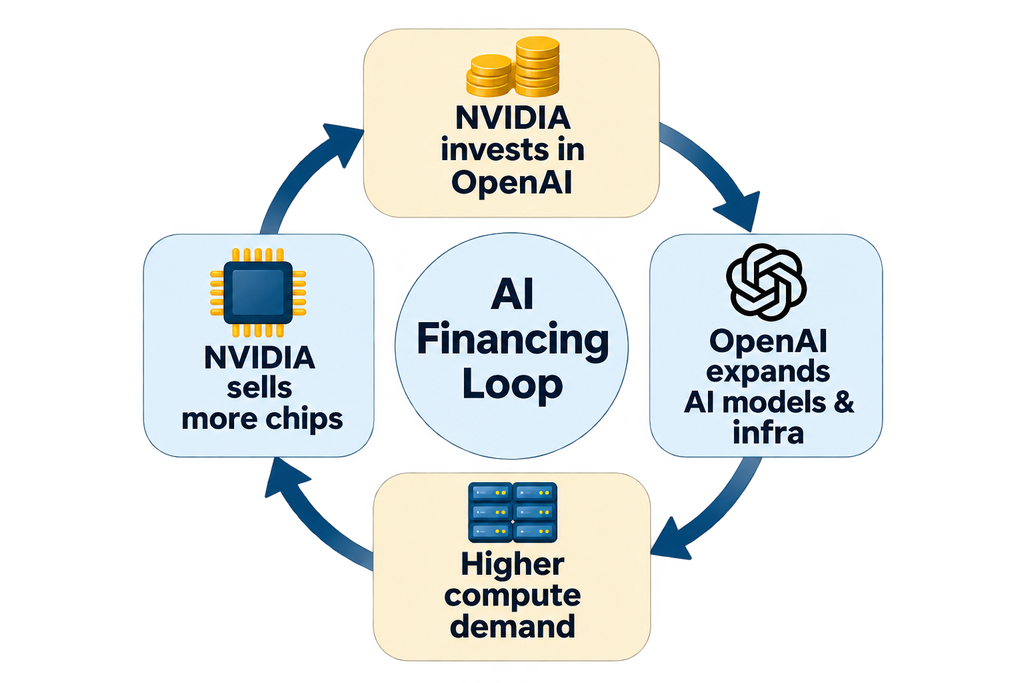
1. NVIDIA–OpenAI: When the supplier becomes the investor
NVIDIA capital → OpenAI expansion → computing infrastructure demand → NVIDIA chip sales.
- 09/ 2025: NVIDIA and OpenAI announce an arrangement under which NVIDIA to invest up to $100 b as OpenAI deployed approximately 10 gigawatts of NVIDIA-powered computing infrastructure.
- That headline figure was conditional, not money already invested. The original proposal did not materialise in its announced form. NVIDIA subsequently made a reported $30 b equity investment in OpenAI’s 02/ 26 financing round.
- The economic relationship however illustrates the central question: NVIDIA invests in an AI developer whose expansion requires enormous computing capacity, much of it dependent on NVIDIA technology.
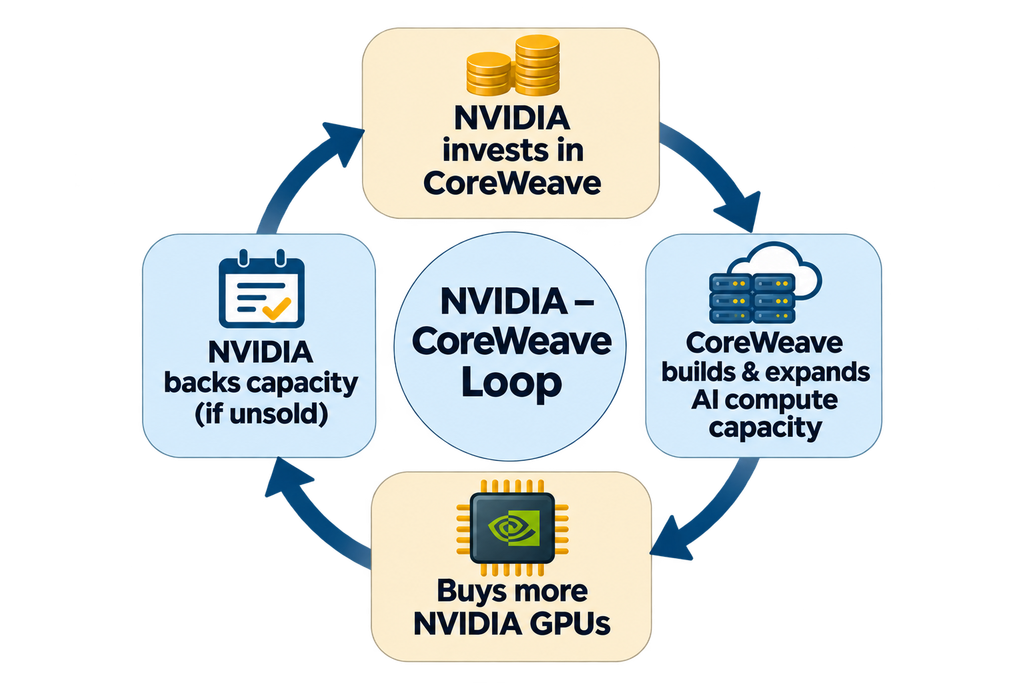
2. NVIDIA–CoreWeave: When the supplier also becomes the backstop
NVIDIA investment and capacity support → CoreWeave financing and expansion → NVIDIA GPU purchases → more computing capacity.
- CoreWeave operates AI computing infrastructure built extensively around NVIDIA processors.
- NVIDIA invests additional $2 billion in CoreWeave in 01/ 2026. Separately, NVIDIA agrees to purchase certain unsold CoreWeave computing capacity under an arrangement valued at approximately at $6.3 billion, extending into 2032.
- Here the relationship goes beyond a conventional supplier–customer arrangement. NVIDIA is simultaneously a technology supplier, equity investor and potential purchaser of unused computing capacity/ Underwriter.
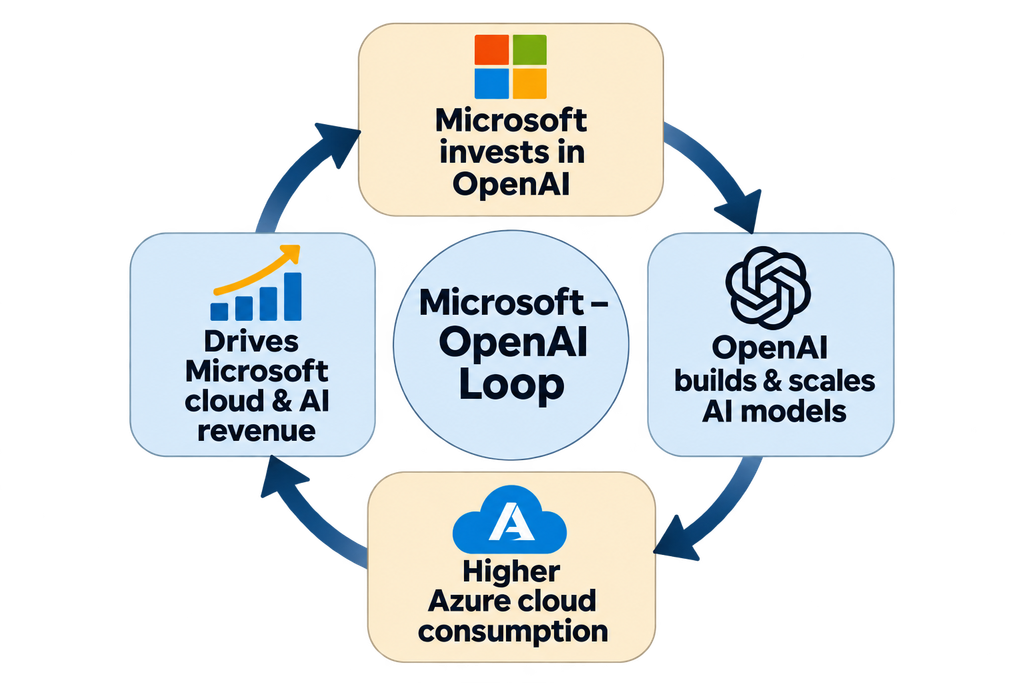
3. Microsoft–OpenAI: When investment and cloud consumption reinforce one another
Microsoft investment → OpenAI model development → Azure computing expenditure → Microsoft cloud revenue.
- Microsoft’s multibillion-dollar investments in OpenAI helped support the development of increasingly sophisticated AI models, while Microsoft Azure became a major provider of the computing infrastructure required to train and operate them.
- OpenAI’s growing computing requirements created substantial business opportunities for Microsoft’s cloud platform, although the relationship has evolved and OpenAI has diversified its infrastructure partnerships
4. Anthropic: When strategic investment helps create a cloud customer
Amazon investment → Anthropic AI development → AWS infrastructure consumption → Amazon cloud business.
- Amazon committed $8 billion to Anthropic through investments announced in 2023 and 2024, while AWS became a major cloud and AI infrastructure partner.
- Anthropic’s development of Claude and other AI capabilities creates demand for substantial computing resources, including AWS infrastructure and Amazon’s custom AI processors.
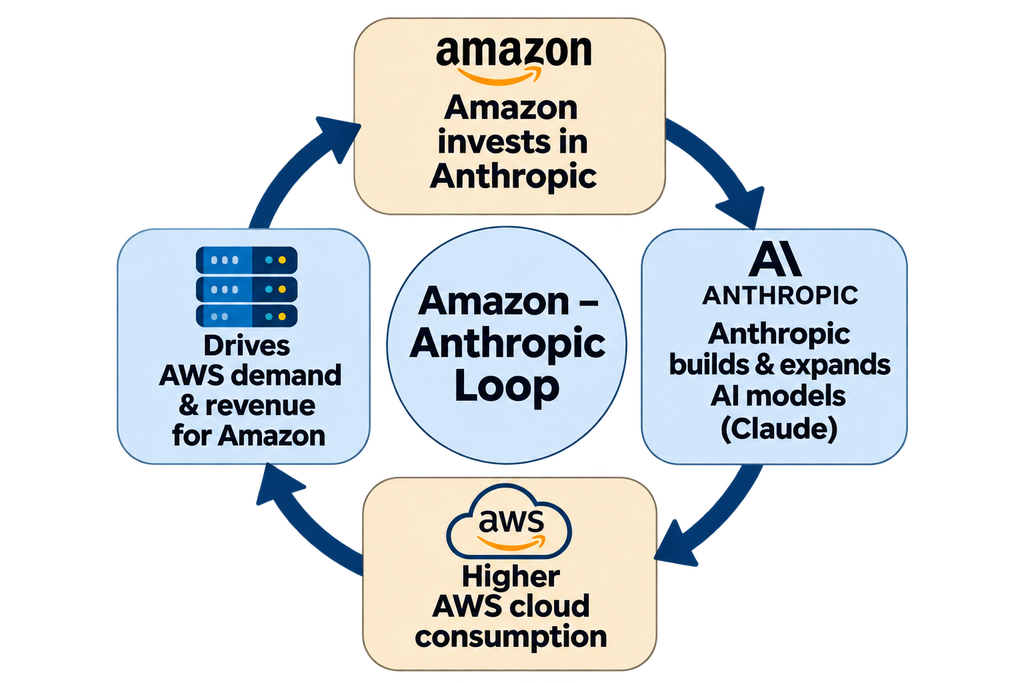
These financial loops are neither inherently virtuous nor inherently vicious. Their economic character depends on what happens beyond the loop: whether independent customers generate enough sustainable demand to support the capital invested.
That is where the distinction between innovation, financial interdependence and systemic risk begins.
The question, therefore, is not merely how many billions are being invested. It is how much independent economic demand ultimately supports those billions, and what happens if those expectations are not realized? The granularity possibly lies in eight interconnected dimensions: Demand, Valuation, Revenue Quality, EV/ EBITDA, Capital Efficiency, Economic Multiplier, Financial Risk, and Governance.
Viewed through these dimensions, circular financing can evolve as ‘Good’ enabler of innovation and value creation to a mechanism of financial amplification. And, under adverse conditions, a potential source of systemic distress, to become ‘Bad’ and or ‘Ugly‘.
So, what then is “the Good, the Bad and the Ugly” in this self-referential arrangement.

Note: Ugly represents likely stress scenarios and not necessarily established outcomes – Not a verdict on NVIDIA, Microsoft, Amazon, OpenAI or Anthropic.
The Good: Financing the Future
Value creation succeeds
There is nothing inherently sinister about a supplier financing its customers. Aircraft manufacturers, automobile companies, telecommunications equipment vendors and infrastructure providers have used variations of vendor financing for decades. When customers face substantial upfront investment requirements, suppliers have often participated to bridge the financing gap. AI presents precisely such a challenge, but on an unprecedented scale.
Developing advanced AI models requires access to expensive processors, enormous data centers, electricity, cooling systems, networking infrastructure and highly specialized talent. Few emerging AI companies can finance these requirements entirely from their operating revenues. The situation is one where infrastructure investment leads demand – unlike in the traditional industries (where investment often lags demand).
As upfront infra investments are needed, the strategic investments by companies such as NVIDIA, Microsoft, Amazon and Google can therefore perform a legitimate economic function. They accelerate infrastructure deployment, reduce financing constraints, create markets for emerging technologies and allow smaller innovators to compete in an industry otherwise dominated by a handful of extraordinarily wealthy corporations.
Without such substantial infrastructure financing, promising applications in medicine, scientific research, education and industrial automation could remain technologically feasible but commercially inaccessible. In that sense, circular financing can be understood as a mechanism for ecosystem creation.
The supplier then does not merely sell a product. He helps create the market in which that product becomes useful. And this may not necessarily be artificial demand. It possibly represents the deliberate construction of an entirely new economic ecosystem that has multiplier effects on economy (as was witnessed in telecom, dot com, internet, etc., where large upfront investments ultimately generated substantial economic value.
- The internet itself required decades of infrastructure investment before many of its most profitable applications became possible.
The Good, therefore, is that “Investment leads demand creation” and strategic financing can bring tomorrow’s infrastructure into existence today.
But the same mechanism that accelerates innovation can also complicate our understanding of its economics.
The Bad: When Customers Become Investments
Value amplification becomes inevitable
Imagine a simplified transaction: Company A manufactures AI processors (NVIDIA). Company B develops AI models but needs capital to purchase computing capacity (OPEN AI).
- Company A invests $30 billion in Company B.
Company B uses that financing to purchase computing services from Company C (CoreWeave). Company C then uses the resulting demand and financing to acquire processors from Company A.
- Company A records genuine sales. Company B gains computing capacity. Company C expands its infrastructure.
On the surface, everybody benefits. But closer examination shows some of the purchasing power supporting Company A’s revenue originated with Company A itself.
This does not automatically make the revenue fictitious or the transaction improper. The equipment may have been delivered, the computing capacity may be operational, and the investment may generate substantial future returns. But the problem could be subtler.
How much of the demand is being generated independently by paying end customers, and how much is being enabled by financing within the ecosystem?
This distinction matters enormously. NVIDIA’s relationships with OpenAI and CoreWeave illustrate different aspects of the issue. Its investments, equipment sales and commitments involving cloud-computing capacity create overlapping roles as supplier, investor and, in some arrangements, purchaser or financial backstop. Similarly, cloud providers investing in AI developers may subsequently benefit from those developers substantial computing commitments.
Thus, implying the difficulty in separating strategic investment from independently financed demand, for the completed investments or realized revenues.
A second and bigger complication arises via ‘Valuations’.
So, when a company receives substantial investment at a high valuation, that valuation can strengthen confidence in its future prospects. Its infrastructure partners may benefit from larger order books. Those orders can support additional borrowing, expansion and market optimism. And the ecosystem then begins to validate itself.
Investment supports demand -> Demand supports revenue – > Revenue supports valuation -> Valuation supports and drives further investment.
A recipe for a perfect storm in making when the critical issue is whether the underlying economic value is growing as rapidly as the financial claims built upon it. This is where conventional measures of revenue growth, order backlogs and market capitalization could become insufficient.
A trillion dollars of announced future commitments is not the same as a trillion dollars of realized revenue, in books. Nor does it necessarily represent a trillion dollars of independent final demand (as much as it represents forward revenue booking on hope and hubris, endorsed by agreements, contracts, and with hope as the best strategy).
The Ugly: When the Circle Becomes a Trap
Value destruction is starring.
The real test of circular financing arrives not during periods of extraordinary growth, but when growth slows. At least three possibilities emerge:
- First, AI adoption continues expanding, but customers prove unwilling to pay enough to justify the infrastructure investments.
- Second, advances in model efficiency reduce the computing requirements for certain applications faster than anticipated.
- Third, rapid technological innovation causes expensive processors and data-center equipment to lose economic value more quickly than their financing assumptions anticipated.
- Recall, CDMA technology in telecom witnessed this trauma, as global GSM (2G, 3G) adoptions significantly reduced the CAPEX costs for GSM players – rendering early CDMA network adopters simply unviable and with no competitive business case possibilities.
Thus, while each possibility could be independently manageable, put together they could create significant financial stress to both the system players and the economy at large – dragging diverse investors along to create a world of hurt and distressing millions of citizens in the process.
- NVIDIA for example is ~ 6% weight in S&P index and has implications for innocent bystanding pensioners etc. and so on downstream citizens there on.
- A cloud provider that borrowed heavily to purchase processors may find that computing rental prices are falling. Its customers may renegotiate contracts, reduce commitments or struggle to meet payment obligations. The value of its equipment collateral then could decline just as lenders become more cautious.
- Accordingly, a supplier that guaranteed unused capacity or residual asset values may face obligations precisely when its own sales are slowing.
Investors soon could discover that exposures previously viewed as diversified were actually linked to the same underlying assumptions about AI demand. Thus, highlighting the danger of interconnected financing.
What looks like a virtuous circle during expansion can become a transmission mechanism for financial distress during contraction.
Recent concerns about NVIDIA’s financing relationships, the financial exposure of emerging cloud providers and the broader correction in AI-related equities make these questions increasingly relevant. Importantly, none of this proves that AI demand is illusory or that particular companies have engaged in misconduct. It does, however, raise a fundamental question of financial resilience:
How many participants in this ecosystem can withstand a prolonged period of slower growth without depending on fresh financing from the same network of investors and customers?
A Familiar Echo: The Telecom Boom — When an Ecosystem Financed Its Own Growth
For those who witnessed the telecommunications expansion of the late 1990s and early 2000s, the AI financing story has a familiar ring.
Telecommunications was not built by operators alone. An entire ecosystem emerged around them. Equipment manufacturers such as Ericsson, Nokia, Alcatel, Lucent and Nortel supplied network infrastructure, often supported by vendor financing, deferred payments and long-term supply arrangements.
As mobile networks expanded, the ecosystem evolved further. Companies such as IBM, Ericsson, Nokia Siemens Networks and other technology partners increasingly assumed responsibility for IT systems, network management, maintenance and operational support through outsourcing and managed-services contracts.
Call-center operations, billing platforms, customer relationship management and back-office functions were outsourced to specialist providers. Tower companies and infrastructure-sharing arrangements allowed operators to reduce direct capital commitments, release capital from existing assets and shift towards more asset-light business models.
Bharti Airtel, in India, became a prominent example of this transformation, with landmark arrangements involving IBM for IT services and Ericsson, Nokia and other equipment partners for network expansion and management. The telecom operator was increasingly becoming an orchestrator of an ecosystem rather than the owner and operator of every component within it.
But there was also the side to this transformation to network deployment before customer revenues had matured. Long-term outsourcing commitments reduced upfront capital expenditure while creating substantial future contractual obligations. Sale-and-leaseback and infrastructure-sharing models could move assets outside an operator’s balance sheet without necessarily eliminating the underlying economic commitments.
Importantly, outsourcing did not automatically remove capital expenditure from the balance sheet. Its accounting treatment depended on asset ownership, contract structure and applicable accounting standards.
The ecosystem thus created enormous value. Mobile penetration expanded, connectivity became affordable, and telecommunications transformed economies. Yet, the telecom infrastructure boom also demonstrated the dangers of building capacity ahead of sustainable demand. Excessive leverage, optimistic traffic forecasts and vendor-financed expansion contributed to severe financial distress among operators and equipment suppliers, before telecom emerged from the valley of death.
The parallels with AI are intriguing, but the scale is vastly different. Today’s AI developers resemble the emerging telecom operators in their dependence on capital-intensive infrastructure, except that the financial commitments now run into hundreds of billions of dollars annually. J.P. Morgan projects global AI capital expenditure of approximately $900 billion in 2026, compared with the OECD telecom infrastructure investment peak of approximately $229 billion in 2000. While not directly comparable, these figures illustrate the magnitude of the transformation.
And with that scale comes a potentially greater concentration of financial exposure. The question is not simply whether AI will repeat telecom’s infrastructure boom, but whether the financial consequences of getting the demand forecasts wrong could be magnified many times over.
The models are not identical. But the underlying financial question is remarkably similar: Who owns the infrastructure, who finances it, who carries the risk — and who ultimately pays for it?
Telecom offers an important historical lesson: a technological revolution can succeed spectacularly even when some of the financial arrangements supporting its expansion fail. In the end it was all about meeting demand and paying customers. The big lesson was not to stop investing.
AI is not telecommunications. Its economics, applications, market structures and technological trajectories are different. Yet, the same lessons may prove true for AI too. The lesson to not to stop investing, and to distinguish between the enduring value of a technology and the sustainability of the financial arrangements used to commercialize it.
Signal Reflection: Circular Investing – Who Really Bears the Risk, Beyond the Balance Sheet?
The AI financing debate truly extends beyond investors and corporate balance sheets.
The exposure seemingly extends beyond companies financing the AI ecosystem, to pension funds, retirement savings, institutional investors and ordinary shareholders. They too have substantial exposure given the unique and hallowed status of NVIDIA as the Central bank of AI.
Also, while banks and private-credit providers are increasingly relevant to infrastructure financing, there are numerous other stakeholders. They include electricity utilities, local governments and communities who have become stakeholders in the construction of enormous data centers. So, the potential benefits of AI may be widely distributed, but so are some of its risks. And this creates the governance challenge.
- Are corporate boards adequately evaluating the concentration of financial exposures across their customers, investments and contractual commitments?
- Are lenders stress-testing their assumptions about equipment depreciation, utilization, refinancing and future cash flows?
- Are investors distinguishing between contracted capacity, actual utiliation and profitable end-customer demand?
- And are policymakers sufficiently attentive to the growing connections between technology investment, capital markets, electricity infrastructure and financial stability?
The answers require more than better accounting disclosures. It requires a clearer understanding of how risks travel across the ecosystem.
AI Circular Financing: The Good, The Bad & The Ugly
Signal-Talk Conceptual assessment framework
| Dimension | THE GOOD Value Creation | THE BAD Value Amplification | THE UGLY Value Destruction |
|---|---|---|---|
| Value Dynamics | Genuine value creation ROIC > WACC Earnings-led EV growth | Financial value amplification Expectations outrun returns – Multiple-led EV growth | Value destruction ROIC < WACC Earnings + Multiple decline |
| Demand | Financing accelerates genuine AI adoption and infrastructure deployment – Independent end-customer adoption grows | Supplier-funded purchases inflate apparent demand – Financing supported demand outpaces actual usage | Demand collapses when financing dries up – Demand contracts as financing tightens |
| Valuation | Future earnings potential supports investment and innovation | Circular revenues and optimistic forecasts reinforce valuations | Sharp repricing destroys equity and collateral values |
| Revenue Quality | Recurring revenues backed by paying customers | Supplier-funded or concentrated customer revenues (Revenue depends on strategically financed customers) | Customer defaults, contract cancellations and impaired receivables |
| EV/ EBITDA | Earnings growth supports sustainable EV multiples | High growth expectations inflate EV multiples | Earnings decline and multiples compress simultaneously |
| Economic Multiplier | Investment generates productive economic returns | Capital recycling creates apparent growth exceeding realized value | Negative feedback amplifies losses |
| Capital Efficiency | Shared financing overcomes high upfront infrastructure costs. – for improving utilization and returns on invested capital | Excess and unutilized capacity, and declining incremental returns | Stranded assets and write-downs |
| Financial Risk | Manageable leverage & diversified exposure. – Risks are well distributed among capable investors and partners | Concentrated exposures, leverage and contingent guarantees. – Growing interconnected liabilities. | Liquidity stress and cascading defaults – Defaults cascade through interconne-cted companies and lenders |
| Governance & Transparency | Clear disclosures and accountable capital allocation – Transparent investment and revenue recognition | Complex related-party relationships – Obscure underlying exposures and economic dependencies | Loss of investor confidence, litigation and regulatory intervention |
The Real Test: Follow the Final Customer
Perhaps the most useful way to assess the sustainability of AI’s financial architecture is to ask a deceptively simple question: Who is the ultimate paying customer, and what economic value is that customer receiving?
It’s not the chip manufacturer, the cloud infrastructure provider, nor the AI developer purchasing computing capacity that matters most. But the business, institution or individual whose willingness to pay ultimately sustains the entire chain.
If AI applications deliver measurable productivity improvements, new revenues, cost reductions and genuine customer value, the infrastructure supporting them may ultimately justify today’s extraordinary investments. If they do not, the financial engineering cannot indefinitely substitute for economic demand.
This suggests that the most meaningful measures of AI’s progress may eventually shift from processors shipped, gigawatts committed and billions invested toward more fundamental indicators: customer retention, productivity gains, operating cash flows, return on invested capital and independently generated revenues.
The Good, the Bad and the Ugly — or Something More?
It would be premature to declare that AI is experiencing a financial bubble destined to burst. Equally, it would be imprudent to assume that technological inevitability guarantees financial sustainability.
The extraordinary promise of artificial intelligence deserves substantial investment. But that promise should not exempt its financial architecture from rigorous scrutiny.
NVIDIA’s evolving position within this ecosystem makes the issue particularly significant. The company is not merely a supplier of computing equipment. Through its investments, partnerships and financial commitments, it has become an influential participant in shaping how AI infrastructure is financed and deployed. It’s the central bank of AI. That raises questions extending beyond any single company or its leadership transition woes.
The ultimate danger may not be that AI fails. It may be that AI succeeds technologically while parts of the financial ecosystem built around it fail economically. And if that happens, the consequences will extend well beyond Silicon Valley.
In Sum:
- The Good is the acceleration of innovation for independent demand.
- The Bad is the growing difficulty of distinguishing independent demand from financed demand.
- The Ugly is the possibility that there is not significant independent demand, and the interconnected financial obligations amplify the consequences of disappointment in a world of hurt.
Perhaps the defining question for the AI economy is no longer simply how much capital it can attract. It is how much genuine economic value it can generate without continuously recycling that capital.
The technology may be revolutionary. However, the financing still needs to add up with paying customers and value creation.
Signal Reflection: SR 011/ AI’s Circular Billions -The Good, The Bad & The Ugly
NV Subba Rao is the author of Uncle Sam 2.0 — a social media and systems-level exploration of power, media, and democracy in the algorithmic age. Uncle Sam 2.0 is more than a book about America. It offers a framework for understanding how modern societies hold, drift and attempt to recalibrate themselves in the age of algorithms.
Available on Amazon
Website: UncleSam2.com